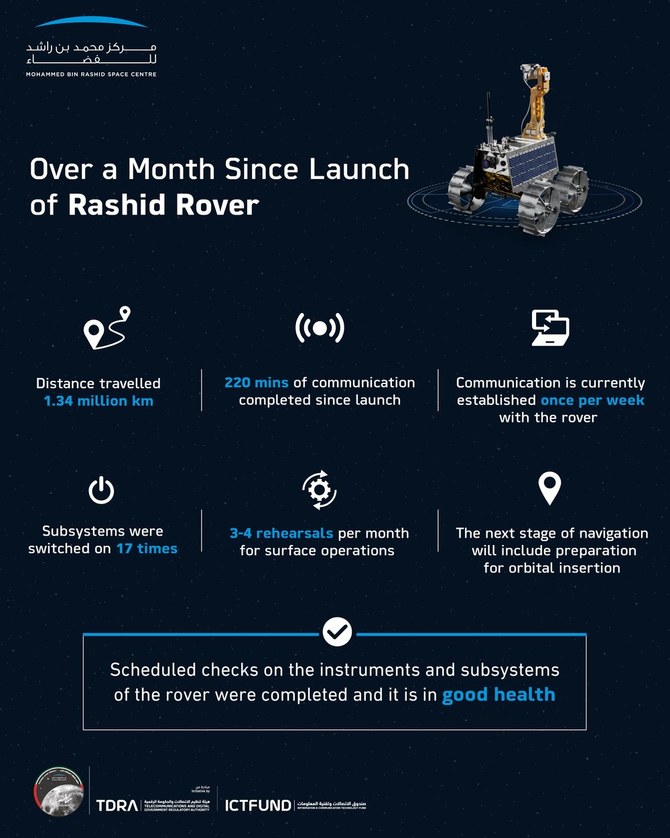
DUBAI: The first Arab-built lunar rover has successfully completed a month in space, traveling close to 1.34 million km, the Mohammed Bin Rashid Space Center announced.
Rashid Rover, designed and built in the UAE by an all-Emirati team of engineers, experts and researchers, lifted off on Dec. 11 from Cape Canaveral Space Force Station in Florida, the Emirates News Agency reported on Friday.
Since the launch, the Emirates Lunar Mission team has completed 220 minutes of communication with the world’s most compact rover.
The team has completed all scheduled health assessment and maintenance checks on the vehicle and its onboard subsystems and instruments. For two weeks after the launch, the rover was powered on for 10 minutes a day and the team on Earth is now communicating with it once every week.
During the ongoing four-month cruise phase, the team will communicate with Rashid Rover for another 150 minutes. The ELM team said its subsystems had been activated 17 times since launch. These were powered on for one hour the first time, followed by 10 minutes of daily activation over the subsequent two weeks. Currently, the subsystems are being powered on once a week for 10 minutes each time.
The team is now preparing for the entry, descent and landing phase, and surface operations. As part of the current cruise phase, the team will conduct 12 simulated mission rehearsals organized at the MBRSC ground station for surface operations before the rover’s lunar landing at the end of April.
The rehearsals will allow the engineering team to prepare their programs for execution after the landing while enabling different subsystem teams to synchronize their work.
The navigation stage for the HAKUTO-R Mission 1 lunar lander that holds the Rashid Rover includes planned deep space orbital control maneuvers and successfully targeting the first lunar orbit insertion.
During its mission, the rover will conduct numerous scientific tests on the surface of the moon that will contribute to making qualitative developments in the fields of science, communication technologies and robotics.
The impact of these developments will extend beyond the space sector into the wider national and global economy. The mission is funded by the ICT Fund of the Telecommunications and Digital Government Regulatory Authority, which aims to support research and development in the ICT sector in the UAE.


![]()

UAE’s Rashid Rover completes one month in space
Short Url
https://arab.news/zs8rn
UAE’s Rashid Rover completes one month in space
- Vehicle was designed, built by all-Emirati team
- It lifted off from Cape Canaveral Space Force Station in Florida in December


Latest updates


© 2026 SAUDI RESEARCH & PUBLISHING COMPANY, All Rights Reserved And subject to Terms of Use Agreement.