KABUL: The Daesh group claimed responsibility Thursday for a deadly bombing that killed at least five people near the Foreign Ministry in the Afghan capital the previous day.
The bombing was the second major attack in Kabul in 2023 and drew condemnation from the international community.
The extremist group said in a statement that a “martyrdom-seeker” it identified as Kheiber Al-Qandahari detonated his explosive vest amidst a gathering of ministry employees and guards as they left through the ministry’s main gate.
There was no immediate response from Afghanistan’s Taliban rulers about the Daesh claim. Kabul police chief spokesman Khalid Zadran said Wednesday that the explosion killed five civilians and that “a number of others were wounded” near the ministry.
The Daesh news outlet Aamaq said the attack coincided with a ministry training course for diplomats.
The extremists have increased their assaults since the Taliban takeover of Afghanistan in 2021. Targets have included Taliban patrols and members of the country’s Shiite minority.
After Wednesday’s attack, more than 40 wounded people were brought to a surgical center in Kabul run by Emergency NGO, a humanitarian organization. Stefano Sozza, Emergency’s director in Afghanistan, said at the time that he expected the number of casualties to rise.
The attack drew condemnation from the United Nations and various countries. In a statement Wednesday, Pakistan said it stood in solidarity with Afghans in the fight against militants.

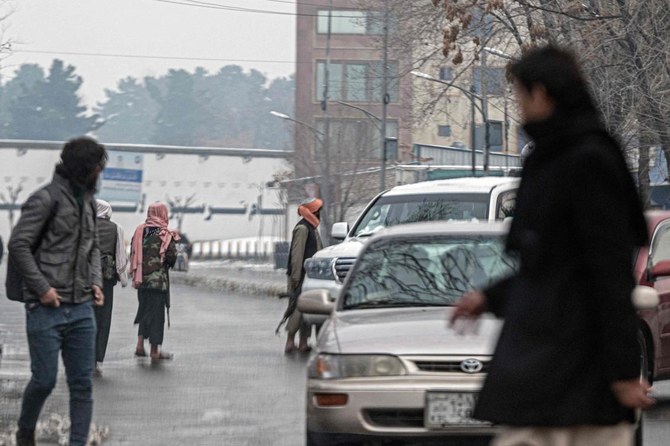
Daesh claims responsibility for Kabul attack that killed 5
https://arab.news/4e62h
Daesh claims responsibility for Kabul attack that killed 5
- Daesh in a statement says that a “martyrdom-seeker” detonated an explosive vest amid a gathering of ministry employees and guards as they left through the ministry’s main gate
Geoeconomic confrontation tops global risks in 2026: WEF report
- Also armed conflict, extreme climate, public polarization, AI
- None ‘a foregone conclusion,’ says WEF’s MD Saadia Zahidi
DUBAI: Geoeconomic confrontation has emerged as the top global risk this year, followed by state-based armed conflict, according to a new World Economic Forum report.
The Global Risks Report 2026, released on Wednesday, found that both risks climbed eight places year-on-year, underscoring a sharp deterioration in the global outlook amid increased international competition.
The top five risks are geoeconomic confrontation (18 percent of respondents), state-based armed conflict (14 percent), extreme weather events (8 percent), societal polarization (7 percent) and misinformation and disinformation (7 percent).
The WEF’s Managing Director Saadia Zahidi said the report “offers an early warning system as the age of competition compounds global risks — from geoeconomic confrontation to unchecked technology to rising debt — and changes our collective capacity to address them.
“But none of these risks are a foregone conclusion.”

The report assesses risks across three timeframes: immediate (2026); short-to-medium term (next two years); and long term (next 10 years).
Economic risks show the largest overall increase in the two-year outlook, with both economic downturn and inflation jumping eight positions.
Misinformation and disinformation rank fifth this year but rise to second place in the two-year outlook and fourth over the 10-year horizon.
The report suggests this reflects growing anxiety around the rapid adoption of artificial intelligence, with adverse outcomes linked to AI surging from 30th place in the two-year timeframe to fifth in the 10-year outlook.
Uncertainty dominates the global risk outlook, according to the report.
Surveyed leaders and experts view both the short- and long-term outlook negatively, with 50 percent expecting a turbulent or stormy global environment over the next two years, rising to 57 percent over the next decade.
A further 40 percent and 32 percent, respectively, describe the outlook as unsettled across the two- and 10-year timeframes, while just 1 percent anticipate a calm global outlook in either period.
Environmental risks ease slightly in the short-term rankings. Extreme weather fell from second to fourth place and pollution from sixth to ninth. Meanwhile, critical changes to Earth systems and biodiversity loss dropped seven and five positions, respectively.
However, over the next decade, environmental threats re-emerge as the most severe, with extreme weather, biodiversity loss, and critical changes to Earth systems topping the global risk rankings.

Looking ahead over the next decade, around 75 percent of respondents anticipate a turbulent or stormy environmental outlook, making it the most pessimistic assessment across all risk categories.
Zahidi said that “the challenges highlighted in the report underscore both the scale of the potential perils we face and our shared responsibility to shape what comes next.”
Despite the gloomy outlook, Zahidi signaled a positive shift in global cooperation.
“It is also clear that new forms of global cooperation are already unfolding even amid competition, and the global economy is demonstrating resilience in the face of uncertainty.”
Now in its 21st year, the Global Risks Report highlights a core message: global risks cannot be managed without cooperation.
As competition intensifies, rebuilding trust and new forms of collaboration will be critical, with the report stressing that today’s decisions will shape future outcomes.
The report was released ahead of WEF’s annual meeting, which will be held in Davos from Jan. 19 to 23.


