

Israeli army makes plans to resettle 1,000 Palestinians without government’s knowledge

Short Url
Updated 11 January 2023
Follow

Israeli army makes plans to resettle 1,000 Palestinians without government’s knowledge

  • Preparations reportedly began in November but the plans were not presented to the government until last week, sources said
  • The plans involve 12 West Bank villages, an increase over the eight included in a recent petition on the issue submitted by residents to the Supreme Court

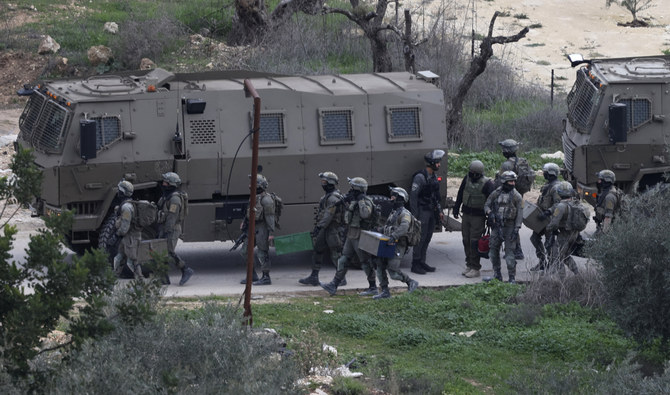
RAMALLAH: Officials from the Israeli armed forces have been making plans to forcibly move about 1,000 Palestinians from villages in Masafer Yatta, near southern Hebron in the southern West Bank, without the Israeli government’s knowledge, according to Israeli sources.

The army’s Central District Command began preparations in November to displace the residents so that the military can conduct regular training exercises in the area, the sources said.

The plan was said to have been presented to the government for the first time only last week, after the new administration took over, and the displacement of residents is due to take place this year. The sources said decision was communicated by officials from the Israeli Civil Administration, which oversees civilian affairs in the Occupied Territories, to the Palestinian Authority during a meeting last week in the West Bank.

The forced displacement of civilians from, or within, the Palestinian Territories is prohibited under international humanitarian law.

Representatives of the Palestinian Authority have told people in Masafer Yatta that the Civil Administration officials informed them of plans to displace residents from 12 villages, an increase over the eight that were included in the most recent, failed, petition on the issue submitted by the residents to the Supreme Court. Officials from the Israeli armed forces propose that the residents of the villages be moved to two new sites in the region and can choose the location of one of them.

Israeli security and political sources reportedly have expressed concern about the behavior of military officials in the case, warning that it is a “warning signal” about future plans affecting Palestinians and the ability of the army to stand up to politicians, the far right and the settlers who “pressure senior officers and expect them to make decisions that are consistent with their ideas according to political and non-professional considerations.”

Nidal Younis, head of the Masafer Yatta Villages Council, told Arab News that attacks on Palestinians by the Israeli army, police and settlers have increased dramatically since a ruling by the Israeli Supreme Court in May to displace eight communities, restrict the movement of residents of other villages, prevent non-residents from entering certain villages, and confiscate agricultural machinery and vehicles. Meanwhile settlers have attacked residents of Masafer Yatta, their livestock pastures, and prevented them from plowing their land and cultivating crops used to feed their livestock.

“The goal of escalating attacks against us is to make our lives difficult and impossible, and thus push us and force us to leave our villages and leave our land for them to control,” said Younis.

The villages in Masafer Yatta occupy an area of about 13.5 square miles and include five schools and five medical centers. About 1,150 Palestinians from 215 households live there, including 569 children.

The residents depend on humanitarian aid due to the restrictive and discriminatory planning regime they face. Israeli authorities have issued demolition or “stop work” orders against most of the homes, animal shelters, and community infrastructure in the villages on the grounds that they were constructed without the required building permits, which are almost impossible for Palestinians to obtain. This has impeded the development of adequate housing, infrastructure and livelihoods.

In addition to the threat of their homes being demolished, the communities also face violence from settlers at a nearby outpost who have blocked roads in the area, attacked farmers, and set haystacks and grazing areas on fire. This has undermined the physical security of villagers, negatively affected their mental and psycho-social health, lowered their standard of living, and increased their dependence on humanitarian aid.

The rearing of livestock provides the community’s primary source of income but access to grazing land has been reduced by military and settlement activity.

Younis Arar, head of the International Relations Unit at the Settlement and Wall Resistance Commission, told Arab News that there is growing concern for the remaining villagers given that Israeli authorities removed eight of the 12 communities from the villages of Masafer Yatta following the Supreme Court decision last year — and especially since the new far-right Israeli government came to power in late December.

Arar said there has been an increase in demolitions of buildings and the destruction of land in Masafer Yatta carried out by Israeli authorities in the past two weeks, and that Palestinians are planning protests in an attempt to resist the forced displacement of residents.

Palestinian officials have expressed disappointment in the efforts of the international community to prevent Israeli authorities from implementing their forced resettlement plans, in particular the weakness of statements issued by the EU and the UN, which did not go beyond expressing concern and did not include any steps to attempt to force Israeli authorities to back down.

Humanitarian organizations and donors have been providing assistance to help meet the needs of the remaining communities in Masafer Yatta, including water and electricity, and prevent forced displacement. However, Israeli authorities are reportedly impeding such efforts by issuing demolition or “stop work” orders, confiscating vehicles and equipment, restricting access to land, and preventing humanitarian workers from entering the area.

The schools in the area, built with support from international donors, face pending demolition orders, as do the medical centers. Activists warn that forced evictions create many humanitarian needs that must be addressed to ensure people are protected and have access to essential services.


Israel says it has launched ‘broad wave’ of strikes on Iran, as Tehran widens its response across the region

Updated 04 March 2026
Follow

Israel says it has launched ‘broad wave’ of strikes on Iran, as Tehran widens its response across the region

  • ​US military says 17 Iranian navy ships destroyed, struck nearly ‌2,000 targets ‌in ​Iran thus far
  • US and Israeli attacks have killed 787 people in Iran:  Iranian Red Crescent

JERUSALEM/DUBAI/TEHRAN: Israel early Wednesday launched new attacks on Iran as the US military said it has hit nearly 2,000 targets inside the Islamic republic, which tried to impose a cost by expanding a missile and drone barrage across the region.
With global energy prices on the rise, President Donald Trump said the US Navy was ready to escort oil tankers through the Strait of Hormuz, the vital chokepoint into the Gulf that Iran has threatened to seal off.
Israel’s military said it launched a “broad wave of strikes” after midnight across Iran, which in the hours before had launched three separate missile barrages at Israel, causing mild injuries to a woman in Tel Aviv.

The US military has ​destroyed 17 Iranian ships, including a submarine, and struck nearly ‌2,000 targets ‌in ​Iran, ‌the ⁠commander ​of the ⁠US Central Command said on Tuesday.

“Today, there is ⁠not a ‌single ‌Iranian ​ship ‌underway ‌in the Arabian Gulf, Strait of Hormuz, or ‌Gulf of Oman,” US ⁠Central Command’s Brad ⁠Cooper said in a video posted to X. 


Cooper said the US military has “severely degraded Iran’s air defenses” and taken out hundreds of ballistic missiles, launchers and drones.
The video showed missiles and jets launching from US ships, and targets exploding on the ground.
Cooper noted that Iran has launched over 500 ballistic missiles and more than 2,000 drones in retaliation.
But he said the US is “hunting” Iran’s last remaining mobile ballistic missile launchers to eliminate their “lingering launch capability.”
Cooper said the operation has involved more than 50,000 troops, 200 fighter jets, two aircraft carriers and bombers, and “more capability is on the way.”
“We’ve just begun,” Cooper said, adding that the US military is targeting “all the things that can shoot at us.”

“These forces bring a massive amount of firepower, representing the largest buildup by the US in the Middle East in a generation,” he said in the video message, describing the first day’s barrage as bigger than the so-called “shock and awe” against Saddam Hussein’s Iraq in 2003.

Iran‘s response

The US and Israeli attacks have killed 787 people in Iran, according to the Iranian Red Crescent, a toll that could not be independently confirmed.
Iran vowed to inflict a heavy price in retaliation. Drones struck adjacent the US consulate in Dubai, starting a fire but inflicting no casualties, and against the US military base at Al-Udeid in Qatar.
The attacks came a day after strikes on the US embassies in Riyadh and Kuwait City and on a US air base in Bahrain.
“We are saying to the enemy that if it decides to hit our main centers, we will hit all economic centers in the region,” Islamic Revolutionary Guard General Ebrahim Jabbari said.

Iranian attacks have killed at least nine people and wounded dozens in the Gulf region, according to various reports quoting local authorities.

Mourners gather at Kuwait's Sulaibikhat cemetery on March 3, 2026, during the funeral of Kuwait Army soldiers who were killed in an Iranian strike. (AFP) 

Among the latest death was an 11-year-old girl who was killed after shrapnel fell in a residential area in Kuwait City, health authorities said Wednesday.
The Kuwait army said in a statement the shrapnel fell over a house and left casualties while forces were intercepting “several hostile aerial targets” over the country.
The Health Ministry said in a separate statement that the child died of her wounds at the hospital.
The child’s mother and three other relatives were injured and being treated at the hospital, it said.

Vessel hit in Gulf of Oman
A vessel was hit by a projectile early Wednesday in the Gulf of Oman off the United Arab Emirates, an agency of the UK military said.
There were no reported casualties.
The United Kingdom Maritime Trade Operations Center said the vessel was struck 8 miles east of Fujairah, one of the UAE’s seven emirates.
The attack damaged the vessel’s steel plating.
No fire or water intake was reported, it said.

​  Tankers are seen off the coast of the Fujairah, United Arab Emirates, on March 3, 2026. President Trump said the US Navy was ready to escort oil tankers through the Strait of Hormuz , which Iran has threatened to close. (REUTERS)  ​

Iran hits US embassies

The US State Department said Tuesday it’s preparing military and charter flights for Americans who want to leave the Middle East. Several other countries also arranged evacuation flights for their citizens.

An attack from two drones on the US Embassy in Riyadh caused a “limited fire,” according to the Saudi Arabian Defense Ministry, and the embassy urged Americans to avoid the compound.
An Iranian drone struck a parking lot outside the US consulate in Dubai, sparking a small fire, Secretary of State Marco Rubio said in Washington. He said all personnel were accounted for.
The United Arab Emirates said it has intercepted the vast majority of more than 1,000 Iranian missile and drone attacks against it.
US embassies in Saudi Arabia, Kuwait and Lebanon said they were closed to the public.
The US State Department ordered the evacuation of non-emergency personnel and family in Kuwait, Bahrain, Iraq, Qatar, Jordan and the United Arab Emirates. And US citizens were urged to leave more than a dozen Middle Eastern countries, though many were stranded because of airspace closures.

The US military has confirmed six deaths of American service members.
Four of the American soldiers killed were identified as Capt. Cody A. Khork, 35, of Winter Haven, Florida; Sgt. 1st Class Noah L. Tietjens, 42, of Bellevue, Nebraska; Sgt. 1st Class Nicole M. Amor, 39, of White Bear Lake, Minnesota; and Sgt, Declan J. Coady, 20, of West Des Moines, lowa, who received a posthumous promotion in rank. They were assigned to the Iowa-based 103rd Sustainment Command.

Ghost town

In Tehran, residents who have not fled remained shut away in their homes for fear of the US-Israeli bombardment.
The Iranian capital is normally home to around 10 million people, but in recent days “there are so few people that you’d think no one ever lived here,” said Samireh, a 33-year-old nurse.
Authorities had previously urged people to leave the city, and police officers, armed security forces and armored vehicles have been stationed at main junctions, carrying out random checks on vehicles.
In the more upmarket north of Tehran, the meowing of cats and chirping of birds replaced the usual din of traffic jams.
Iranian authorities said a strike on a school in the city of Minab on the first day of the war killed more than 150 people.
