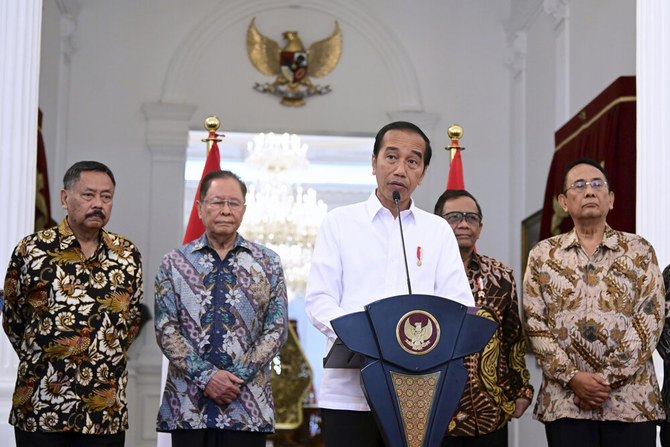

JAKARTA: Indonesia’s President Joko Widodo acknowledged on Wednesday “gross human rights violations” in the country’s past, including the 1960s massacres when up to 1 million people were killed on suspicion of being linked to communists.
One of the darkest periods in Indonesia’s history, the killings of 1965-66 were a series of countrywide political purges targeting members and alleged sympathizers of Partai Komunis Indonesia — at the time the third-largest communist party after China and the Soviet Union.
While an accurate and verified count of the dead is unlikely ever to be known, historians say that a total of 500,000 to 1 million people had been killed. Another 1.5 million had been imprisoned, while their family members still face stigma and discrimination, and many were prevented from holding government jobs up until last year.
“With a clear mind and an earnest heart, I as Indonesia’s head of state admit that gross human rights violations did happen in many instances,” Widodo said on Wednesday after receiving a report from a team formed to help restore the victims’ rights.
“I deeply regret these human rights abuses.”
The president cited 12 incidents of state-sponsored violence between 1965 and 2003, which also included the killing and abduction of activists protesting against the regime of former President Suharto in the 1990s and the military’s violence against indigenous people of the restive Papua province.
Although previous presidents have also acknowledged some of the abuses, including late President Abdurrahman Wahid, who had apologized for the 1965-66 bloodshed, Widodo’s statement is the clearest, most comprehensive admission of the country’s darkest chapters.
“Myself and the government will try to restore the victim’s rights justly and wisely, without negating judicial resolving,” Jokowi said.
But activists say more needs to be done to redress the past violations and injustice faced by the victims and their families for decades.
“A mere acknowledgment without efforts to bring to trial those responsible for past human rights abuses will only add salt to the wounds of victims and their families,” Usman Hamid, executive director of Amnesty International Indonesia, told Arab News.
“This statement is nothing without accountability.”
Widodo “needs to do more than just airing his position,” said Andreas Harsono, Indonesia researcher at Human Rights Watch.
“President Jokowi made the correct statement but he should order his aides to investigate these mass killings, to document mass graves, and to find their families, to match the graves and their families, as well as to set up a commission to decide what to do next,” he told Arab News.
For historian Bonnie Triyana, Widodo’s acknowledgment was, however, a “step forward” for Indonesia to move on from its dark past.
“But we must also ask — what comes next?” he said.
“I hope this isn’t lip service. I hope this comes from the deepest conscience of our head of state and leaders to resolve the issues in our past because of their widespread impact, including the stigmas that are still attached to the victims, especially in relation to the events of 1965.”