

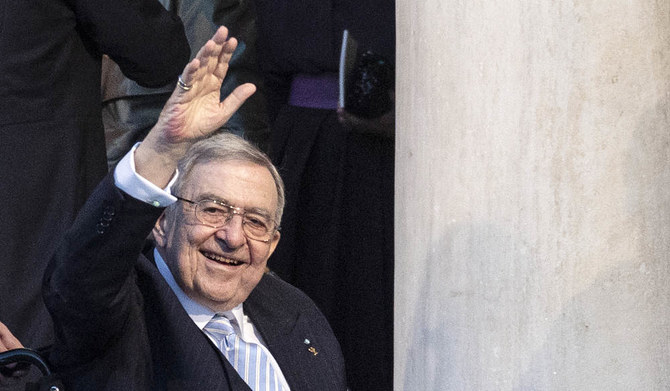

ATHENS, Greece: Constantine, the former and last king of Greece, who won an Olympic gold medal before becoming entangled in his country’s volatile politics in the 1960s as king and spent decades in exile, has died. He was 82.
Doctors at the private Hygeia Hospital in Athens confirmed to The Associated Press that Constantine died late Tuesday after treatment in an intensive care unit but had no further details pending an official announcement.
When he acceded to the throne as Constantine II 1964 at the age of 23, the youthful monarch, who had already achieved glory as an Olympic gold medalist in sailing, was hugely popular. By the following year he had squandered much of that support with his active involvement in the machinations that brought down the elected Center Union government of prime minister George Papandreou.
The episode involving the defection from the ruling party of several lawmakers, still widely known in Greece as the “apostasy,” destabilized the constitutional order and led to a military coup in 1967. Constantine eventually clashed with the military rulers and was forced into exile.
The dictatorship abolished the monarchy in 1973, while a referendum after democracy was restored in 1974 dashed any hopes that Constantine had of ever reigning again.
Reduced in the following decades to only fleeting visits to Greece that raised a political and media storm each time, he was able to settle again in his home country in his waning years when opposing his presence no longer held currency as a badge of vigilant republicanism. With minimal nostalgia for the monarchy in Greece, Constantine became a relatively uncontroversial figure.
Constantine was born June 2, 1940 in Athens, to Prince Paul, younger brother to King George II and heir presumptive to the throne, and princess Frederica of Hanover. His older sister Sophia is the wife of former King Juan Carlos I of Spain. The Greek-born Prince Philip, the late Duke of Edinburgh and husband of the late Queen Elizabeth II, was an uncle.
The family, which had ruled in Greece from 1863 apart from a 12-year republican interlude between 1922-1935, was descended from Prince Christian, later Christian IX of Denmark, of the House of Schleswig-Holstein-Sonderburg-Glücksburg branch of the Danish ruling family.
Before Constantine’s first birthday, the royal family was forced to flee Greece during the German invasion in World War II, moving to Alexandria in Egypt, South Africa and back to Alexandria. King George II returned to Greece in 1946, following a disputed referendum, but died a few months later, making Constantine the heir to King Paul I.
Constantine was educated at a boarding school and then attended three military academies as well as Athens Law School classes as preparation for his future role. He also competed in various sports, including sailing and karate, in which he held a black belt.
In 1960, aged 20, he and two other Greek sailors won a gold medal in the Dragon Class — now no longer an Olympic class — at the Rome Olympics. While still a prince, Constantine was elected a member of the International Olympic Committee and became an honorary member for life in 1974.
King Paul I died of cancer on March 6, 1964 and Constantine succeeded him, weeks after the Center Union party had triumphed over the conservatives with 53 percent of the vote.
The prime minister, George Papandreou, and Constantine initially had a very close relationship, but it soon soured over Constantine’s insistence that control of the armed forces was the monarch’s prerogative.
With many officers toying with the idea of a dictatorship and viewing any non-conservative government as soft on communism, Papandreou wanted to control the ministry of defense and eventually demanded to be appointed defense minister. After an acrimonious exchange of letters with Constantine, Papandreou resigned in July 1965.
Constantine’s insistence on appointing a government composed of centrist defectors that won a narrow parliamentary majority on the third try was hugely unpopular. Many viewed him as being manipulated by his scheming mother, dowager Queen Frederica.
“The people don’t want you, take your mother and go!” became the rallying cry in the protests that rocked Greece in the summer of 1965.
Eventually, Constantine made a truce of sorts with Papandreou and, with his agreement, appointed a government of technocrats and, then, a conservative-led government to hold an election in May 1967.
But, with the polls heavily favoring the Center Union and with Papandreou’s left-leaning son, Andreas, gaining in popularity, Constantine and his courtiers feared revenge and with the aid of high-ranking officers prepared a coup.
However, a group of lower-ranking officers, led by colonels, were preparing their own coup and, apprised of Constantine’s plans by a mole, proclaimed a dictatorship on April 21, 1967.
Constantine was taken by surprise and his feelings toward the new rulers were obvious in the official photo of the new government. He pretended to go along with them, while preparing a counter-coup with the help of troops in northern Greece and the navy, which was loyal to him.
On Dec. 13, 1967, Constantine and his family flew to the northern city of Kavala with the intention of marching on Thessaloniki and setting up a government there. The counter-coup, badly managed and infiltrated, collapsed and Constantine was forced to flee to Rome the following day. He would never return as reigning king.
The junta appointed a regent and, after an abortive Navy counter-coup in May 1973, abolished the monarchy on June 1, 1973. A July plebiscite, widely considered rigged, confirmed the decision.
When the dictatorship collapsed in July 1974, Constantine was eager to return to Greece but was advised against it by veteran politician Constantine Karamanlis, who returned from exile to head a civilian government. Karamanlis, who had also headed the government between 1955-63, was a conservative but had clashed with the court over what he considered its excessive interference in politics.
After his triumphal win in November elections, Karamanlis called for a plebiscite on the monarchy in 1974. Constantine was not allowed in the country to campaign, but the result was unambiguous and widely accepted: 69.2 percent voted in favor of a republic.
Soon after, Karamanlis famously said the nation had rid itself of a cancerous growth. Constantine said on the day following the referendum that “national unity must take precedence ... I wholeheartedly wish that developments will justify the result of yesterday’s vote.”
To his final days, Constantine, while accepting that Greece was now a republic, continued to style himself King of Greece and his children as princes and princesses even though Greece no longer recognized titles of nobility.
For most of his years in exile he lived in Hampstead Garden Suburb, London, and was said to be especially close to his second cousin Charles, the Prince of Wales and now King Charles III.
While it took Constantine 14 years to return to his country, briefly, to bury his mother, Queen Frederica in 1981, he multiplied his visits thereafter and, from 2010, made his home there. There were continued disputes: in 1994, the then socialist government stripped him of his nationality and expropriated what remained of the royal family’s property. Constantine sued at the European Court of Human Rights and was awarded 12 million euros in 2002, a fraction of the 500 million he had sought.
He is survived by his wife, the former Princess Anne-Marie of Denmark, youngest sister of Queen Margrethe II; five children, Alexia, Pavlos, Nikolaos, Theodora and Philippos; and nine grandchildren.


