

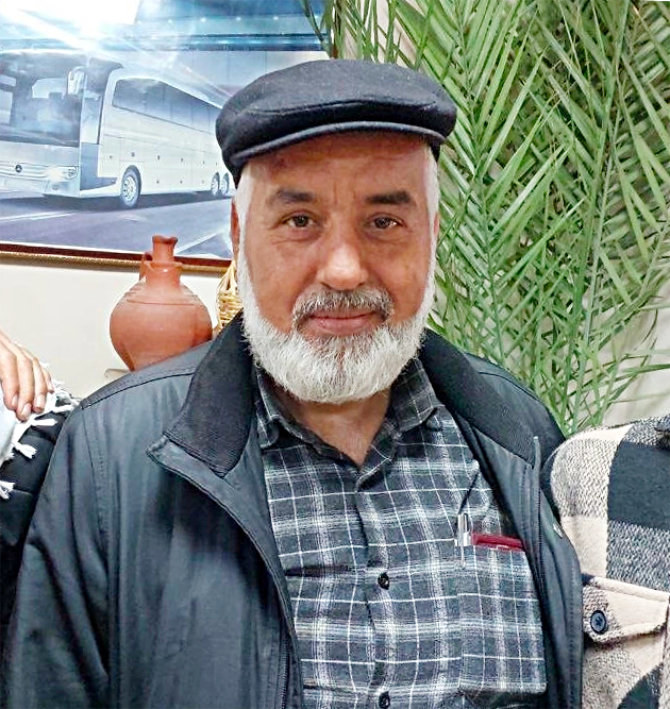
First Syrian refugee with Turkiye citizenship to fulfill military service

Ahmet Hamo. (Supplied)
Short Url
Updated 10 January 2023
Follow

First Syrian refugee with Turkiye citizenship to fulfill military service

  • Conscription stirs debate about asylum seekers’ integration
  • Ahmet Hamo, 53, volunteered and received call-up

ANKARA: Ahmet Hamo, 53, recently received his call-up letter for military service in Turkiye after he voluntarily applied to the authorities — becoming the first Syrian refugee with citizenship to be conscripted into the nation’s army.

Hamo came to Turkiye as a refugee amid the Syrian civil war that started in 2011. He applied for military service after becoming a citizen.

Hamo joined his unit in the central province of Amasya this weekend.

The newly conscripted soldier spent the previous weekend with his family and friends who came to bid him farewell. They placed him on their shoulders and danced to Arab songs. 

“I feel respect for the Turkish nation and Turkish flag. My mother was of Turkish descent. Fortunately I will be under the protection of the Turkish flag,” he told reporters.

He became the first-ever Syrian refugee with citizenship to be called up for military service at his request. It is uncommon in Turkiye to have people called up at his age.

Military service in Turkiye is compulsory for all male citizens between 20 and 41 years of age. According to the Turkish Law of Recruitment that was amended in 2019, the conscription status of refugees with Turkish citizenship is classified based on the age at which they become citizens.

Under the same law, foreigners who become citizens are exempted from military service if they can prove that they already undertook this duty in their country of origin, or are older than 22 at the time they receive citizenship.

Metin Corabatir, president of the Ankara-based Research Center on Asylum and Migration, told Arab News that Hamo should have been exempted from military service due to his age and the fulfillment of his duty in Syria — and as a goodwill gesture because he has shown his loyalty to Turkiye.

“Those who gained Turkish citizenship have already been staying in this country for a while, far away from the war in their homeland. Therefore, it is an obligation of citizenship for males to perform military duty provided that they have already overcome (the) psychological trauma of the war they escaped from,” he added.

Now, all eyes are set on the next stage — whether Syrians will vote in the upcoming presidential and parliamentary elections in Turkiye this year. As of December 2022, around 223,000 Syrian nationals were given Turkish citizenship, while around 126,000 are eligible to vote.

Turkiye’s political parties will have to take into consideration the votes of Syrians-turned-citizens and adjust their electioneering accordingly because these people are trying to show that they are not a burden but an integral part of society, Corabatir said.

According to Muge Dalkiran, visiting fellow at the Austrian Institute for International Affairs, recruitment of naturalized refugees into military service is an underestimated but still important topic to discuss in terms of integration policies. 

“There (were) certain debates with regard to recruiting immigrants for the US army after the Second World War and citizenship was provided through military service. Also, recently there are some discussions on whether citizens with ‘migration background’ can be recruited by the German army due to the high number of ‘migration background’ (people in the) population,” she told Arab News.

“Even though this topic still seems controversial, the experts highlight the need for young people, with technical skills and different professions with special training, (to join) the army in the future since military service is no longer mandatory. It is also considered as part of integration, especially for those who were born in Germany,” Dalkiran said.

The public reaction to the news did see some criticism on social media, with some saying that Hamo should have rather defended his home country first before joining Turkiye’s army.

Dalkiran said it was also a concern that people are recruited into Turkiye’s army who may still not have fully recovered from previous traumas and violence.

“This single case should not lead to any kind of coercion for the rest of the Syrians who recently obtained citizenship,” she added.

Dalkiran also said that perhaps military service should be secondary to other societal needs. “Before these doubts are cleared, recruitment for the military service would only increase the polarization. With regard to social cohesion, I think there are other priorities to consider such as full integration into the labor market,” she said.

Dalkiran said issues around migration and refugees remains complex, which require long-term solutions.


Iran launches missiles at Israel as attacks in Middle East commence for a sixth day

Updated 05 March 2026
Follow

Iran launches missiles at Israel as attacks in Middle East commence for a sixth day

  • IRGC: Strikes against Iran would result in “the complete destruction of the region’s military and economic infrastructure”
  • Drones and missiles intercepted in different countries, including Turkiye and Saudi Arabia, after IRGC warning

DUBAI: Iran launched missiles at Israel early Thursday as aerial attacks in the Middle East commenced for a sixth day after an American submarine sank an Iranian warship and Iran threatened the destruction of military and economic infrastructure across the region.
Israel announced the incoming attack shortly after its military said it had begun new strikes in Lebanon targeting the Iranian-backed Hezbollah militant group in Beirut’s southern suburbs.
The fighting continued after the US and Israel intensified their bombardment Wednesday of Iran’s security forces and other symbols of power.
The tempo of the strikes on Iran was so intense that state television announced the mourning ceremony for Iranian Supreme Leader Ayatollah Ali Khamenei, who was killed at the start of the conflict, would be postponed. Millions attended the funeral of his predecessor, Ayatollah Ruhollah Khomeini, in 1989.
The US and Israel launched the war Saturday, targeting Iran’s leadership, missile arsenal and nuclear program while suggesting that toppling the government is a goal. But the exact aims and timelines have repeatedly shifted, signaling an open-ended conflict.
President Donald Trump praised the US military Wednesday for “doing very well on the war front, to put it mildly.” Fellow Republicans in the US Senate stood with Trump on Iran as they voted down a resolution seeking to halt the war.
Iran fired on Bahrain, Kuwait and Israel as the conflict spiraled. Turkiye said NATO defenses intercepted a ballistic missile launched from Iran before it entered Turkiye’s airspace.
The war has killed more than 1,000 people in Iran, more than 70 in Lebanon and around a dozen in Israel, according to officials in those countries. It has disrupted the supply of the world’s oil and gas, snarled international shipping and stranded hundreds of thousands of travelers in the Middle East.

Buildings of Iranian military and security forces targeted
US Defense Secretary Pete Hegseth said a torpedo from an American submarine sank an Iranian warship Tuesday night in the Indian Ocean.
Sri Lankan authorities said 32 people were rescued from the ship, while the country’s navy said it recovered 87 bodies.
Israel said it hit buildings associated with Iran’s Basij, the all-volunteer force of the paramilitary Revolutionary Guard whose bloody crackdown on protesters in January left thousands dead.
The Israeli military hit buildings associated with Iran’s internal security command. Israel and the US have said they want to see Iranians overthrow the country’s theocracy, and strikes against Iran’s internal security forces may be aimed at hastening that.
However, Iranian Foreign Minister Abbas Araghchi has said his country’s forces have decentralized leadership, with units acting largely on their own, which could blunt the effect of attacks on top command and control hubs.
Iranian state television showed the ruins of buildings in Tehran and interviews with people saying the attacks damaged their homes. Strikes were also reported in the city of Qom targeting a building associated with a clerical panel set to pick Iran’s next supreme leader. Iranian media said it was empty at the time.
Shifting timelines for US operations
During his Pentagon briefing, Hegseth did not give a definitive timeline for US operations.
“You can say four weeks, but it could be six. It could be eight. It could be three,” he said. “Ultimately, we set the pace and the tempo. The enemy is off balance, and we’re going to keep them off balance.”
Adm. Brad Cooper, the top US military commander in the Middle East, said American forces have damaged Iran’s air defenses and taken out ballistic missiles, launchers and drones.
US and Israeli military officials say launches from Iran have declined as the war has progressed. Israel’s Homefront Command announced it was easing restrictions that closed workplaces nationwide. It said workplaces could reopen Thursday if there’s a shelter nearby. Schools would remain closed.
Still, explosions sounded early Thursday in Israel, which said its defensive systems were moving to intercept Iranian missiles.
At least 1,045 people have been killed in Iran, the country’s Foundation of Martyrs and Veterans Affairs said Wednesday. Eleven people have died in Israel. Six US troops have been killed.
The death toll has exceeded 70 in Lebanon, where the health ministry said Wednesday that three people died when drone strikes hit two vehicles on a Beirut highway. The Israeli military said it was targeting a Hezbollah member.
Israel says its offensive had been planned for midyear
Israeli Defense Minister Israel Katz said the offensive against Iran was originally planned for mid-2026, but “the need arose to bring everything forward to February.”
He listed events inside Iran, Trump’s positions and the possibility of “creating a combined operation” as reasons.
The protests in Iran put unprecedented pressure on its leadership. Trump threatened military action in response to the crackdown before shifting his attention to Iran’s disputed nuclear program.
White House press secretary Karoline Leavitt said Wednesday that the US launched its operation partly out of concern Iran might strike American personnel and assets in the region first. A phone call between Trump and Israeli Prime Minister Benjamin Netanyahu before the airstrikes began was also “important with respect to the timeline,” she said.
Energy supplies in the crosshairs
Iran’s paramilitary Revolutionary Guard issued its most-intense threat yet, saying the strikes against it would result in “the complete destruction of the region’s military and economic infrastructure.”
A Maltese-flagged container ship was attacked Wednesday while passing through the Strait of Hormuz, the narrow mouth of the Arabian Gulf through which about a fifth of the world’s oil is shipped. The ship was hit by two missiles, sparking a fire, according to Malta’s transport minister, Chris Bonett. Its 24 crew members were rescued.
Tanker traffic through the strait has fallen by around 90 percent compared to prewar levels, shipping tracker MarineTraffic.com said Wednesday.
Oil prices have soared as Iranian attacks have disrupted traffic through the strait, and global stock markets have been hammered over worries that the spike in oil prices may grind down the world economy.
Iran’s clerics are choosing a new supreme leader
Iran’s leaders are scrambling to replace Khamenei, who ruled the country for 37 years. It’s only the second time since the 1979 Islamic Revolution that a new supreme leader is being chosen.
Potential candidates range from hard-liners committed to confrontation with the West to reformists who seek diplomatic engagement. Mojtaba Khamenei, Khamenei’s son, has long been considered among them — though he has never been elected or appointed to a government position.
In a sign that Iran’s leadership will only seek to consolidate its power as it faces its biggest crisis in decades, the head of the judiciary warned that “those who cooperate with the enemy in any way will be considered an enemy.”
Israel’s defense minister, Katz, said on X that Iran’s next supreme leader — if he continues to threaten Israel, the US and others — “will be a target for elimination.”