DIFC maintains leading position among global financial centers, says CEO 

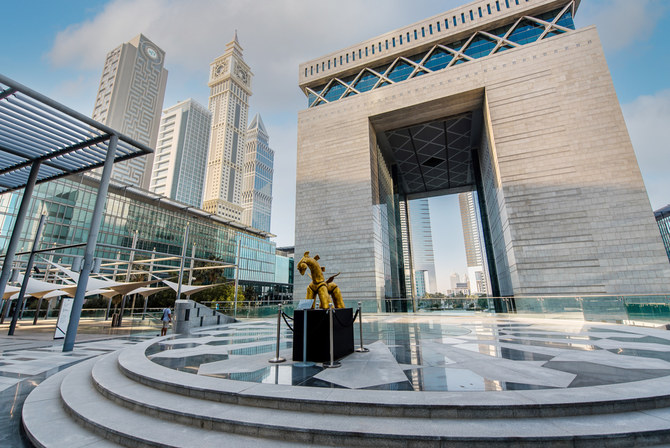
Among the 4,031 companies registered in DIFC, the center hosts 17 of the top 20 banks in the world, and 25 of the 30 most important banks of systemic importance globally. (Shutterstock)
Short Url
Updated 10 January 2023
Follow

DIFC maintains leading position among global financial centers, says CEO 

RIYADH: With more than 250 companies worth over $450 billion, Dubai International Financial Centre has become the largest wealth and asset management center in the world, said the CEO of DIFC Arif Amiri.    

Calling it a major engine for economic growth in Dubai and the UAE, he revealed that the center contributes about 5 percent of the value of the nominal gross domestic product of Dubai. 

Amiri stated that DIFC has maintained its leading position among global financial centers, as Dubai ranked first in the Middle East and among the top 20 globally on the Global Financial Centres Index for 2022.  

In an interview with the Emirates News Agency, WAM, Amiri said that the contribution of financial companies operating from DIFC to the financial services sector in the country exceeds 13 percent of the nominal GDP of Dubai during the year 2021. 

Among the 4,031 companies registered in DIFC, the center hosts 17 of the top 20 banks in the world, and 25 of the 30 most important banks of systemic importance globally. It is also home to five of the top 10 insurance companies, five of the top 10 asset management companies, and many other leading law and consulting companies at the global level.  

He stressed that DIFC enjoys a pioneering operating environment and legal and regulatory frameworks that are in line with the best international standards. 

The center attracted 1,252 related companies specialized in finance and innovation. This comes as the first six months of 2022 witnessed an increase in the number of financial technology companies and innovation companies registered in the center to 599 companies, registering a year-on-year increase of 23 percent.  

Amiri pointed out that the center’s strategic location helps wealth and asset managers access emerging wealth in the fast-growing markets in the Middle East Africa and South Asia region.  

He concluded by saying that the center will continue its leading role in defining the parameters of the sector by launching initiatives that are consistent with its strategy for the year 2030.  


Jordan’s industry fuels 39% of Q2 GDP growth

Updated 31 December 2025
Follow

Jordan’s industry fuels 39% of Q2 GDP growth

JEDDAH: Jordan’s industrial sector emerged as a major contributor to economic performance in 2025, accounting for 39 percent of gross domestic product growth in the second quarter and 92 percent of national exports.

Manufactured exports increased 8.9 percent year on year during the first nine months of 2025, reaching 6.4 billion Jordanian dinars ($9 billion), driven by stronger external demand. The expansion aligns with the country’s Economic Modernization Vision, which aims to position the country as a regional hub for high-value industrial exports, the Jordan News Agency, known as Petra, quoted the Jordan Chamber of Industry President Fathi Jaghbir as saying.

Export growth was broad-based, with eight of 10 industrial subsectors posting gains. Food manufacturing, construction materials, packaging, and engineering industries led performance, supported by expanded market access across Europe, Arab countries, and Africa.

In 2025, Jordanian industrial products reached more than 144 export destinations, including emerging Asian and African markets such as Ethiopia, Djibouti, Thailand, the Philippines, and Pakistan. Arab countries accounted for 42 percent of industrial exports, with Saudi Arabia remaining the largest market at 955 million dinars.

Exports to Syria rose sharply to nearly 174 million dinars, while shipments to Iraq and Lebanon totaled approximately 745 million dinars. Demand from advanced markets also strengthened, with exports to India reaching 859 million dinars and Italy about 141 million dinars.

Industrial output also showed steady improvement. The industrial production index rose 1.47 percent during the first nine months of 2025, led by construction industries at 2.7 percent, packaging at 2.3 percent, and food and livestock-related industries at 1.7 percent.

Employment gains accompanied the sector’s expansion, with more than 6,000 net new manufacturing jobs created during the period, lifting total industrial employment to approximately 270,000 workers. Nearly half of the new jobs were generated in food manufacturing, reflecting export-driven growth.

Jaghbir said industrial exports remain among the economy’s highest value-added activities, noting that every dinar invested generates an estimated 2.17 dinars through employment, logistics, finance, and supply-chain linkages. The sector also plays a critical role in narrowing the trade deficit and supporting macroeconomic stability.

Investment activity accelerated across several subsectors in 2025, including food processing, chemicals, pharmaceuticals, mining, textiles, and leather, as manufacturers expanded capacity and upgraded production lines to meet rising demand.

Jaghbir attributed part of the sector’s momentum to government measures aimed at strengthening competitiveness and improving the business environment. Key steps included freezing reductions in customs duties for selected industries, maintaining exemptions for production inputs, reinstating tariffs on goods with local alternatives, and imposing a 16 percent customs duty on postal parcels to support domestic producers.

Additional incentives in industrial cities and broader structural reforms were also cited as improving the investment climate, reducing operational burdens, and balancing consumer needs with protection of local industries.