Saudi Arabia restores Pakistan’s pre-pandemic Hajj quota of 179,210 pilgrims 

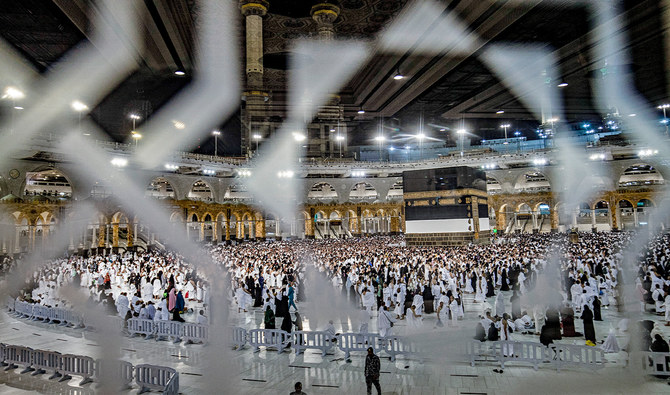
Muslim pilgrims circumambulate around the Kaaba, Islam's holiest shrine, during the annual Hajj pilgrimage at the Grand Mosque in Saudi Arabia's holy city of Makkah on July 6, 2022. (AFP/File)
Short Url
Updated 10 January 2023
Follow

Saudi Arabia restores Pakistan’s pre-pandemic Hajj quota of 179,210 pilgrims 

  • Saudi Arabia lifts pre-pandemic age restriction of 65 years to perform Hajj
  • Pakistan to likely accept Hajj applications from February 2023 onwards

Islamabad: Saudi Arabia restored Pakistan’s pre-coronavirus Hajj quota of 179,210 pilgrims and abolished the upper age limit of 65 years to perform the annual pilgrimage, Pakistan’s religion ministry confirmed on Monday. 

The Hajj is a spiritual journey that every Muslim adult must undertake once in his lifetime, to the holy sites in Makkah and Madinah, if he is financially and physically able to do so. It is one of the important five pillars of the Islamic faith.

At the height of the coronavirus pandemic in 2020, the Hajj was restricted to just 1,000 local residents. In 2021, the kingdom limited the annual pilgrimage to 60,000 domestic participants only, compared with the pre-coronavirus pandemic figure of 2.5 million pilgrims from around the world. 

Last year, the kingdom granted Pakistan a quota of 81,132 pilgrims. Other restrictions imposed on pilgrims from around the world to perform the Hajj included an upper age limit of 65. Pilgrims were also required to be vaccinated with vaccinations approved by the Saudi health authorities. 

Pakistan’s Minister for Religious Affairs and Interfaith Harmony, Mufti Abdul Shakoor, arrived in Jeddah on Monday to attend the annual Hajj Conference. 

“The religious affairs minister received the draft of the annual Hajj agreement according to which Pakistan’s old quota of 179,210 and the age limit of 65 years has been abolished as well,” the ministry wrote on Twitter. 

Pakistan’s religion ministry said Shakoor requested the kingdom’s Hajj authorities to lessen the cost of the pilgrimage so that Pakistani pilgrims who aspire to undertake the journey could do so with ease. “The Saudi minister for Hajj and Umrah assured [Pakistan] of positive efforts in this regard,” the ministry said. 


Pakistan Airports Authority reports ‘historic’ twin-engine aircraft landing in Lahore

Updated 13 December 2025
Follow

Pakistan Airports Authority reports ‘historic’ twin-engine aircraft landing in Lahore

  • Twin-engine aircraft are usually larger, heavier and require better airport infrastructure, navigation systems to land
  • Pakistan Airports Authority says landing reflects its commitment to enhance aviation sector, strengthen infrastructure

ISLAMABAD: The Pakistan Airports Authority (PAA) announced on Saturday that the New General Aviation Aerodrome achieved a significant milestone when it handled the landing of a twin-engine aircraft. 

A twin-engine aircraft has two engines that provide it redundancy and increased performance compared to single-engine counterparts. These aircraft range from small twin-engine propeller planes to large commercial jetliners. The presence of multiple engines enhances safety by allowing the aircraft to continue flying in the event of an engine failure.

However, twin-engine aircraft are usually larger, heavier and more complex than single-engine planes. They require advanced airport infrastructure such as better runways, navigation systems and air traffic coordination. 

“The New General Aviation Aerodrome, Lahore achieved another significant operational milestone today with the successful landing of a twin-engine aircraft, following the recent arrival of a single-engine aircraft,” the PAA said in a statement. 

It said the flight was also boarded by Air Vice Marshal Zeeshan Saeed, the director general of the PAA. The move reflected “strong institutional confidence” in the aerodrome’s safety standards, operational capability, and overall readiness, it added. 

“The landing was conducted with exceptional precision and professionalism, demonstrating the aerodrome’s robust operational framework, technical preparedness, and effective airside coordination in accordance with contemporary aviation requirements,” the PAA said. 

It said the landing represented a “major advancement” in Pakistan’s general aviation sector and underscores the PAA’s commitment to enhancing regional aviation capacity, strengthening infrastructure and promoting excellence in aviation development.