

Pakistani firm says discovered new gas reserves in country’s south

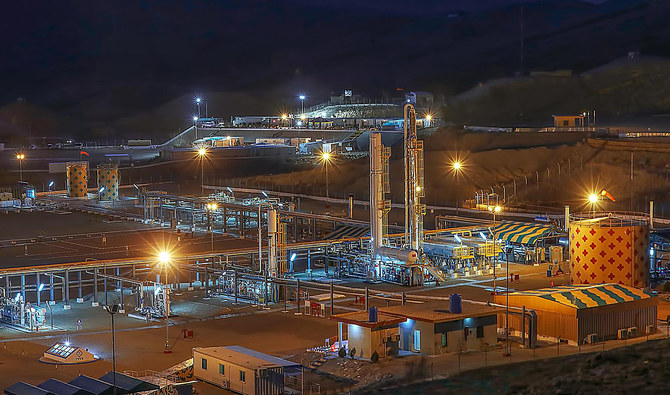
This undated handout photo, available on the Mari Petroleum Company Limited's official website, shows Zarghun South Gas Field in Balochistan. (Photo courtesy: MPCL)
Short Url
Updated 09 January 2023
Follow

Pakistani firm says discovered new gas reserves in country’s south

  • The cash-strapped nation failed to buy gas from the expensive spot market this year
  • Firm says discovery will contribute to mitigating the energy demand and supply gap

ISLAMABAD: An Islamabad-based petroleum exploration and lease company on Monday announced it has discovered gas reserves in the southern Pakistani province of Sindh that will “positively contribute” to mitigating the country’s energy demand and supply gap from indigenous resources.

Oil and gas make up the largest portion of Pakistan’s imports and the cash-strapped South Asian country has been hit with widespread gas blackouts after several failed attempts to buy gas from the expensive international spot market.

Pakistan tried to get a long-term deal at more reasonable prices, but that hasn’t materialized, according to Bloomberg. Local media has also reported that oil supplies remain tenuous owing to difficulties in paying for imports.

In a statement shared with the Pakistan Stock Exchange (PSX) on Monday, the Mari Petroleum Company Limited, an integrated exploration and production company that is operating the country’s second-largest gas reservoir, said it had discovered reserves in Sindh’s Ghotki district as a result of its exploratory efforts.

“Mari Petroleum Company Limited (MPCL), the Operator of Mari Development & Production Lease (Mari D&PL) with 100 percent working interest, is pleased to announce a gas discovery resulting from its exploratory efforts at Mari Ghazij-1 Exploration Well, drilled in Mari D&PL, located in District Ghotki, Sindh Province,” the statement read.

“The said discovery in Mari D&PL shows the commitment of MPCL to exploit the hydrocarbon (HC) potential of the Lease and aggressive exploration strategy. It has opened a new avenue and will positively contribute to mitigating energy demand and supply gap from indigenous resources and will add to the hydrocarbon reserves base of MPCL and the Country.”

Last month, the Oil & Gas Development Company Limited (OGDCL), a leading Pakistani exploration and production firm, announced the discovery of oil and gas reserves in the Sanghar district of Sindh.

Gas shortages always intensify in Pakistan with the arrival of winter. Pakistan needs 4.1 billion cubic feet per day (bcfd) of gas, with winter demand peaking to around 4.5 bcfd against a production of 3.22 bcfd. The shortfall is bridged through LNG imports.

Pakistan began importing LNG seven years ago. However, the price of the commodity in the international spot or short-term market rose from the lows of $2 per million British thermal units (mmBtu) in 2020 to the highs of $57 in August last year after demand in Europe surged, pushing Islamabad out of the market.


Curfew extended in Gilgit-Baltistan, probe ordered after deadly Khamenei protests

Updated 03 March 2026
Follow

Curfew extended in Gilgit-Baltistan, probe ordered after deadly Khamenei protests

  • At least 15 people were killed in clashes with law enforcement agencies over the weekend in Gilgit-Baltistan
  • Government also announces a de-weaponization campaign, crackdown on hate speech and cybercrime in region

ISLAMABAD: The government in Pakistan’s Gilgit-Baltistan (GB) region on Tuesday extended a curfew in Gilgit district and ordered a judicial probe into violent protests over the killing of Iranian Supreme Leader Ali Khamenei in US-Israeli strikes last week, an official said.

At least 15 people were killed in clashes with law enforcement agencies over the weekend in GB, where protesters torched and vandalized several buildings, including United Nations regional offices, an army-run school, software technology park and a local charity building.

The violence prompted regional authorities to impose curfew in Gilgit and Skardu districts on March 2-4 as officials urged people to stay indoors and cooperate with law enforcers, amid widespread anger in Pakistan, particularly among members of the Shiite minority, over Khamenei’s killing.

On Tuesday, the GB government convened to review the situation and announced the extension of curfew in Gilgit among a number of security measures as well as ordered the establishment of a judicial commission to investigate the weekend violence in the region.

“The government has made it clear that the law will strictly take its course against elements involved in vandalism at government institutions, private properties and incidents of vandalism in Gilgit and Skardu and no kind of mischief will be tolerated,” Shabbir Mir, a GB government spokesperson, said in a statement.

“In view of the security situation, curfew will remain in force in Gilgit, while the decision to extend the curfew in Skardu will be taken keeping the ground realities and the changing situation in view.”

The statement did not specify how long the curfew will remain in place in Gilgit.

Besides the formation of the judicial commission to investigate the violent clashes, the government also decided to launch a large-scale de-weaponization campaign in the entire Gilgit district, for which relevant institutions have been directed to immediately complete all necessary arrangements, according to Mir.

In addition, a crackdown has been ordered on hate speech, spread of fake news and cybercrime.

“The aim of these decisions is to ensure the rule of law, protect the lives and property of citizens and crack down on miscreants,” he said. “Approval has also been given to immediately survey the affected infrastructure and start their restoration work on priority basis.”

Demonstrators in Pakistan’s southern port city of Karachi also stormed the US Consulate on Sunday, smashing windows and attempting to burn the building. Police responded with batons, tear gas, and gunfire, leaving 10 people dead and more than 50 injured.

Pakistani authorities have since beefed up security at US diplomatic missions across the country, including around the US consulate building in Peshawar, to avoid any further violence.