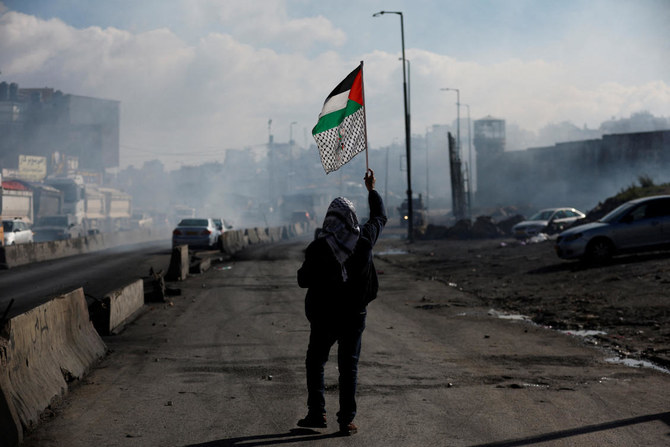
TEL AVIV: Israel’s national security minister has ordered police to ban Palestinian flags from public places in the latest crackdown by the country’s new hard-line government.
Itamar Ben-Gvir’s order follows a series of other punitive steps against the Palestinians since taking office late last month.
“Today I directed the Israel Police to enforce the prohibition of flying any PLO flag that shows identification with a terrorist organization from the public sphere and to stop any incitement against the State of Israel,” Ben-Gvir announced on Twitter.
Prime Minister Benjamin Netanyahu’s new government has moved quickly against the Palestinians in retaliation for a Palestinian push for the UN’s highest judicial body to give its opinion on Israel’s 55-year military occupation of the West Bank.
It has withheld nearly $40 million in Palestinian tax revenues and said it will transfer the money to victims of Palestinian militant attacks, stripped Palestinian officials of VIP privileges and even broke up a meeting of Palestinian parents discussing their children’s education, claiming it was unlawfully funded by the Palestinian Authority.
Ben-Gvir, a far-right firebrand known for his anti-Arab rhetoric, drew widespread international condemnation when he visited Jerusalem’s most sensitive holy site last week.
The repeated moves have the potential to increase tensions after the deadliest year of the Israel-Palestinian conflict in nearly two decades, according to a report by the Israeli rights group B’Tselem.
Ben-Gvir’s latest order is not the first battle over flying the Palestinian flag.
The red, green and white Palestinian flag carries great symbolism in the Israel-Palestinian conflict. Last May, Israeli riot police beat pallbearers at the funeral for slain Al Jazeera journalist Shireen Abu Akleh, causing them to nearly drop the casket. Police ripped Palestinian flags out of people’s hands and fired stun grenades to disperse the crowd.
Israel once considered the Palestinian flag that of a militant group akin to the Palestinian Hamas or the Lebanese Shiite Hezbollah. But after Israel and the Palestinians signed a series of interim peace agreements known as the Oslo Accords, the flag was recognized as that of the Palestinian Authority, which was created to administer Gaza and parts of the occupied West Bank. Israel opposes any official business being carried out by the PA in east Jerusalem, and police have in the past broken up events they alleged were linked to the PA.
Netanyahu told his Cabinet on Sunday the measures against the Palestinians were aimed at what he called “an extreme anti-Israel” step at the UN
Israel’s Palestinian citizens make up 20 percent of the population and they’ve had a turbulent relationship with the state since its creation in 1948, when hundreds of thousands of Palestinians fled or were forced to flee in the events surrounding the establishment of the state of Israel.
Those who remained became citizens, but have long been viewed with suspicion by some Israelis because of their ties to Palestinians in the West Bank, Gaza Strip and east Jerusalem, territories Israel captured in the 1967 Mideast war.
The Palestinians seek all three areas for a future independent state. Netanyahu’s new government is dominated by hard-liners who oppose Palestinian statehood.


![]()

Israel’s Ben-Gvir bans Palestinian flag-flying in public
Short Url
https://arab.news/b6tqq
Israel’s Ben-Gvir bans Palestinian flag-flying in public
- Israel revoked the Palestinian foreign minister’s VIP travel permit
- Ben-Gvir is an ultranationalist with a long record of anti-Arab rhetoric and stunts who now oversees the police


Latest updates


© 2026 SAUDI RESEARCH & PUBLISHING COMPANY, All Rights Reserved And subject to Terms of Use Agreement.