Israel’s Ben-Gvir bans Palestinian flag-flying in public

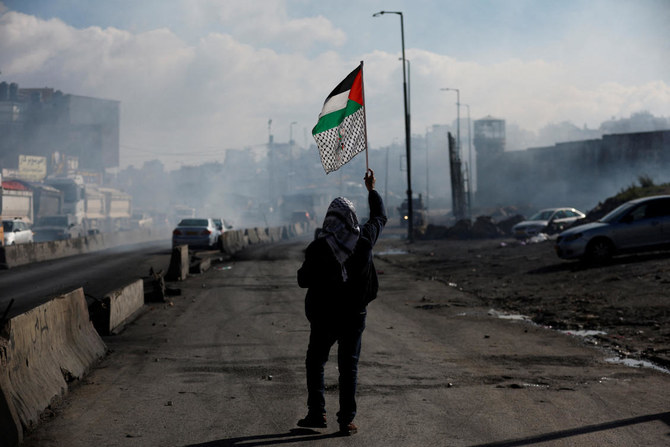
A man walks with a Palestinian flag, as Palestinians clash with Israeli forces during a protest (REUTERS)
Short Url
Updated 09 January 2023
Follow

Israel’s Ben-Gvir bans Palestinian flag-flying in public

  • Israel revoked the Palestinian foreign minister’s VIP travel permit
  • Ben-Gvir is an ultranationalist with a long record of anti-Arab rhetoric and stunts who now oversees the police

TEL AVIV: Israel’s national security minister has ordered police to ban Palestinian flags from public places in the latest crackdown by the country’s new hard-line government.
Itamar Ben-Gvir’s order follows a series of other punitive steps against the Palestinians since taking office late last month.
“Today I directed the Israel Police to enforce the prohibition of flying any PLO flag that shows identification with a terrorist organization from the public sphere and to stop any incitement against the State of Israel,” Ben-Gvir announced on Twitter.
Prime Minister Benjamin Netanyahu’s new government has moved quickly against the Palestinians in retaliation for a Palestinian push for the UN’s highest judicial body to give its opinion on Israel’s 55-year military occupation of the West Bank.
It has withheld nearly $40 million in Palestinian tax revenues and said it will transfer the money to victims of Palestinian militant attacks, stripped Palestinian officials of VIP privileges and even broke up a meeting of Palestinian parents discussing their children’s education, claiming it was unlawfully funded by the Palestinian Authority.
Ben-Gvir, a far-right firebrand known for his anti-Arab rhetoric, drew widespread international condemnation when he visited Jerusalem’s most sensitive holy site last week.
The repeated moves have the potential to increase tensions after the deadliest year of the Israel-Palestinian conflict in nearly two decades, according to a report by the Israeli rights group B’Tselem.
Ben-Gvir’s latest order is not the first battle over flying the Palestinian flag.
The red, green and white Palestinian flag carries great symbolism in the Israel-Palestinian conflict. Last May, Israeli riot police beat pallbearers at the funeral for slain Al Jazeera journalist Shireen Abu Akleh, causing them to nearly drop the casket. Police ripped Palestinian flags out of people’s hands and fired stun grenades to disperse the crowd.
Israel once considered the Palestinian flag that of a militant group akin to the Palestinian Hamas or the Lebanese Shiite Hezbollah. But after Israel and the Palestinians signed a series of interim peace agreements known as the Oslo Accords, the flag was recognized as that of the Palestinian Authority, which was created to administer Gaza and parts of the occupied West Bank. Israel opposes any official business being carried out by the PA in east Jerusalem, and police have in the past broken up events they alleged were linked to the PA.
Netanyahu told his Cabinet on Sunday the measures against the Palestinians were aimed at what he called “an extreme anti-Israel” step at the UN
Israel’s Palestinian citizens make up 20 percent of the population and they’ve had a turbulent relationship with the state since its creation in 1948, when hundreds of thousands of Palestinians fled or were forced to flee in the events surrounding the establishment of the state of Israel.
Those who remained became citizens, but have long been viewed with suspicion by some Israelis because of their ties to Palestinians in the West Bank, Gaza Strip and east Jerusalem, territories Israel captured in the 1967 Mideast war.
The Palestinians seek all three areas for a future independent state. Netanyahu’s new government is dominated by hard-liners who oppose Palestinian statehood.


Iran launches new attacks at Gulf Arab countries as it keeps up pressure on the region

Updated 9 sec ago
Follow

Iran launches new attacks at Gulf Arab countries as it keeps up pressure on the region

  • In addition to firing missiles and drones at Israel and American bases in the region, Iran has also been targeting energy infrastructure

DUBAI, United Arab Emirates: Iran launched new attacks Tuesday at Gulf Arab countries as it keeps up pressure on the region, while five pro-Iranian militants were killed in an airstrike northern Iraq.
Incoming missile sirens sounded early in the morning in Dubai in the United Arab Emirates and Bahrain, while Saudi Arabia said it had destroyed two drones over its oil-rich eastern region and Kuwait’s National Guard said it had show down six drones.
In addition to firing missiles and drones at Israel and American bases in the region, Iran has also been targeting energy infrastructure which, combined with its stranglehold on the Strait of Hormuz, has sent oil prices soaring.
Brent crude, the international standard, spiked to nearly $120 on Monday before falling back but was still at around $90 a barrel on Tuesday, nearly 24 percent higher than when the war started on Feb. 28.
US President Donald Trump, who has previously said that the war could last for a month or longer, on Tuesday sought to downplay growing fears that it could be a long-term regional conflict, saying it was “going to be a short-term excursion.”
Trump sends contradictory messages as Tehran says it’s prepared for a long war
The war has choked off major supplies of oil and gas to world markets and sent fuel prices rising across the US The fighting has also led foreigners to flee from business hubs and prompted millions to seek shelter as bombs hit military bases, government buildings, oil and water installations, hotels and at least one school.
Iran has effectively stopped tankers from using the Strait of Hormuz, the shipping lane between the Arabian Gulf and the Gulf of Oman — the gateway to the Indian Ocean — through which 20 percent of the world’s oil is carried. Attacks on merchant ships near the strait have killed at least seven sailors, according to the International Maritime Organization.
In a post on social media on Tuesday, Trump seemed not to acknowledge that, saying that “If Iran does anything that stops the flow of Oil within the Strait of Hormuz, they will be hit by the United States of America TWENTY TIMES HARDER than they have been hit thus far.”
In an apparent response to Trump’s remarks published in Iranian state media, a spokesperson for the paramilitary Revolutionary Guard, Ali Mohammad Naini, said “Iran will determine when the war ends.”
Kamal Kharazi, foreign policy adviser to the office of the supreme leader, told CNN on Monday that Iran is prepared for a long war. He said he sees no “room for diplomacy anymore” unless economic pressure prompts other countries to intervene and stop the “aggression of Americans and Israelis against Iran.”
Airstrike on Iran-linked militia in Iraq kills five
As the conflict has spread against the region, Israel has launched multiple attacks on Hezbollah in Lebanon and the Iranian-linked militia has responded by firing missiles into Israel.
Pro-Iran militias in Iraq have also launched attacks at US bases in the country since the beginning of the conflict.
Early Tuesday, one of those militias, the 40th Brigade of the Popular Mobilization Forces in the city of Kirkuk, was hit with an airstrike that killed at least five militants and wounded four others, according to officials, who spoke on condition of anonymity because they weren’t authorized to brief reporters.
It was not immediately clear who was behind the strikes.
Since the war began, at least 1,230 people have been killed in Iran, at least 397 in Lebanon and 11 in Israel, according to officials.
A total of seven US service members have been killed.
Financial markets, which swung wildly in recent days, opened the day Tuesday in Asia with early gains, building on late optimism in the US