Nearly 200 Rohingya refugees land in Indonesia in latest boat arrival

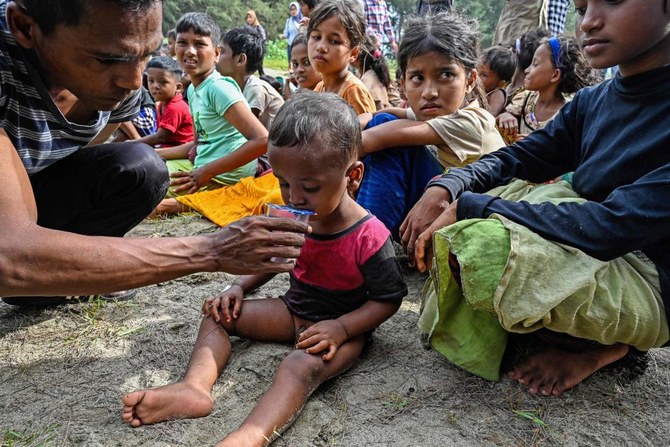
Rohingya refugees gather upon their arrival by a boat in Lamnga beach, Aceh province on January 8, 2023. (AFP)
Short Url
Updated 09 January 2023
Follow

Nearly 200 Rohingya refugees land in Indonesia in latest boat arrival

  • Thousands of the mostly Muslim Rohingya risk their lives each year on long sea journeys in an attempt to reach Malaysia or Indonesia

BANDA ACEH: A wooden boat carrying nearly 200 Rohingya refugees, a majority of them women and children, landed on Indonesia’s western coast on Sunday, police said.
The ship is the fifth boat carrying Rohingya refugees to land in Indonesia since November, according to authorities.
Thousands of the mostly Muslim Rohingya, heavily persecuted in Myanmar, risk their lives each year on long and expensive sea journeys — often in poor-quality boats — in an attempt to reach Malaysia or Indonesia.
The wooden vessel — which carried 69 men, 75 women and 40 children — arrived at around 02:30 p.m. local time (0730 am GMT) on a beach in Indonesia’s westernmost province of Aceh, local police chief Irwan Fahmi Ramli said Sunday.
“They are generally healthy, but there is one pregnant woman among them, and four people are sick,” Ramli said.
“We had coordinated with doctors who will come here to conduct an initial health check of these refugees, particularly those who are sick.”
He added that the refugees will be transferred to a local government facility.
According to one of the passengers, the boat departed Bangladesh on December 10.
“We feel very happy because we arrived here. Already, our engine is damaged and also we don’t have food in the boat,” 26-year-old Fairus told reporters.
Around a million Rohingya were estimated to be living in refugee camps in Bangladesh after they fled persecution in neighboring Myanmar in 2017.
Four vessels carrying Rohingya refugees have already landed in Indonesia in November and December last year, carrying a total of more than 400 passengers.
More than 2,000 Rohingya are believed to have attempted the risky journey in 2022, according to the UN refugee agency UNHCR — at levels similar to 2020.
The agency estimated nearly 200 Rohingya have died or remain missing after attempting hazardous sea crossings last year.
But the figure could rise after relatives of around 180 Rohingya refugees that were on another vessel drifting at sea for weeks lost contact and were feared dead.
The UNHCR could not confirm their deaths.
But spokesman Babar Baloch said if true, it would make 2022 the deadliest year for Rohingya crossings since 2013 and 2014, when more than 900 and 700 were reported dead or missing respectively.
Relatively affluent Malaysia is a favored destination for the refugees, but many land first in Muslim-majority Indonesia, seen as more welcoming.


Philippines signs free trade pact with UAE

Updated 4 sec ago
Follow

Philippines signs free trade pact with UAE

  • UAE deal is Philippines’ fourth free trade pact, after South Korea, Japan, and EFTA
  • Business body warns of uneven gains if domestic safeguard mechanisms insufficient

MANILLA: The Philippines signed on Tuesday a comprehensive economic partnership agreement with the UAE, its first such deal with a Middle Eastern nation.

The Philippines and the UAE first agreed to explore a free trade pact in February 2022 and formalized the process with terms of reference in late 2023. Negotiations started in May 2024 and were finalized in 2025.

The CEPA signing was witnessed by President Ferdinand R. Marcos Jr. who led the Philippine delegation to Abu Dhabi.

“The CEPA is the Philippines’ first free trade pact with a Middle Eastern country, marking a milestone in expanding the nation’s global trade footprint,” Marcos’s office said.

“The agreement aims to reduce tariffs, enhance market access for goods and services, increase investment flows, and create new opportunities for Filipino professionals and service providers in the UAE.”

The UAE is home to some 700,000 Filipinos, the second-largest Filipino diaspora after Saudi Arabia.

With bilateral trade worth about $1.8 billion, it is also a key trading partner of the Philippines in the Middle East, and accounted for almost 39 percent of Philippine exports to the region in 2024.

The Philippine Department of Trade and Industry earlier estimated it would lead to at least 90 percent liberalization in tariffs and give the Philippines wider access to the GCC region.

“Preliminary studies indicate the CEPA could boost Philippine exports to the UAE by 9.13 percent, generate consumer savings, and strengthen overall trade linkages with the Gulf region,” Marcos’s office said.

The Philippine Chamber of Commerce and Industry-Makati expects the pact to bring stronger trade flows, capital and technology for renewable energy, infrastructure, food, and water security projects as long as domestic policy supports it.

“CEPA can serve as a trade accelerator and investment catalyst for the Philippines,” Nunnatus Cortez, the chamber’s chairman, told Arab News.

The pact could result in “expanding exports, attracting capital, diversifying economic partners, upgrading industries, and supporting long-term growth — provided the country actively supports exporters and converts provisions into concrete commercial outcomes,” said Cortez.

“The main downside risk of CEPA lies in domestic readiness. Without strong industrial policy, MSME (Micro, Small and Medium Enterprises) support, safeguard mechanisms, and export development, CEPA could lead to import dominance, uneven gains, fiscal pressure, and limited structural transformation.”

The deal with the UAE is the Philippines’ fourth bilateral free trade pact, following agreements with South Korea, Japan, and the European Free Trade Association, which comprises Iceland, Liechtenstein, Norway, and Switzerland.