

Saudi prince to set up technology house in Pakistan for enhanced technical collaboration

An overview of Pakistan’s biggest tech conference, Future Fest 2023, in Lahore on January 6, 2023. (AN Photo)
Short Url
Updated 07 January 2023
Follow

Saudi prince to set up technology house in Pakistan for enhanced technical collaboration

  • Prince Fahad bin Mansour Al Saud tells Future Fest 2023 the Saudi-Pakistan Tech House will help ‘ease of doing business’
  • Saudi organizations speak highly of Pakistani workforce talent, say the country is a ‘potential market for a lot of things’

LAHORE: Saudi Arabia’s Prince Fahad bin Mansour Al Saud has announced to set up a technology house in Pakistan to enhance cooperation between the two countries in diverse technical fields, the Future Fest management said on Friday.

Pakistan’s biggest tech conference, Future Fest 2023 is a three-day event that has brought together 50,000 participants along with representatives of 500 startups and 200 exhibitors from over 30 countries. After premiering in Islamabad last year, its second edition is currently taking place in Lahore where it has been organized in collaboration with the Punjab provincial administration and information technology board.

The conference, which is scheduled to end on January 8, features keynote speeches and discussions by investors, innovators, thought leaders, policymakers and leading entrepreneurs.

This year’s conference is particularly important for the Saudi-Pakistan relations since it has brought a bunch of business leaders and entrepreneurs from the kingdom and other Middle East countries.

The Saudi delegation participating in the event includes senior representatives from Riyadh-based Digital Cooperation Organization and Invest Saudi, which works under the kingdom’s investment ministry.

“HRH [His Royal Highness] Prince Fahad bin Mansour Al Saud, during a virtual address to Future Fest stakeholders, announced the establishment of a dedicated Saudi-Pakistan Tech House to promote greater ease of doing business,” said the festival management in an official statement.
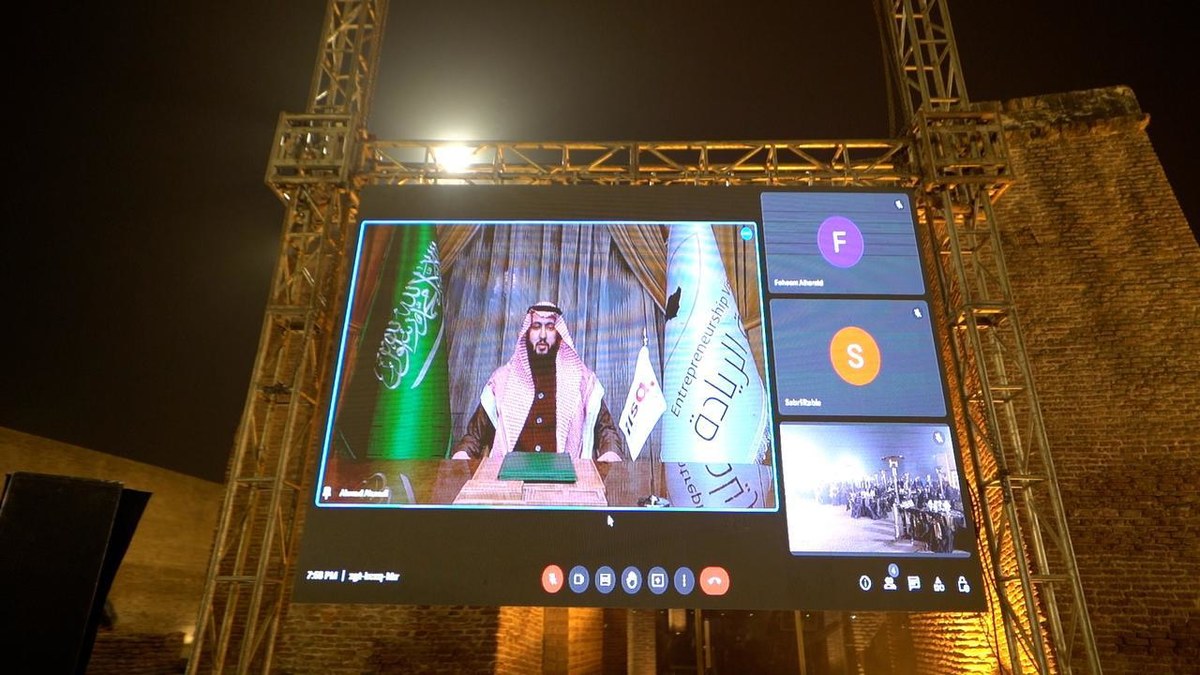


Saudi Arabia’s Prince Fahad bin Mansour Al Saud virtually addresses Future Fest 2023, Pakistan’s biggest tech conference, in Lahore on January 6, 2023. (Photo courtesy: Future Fest)

The Saudi prince is also the co-founder of technology giant, ILSA Interactive, which was founded by a Pakistani entrepreneur, Salman Nasir, in 2009. Back then, he announced over 300 projects for the company while hoping they would create more than a thousand jobs in Pakistan, Saudi Arabia and other parts of the world.

“I’m deeply honored to be a part of such a respected and prestigious gathering of the IT industry with thought leaders of Pakistan at the country’s largest tech conference and expo, Future Fest 2023,” the Saudi prince said.

He confirmed the technology house would be headquartered in Riyadh with its first branch in Lahore.

Meanwhile, representatives of various Saudi companies attending the event said there was immense business potential in Pakistan while applauding the technical skills among the country’s young workforce.

Ayman Jaber, chief internal auditor of a Saudi fintech company, Hala, said he was “grateful” to be in Pakistan for the event.

“It [Pakistan] is a full potential market for a lot of things, a lot of aspects, even to support the market itself or looking for partnerships with companies as a vendor,” he told Arab News.

“They have a really talented resource that can assist us in building the company,” he continued. “So, we are here in three dimensions and we are really having a fruitful result from this trip.”

Mujtaba Hussain, general manager of the global edtech platform, Noon, based in Saudi Arabia, said his company had a special focus on the Middle East, North Africa and Pakistan. He noted that Noon had already been working in Pakistan for the past two years.

“Pakistan, in edtech, is a very, very large opportunity for anyone who’d want to come in,” he maintained. “The industry has very few players who are trying to do a lot of things.”

Hussain said the problems related to Pakistan’s education sector were “large enough,” adding that global edtechs should assist the South Asian country resolve those issues.

“We’ve been doing that for two-and-a-half years and our experience has been absolutely amazing,” he continued.

Hussain said that his organization was operating in five countries, though the level of commitment among its Pakistani employees was not seen elsewhere.

“In Pakistan, we’ve seen this through and through that the commitment of employees has been up there, the talent quality is up there, their comprehension of problems locally and in other markets is up there,” he said.


Islamabad dismisses claims about paying up to 8 percent interest on foreign loans as ‘misleading’

Updated 22 February 2026
Follow

Islamabad dismisses claims about paying up to 8 percent interest on foreign loans as ‘misleading’

  • Pakistan has long relied on external loans to help bridge persistent gaps in public finances and foreign exchange reserves
  • Pakistan’s total external debt, liabilities stand at $138 billion at an overall average cost of around 4 percent, ministry says

KARACHI: Pakistan’s finance ministry on Sunday dismissed as “misleading” claims that the country is paying up to 8 percent interest on external loans, saying the overall average cost of external public debt is approximately 4 percent.

Pakistan has long relied on external loans to help bridge persistent gaps in public finances and foreign exchange reserves, driven largely by a narrow tax base, chronic trade deficits, rising debt-servicing costs and repeated balance-of-payments pressures.

Over the decades, successive governments have turned to multilateral and bilateral lenders, including the International Monetary Fund, the World Bank and the Asian Development Bank, to support budgetary needs and shore up foreign exchange reserves.

The finance ministry on Sunday issued a clarification in response to a “recent press commentary” regarding the country’s external debt position and associated interest payments, and said the figures required contextual explanation to ensure accurate understanding of Pakistan’s external debt profile.

“Pakistan’s total external debt and liabilities currently stand at $138 billion. This figure, however, encompasses a broad range of obligations, including public and publicly guaranteed debt, debt of Public Sector Enterprises (both guaranteed and non-guaranteed), bank borrowings, private-sector external debt, and intercompany liabilities to direct investors. It is therefore important to distinguish this aggregate figure from External Public (Government) Debt, which amounts to approximately $92 billion,” it said.

“Of the total External Public Debt, nearly 75 percent comprises concessional and long-term financing obtained from multilateral institutions (excluding the IMF) and bilateral development partners. Only about 7 percent of this debt consists of commercial loans, while another 7 percent relates to long-term Eurobonds. In light of this composition, the claim that Pakistan is paying interest on external loans ‘up to 8 percent’ is misleading.

The overall average cost of External Public Debt is approximately 4 percent, reflecting the predominantly concessional nature of the borrowing portfolio.”

With respect to interest payments, public external debt interest outflows increased from $1.99 billion in Fiscal Year (FY) 2022 to $3.59 billion in FY2025, representing an increase of 80.4 percent, not 84 percent as reported. In absolute terms, interest payments rose by $1.60 billion over this period, not $1.67 billion, it said.

According to the State Bank of Pakistan’s records, Pakistan’s total debt servicing payments to specific creditors during the period under reference were as follows: the IMF received $1.50 billion, of which $580 million constituted interest; Naya Pakistan Certificates payments totaled $1.56 billion, including $94 million in interest; the Asian Development Bank received $1.54 billion, including $615 million in interest; the World Bank received $1.25 billion, including $419 million in interest; and external commercial loans amounted to nearly $3 billion, of which $327 million represented interest payments.

“While interest payments have increased in absolute terms, this rise cannot be attributed solely to an expansion in the debt stock,” the ministry said. “Although the overall debt stock has increased slightly since FY2022, the additional inflows have primarily originated from concessional multilateral sources and the IMF’s Extended Fund Facility (EFF) under the ongoing IMF-supported program.”

Pakistan secured a $7 billion IMF bailout in Sept. 2024 as part of Prime Minister Shehbaz Sharif’s efforts to stabilize the South Asian economy that narrowly averted a default in 2023. The government has since been making efforts to boost trade and bring in foreign investment to consolidate recovery.

“It is also important to note that the increase in interest payments reflects prevailing global interest rate dynamics. In response to the inflation surge of 2021–22, the US Federal Reserve raised the federal funds rate from 0.75-1.00 percent in May 2022 to 5.25–5.50 percent by July 2023. Although rates have since moderated to around 3.75 percent, they remain significantly higher than 2022 levels,” the finance ministry said.

“The government remains committed to prudent debt management, transparency, and the continued strengthening of Pakistan’s macroeconomic stability,” it added.