World food prices hit record high in 2022

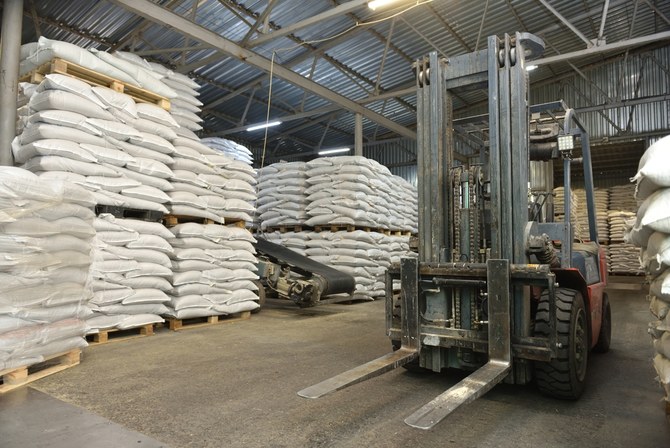
Food prices surged after Russia’s invasion of Ukraine in February last year (Shutterstock)
Short Url
Updated 06 January 2023
Follow

World food prices hit record high in 2022

PARIS: A surge in the cost of most food commodities last year, as the disruption caused by Russia’s invasion of Ukraine raised concerns of shortages, sent the UN food agency’s average price index to the highest level on record, according to Reuters.

The Food and Agriculture Organization’s food price index, which tracks international prices of the most globally traded food commodities, averaged 143.7 points in 2022, up 14.3 percent from 2021, and the highest since records started in 1990, the agency said on Friday.

The index had already gained 28 percent in 2021 from the previous year as the world economy recovered from the impact of the pandemic.

Food prices surged after Russia’s invasion of Ukraine in February last year on fears of disruptions to Black Sea trade. They have pared some of their gains since, in part because of a UN-backed grain export channel from Ukraine and the prospect of improved supplies in producing countries.

In December the benchmark index fell for the ninth consecutive month to 132.4 points, compared with a revised 135.00 points for November. The November figure was previously given as 135.7 points.

“Calmer food commodity prices are welcome after two very volatile years,” FAO Chief Economist Maximo Torero said.

The decline in the index in December was driven by a drop in the international price of vegetable oils, together with some declines in cereal and meat prices, but mitigated by slight increases in those of sugar and dairy, the FAO said.

Still over the whole of 2022, four of the FAO’s five food sub-indexes — cereals, meat, dairy and vegetable oils — had reached record highs, while the fifth one, sugar, was at a 10-year high.

The FAO Cereal Price Index index rose 17.9 percent in 2022 due to factors including significant market disruptions, higher energy and input costs, adverse weather and continued strong global food demand, the FAO said. 


Closing Bell: Saudi main index extends gains as market opens wider to foreign investment

Updated 02 February 2026
Follow

Closing Bell: Saudi main index extends gains as market opens wider to foreign investment

RIYADH: Saudi Arabia’s Tadawul All Share Index rose on Monday, gaining 153.61 points, or 1.38 percent, to close at 11,321.09.

The total trading turnover of the benchmark index was SR5.85 billion ($1.56 billion), as 207 of the listed stocks advanced, while 55 retreated.

The MSCI Tadawul Index increased, up 21.20 points or 1.41 percent, to close at 1,524.18.

The Kingdom’s parallel market Nomu gained 278.13 points, or 1.17 percent, to close at 24,013.03. This comes as 43 of the listed stocks advanced, while 29 retreated.

The best-performing stock was Saudi Pharmaceutical Industries and Medical Appliances Corp., with its share price surging by 7.26 percent to SR28.94.

Other top performers included Rasan Information Technology Co., which saw its share price rise by 6.51 percent to SR144, and Knowledge Economic City, which saw a 6.25 percent increase to SR13.09.

On the downside, the worst performer of the day was Najran Cement Co., whose share price fell by 2.11 percent to SR6.49.

Almasane Alkobra Mining Co. and Saudi Cable Co. also saw declines, with their shares dropping by 2 percent and 1.88 percent to SR103.10 and SR166.80, respectively.

On the announcement front, Riyad Bank has announced its annual financial results for 2025, with the total income from special commission of financing reaching SR24.1 billion, while net income from special commission of financing amounted to SR12 billion.

In a statement on Tadawul, the bank said: “Net income increased by 11.7 percent mainly due to an increase in total operating income and a decrease in total operating expenses.”

The bank further noted that the rise in total operating income was primarily driven by increased revenue from fees and commissions, trading activities, special commissions, gains on non-trading investments, and other operating sources. This growth was partially tempered by declines in exchange and dividend income.

“Net provision of expected credit losses and other losses decreased by 15.8 percent due to a decrease in impairment charge of credit losses and impairment charge for other financial assets, partially offset by an increase in impairment charge for investments,” it added.

RIBL’s share price closed at SR18.18 on the main market, marking a 1.43 percent increase.