

After 10 days of shutdown, authorities in Balochistan restore mobile Internet service in Gwadar

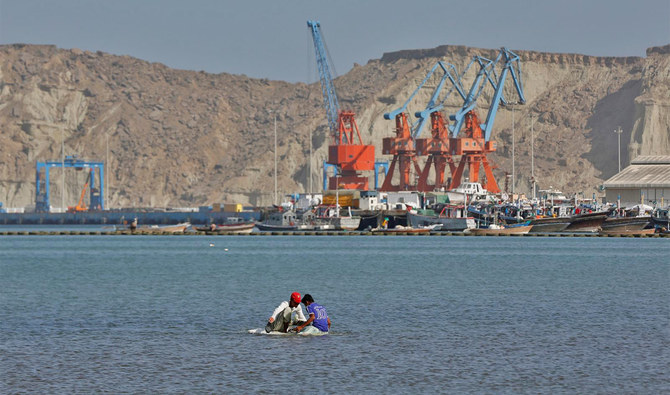
Boys sit on a piece of styrofoam sheet as they search for crabs in front of the Gwadar port in Pakistan on April 11, 2017. (Reuters)
Short Url
Updated 05 January 2023
Follow

After 10 days of shutdown, authorities in Balochistan restore mobile Internet service in Gwadar

  • The service was suspended after a police constable was killed in a clashes with protesters agitating for their rights
  • Amnesty International expressed concern over the situation while asking Pakistan to lift a ban on public gatherings

QUETTA: Authorities in Pakistan’s southwestern Balochistan province on Thursday restored mobile Internet service in Gwadar port city after shutting it down for 10 days in the wake of clashes between a group of protesters and police personnel in December, said a senior official.

Gwadar is at the heart of a $60 billion China-Pakistan Economic Corridor (CPEC) where workers from Beijing have been involved in the development of the port on the Arabian Sea. The residents of the city, however, maintain the Chinese investment in the region has done little to improve their lives. Many of them have complained about water scarcity and lack of employment opportunities while demanding an end to illegal trawling and removal of unnecessary security checkpoints from the area.

Protests against the lack of basic facilities first started in November 2021 under the banner of “Give Gwadar its Rights” but dissipated after the government negotiated with demonstrators and promised to meet their demands. Around two months ago, these protests broke out again and led to the killing of a police constable last month, making the provincial authorities in Balochistan prohibit large gatherings by imposing Section 144 of the Code of Criminal Procedure.

“The Government of Balochistan has restored the 3G and 4G mobile services in Gwadar after the city returned to normalcy and the law and order situation was brought under complete control,” the secretary information of the province, Hamza Shafqat, told Arab News.

He reiterated the government would fully address the demands of the people of Gwadar, adding that some of them had already been met.

The restoration of the Internet service has been announced only a few days after Amnesty International expressed concern over its shutdown while also urging Pakistani officials to lift ban on public gatherings in Gwadar.

The rights organization said in a statement it feared that “the Internet ban and emergency law will serve as a springboard for further crackdown on people’s fundamental freedoms, including freedom of expression, peaceful assembly, right to personal security and freedom from arbitrary detention.”

“Despite the attacks on police, which led to the death of a constable, the government has shown complete restraint and handled the situation with tolerance since Gwadar has tremendous significance with the future of Balochistan and Pakistan,” Shafqat said.

He noted that port activities and other businesses in the coastal town were running smoothly.

However, the top leader of the protest movement who galvanized people and led demonstrations in Gwadar said in a recent post on Twitter the authorities had still not discussed illegal trawling in the area.

“There are still 200 trawlers on Ormara coast,” he said while addressing the provincial authorities. “When will action be taken against them? Or the use of force is only for peaceful demonstrators.”

Fahad Ishaq, a local resident of Gwadar who manages a tourism company, said his business had suffered due to the recent clashes.

“Blocking Internet or mobile service is not the solution,” he told Arab News. “The students and people living in other cities of Pakistan cannot contact their families in Gwadar which sometimes results in immense difficulties.”

Ishaq said the government should find alternative solutions to address social unrest, instead of imposing a total communication blackout.


Pakistan orders four-day workweek, shuts schools to save fuel amid Middle East oil crisis

Updated 09 March 2026
Follow

Pakistan orders four-day workweek, shuts schools to save fuel amid Middle East oil crisis

  • The development comes as ongoing US-Israeli strikes on Iran disrupt oil supplies in Strait of Hormuz, push prices past $119 a barrel
  • Islamabad bans government purchases, cuts fuel allocation for vehicles as well as workforce in public and private offices by 50 percent

ISLAMABAD: Prime Minister Shehbaz Sharif on Monday announced austerity measures, including a four-day work week, cuts in government expenditures and closure of schools, to offset the impact of rising global oil prices due to an ongoing conflict in the Middle East.

Global fuel supply lines have been disrupted in the Strait of Hormuz, which supplies nearly a fourth of world oil consumption, after Tehran blocked it following United States-Israeli strikes on Iran and counterattacks against US interests in the Gulf region.

Oil prices surged more than 25 percent globally on Monday to $119.50 a barrel, the highest levels since mid-2022, as some major producers cut supplies and fears of prolonged shipping disruptions gripped the market due to the expanding US-Israeli war with Iran.

In his televised address on Sunday night, Sharif said global oil prices were expected to rise again in the coming days but vowed not to let the people bear their brunt, announcing austerity measures to lessen the impact of fuel price hikes.

“Fifty percent staff in public and private entities will work from home,” he announced, adding this would not be applicable to essential services. “Offices will remain open for four days a week. One-day additional off is being given to conserve oil, but it would not be applicable to banks.”

Sharif didn’t specify working days of the week and the government was likely to issue a notification in this regard.

He said a decrease of 50 percent was being made in fuel allocation for government vehicles immediately for the next two months, but they would not include ambulances and public buses.

“Cabinet members, advisers and special assistants will not draw salaries for the next two months, 25 percent salaries of parliamentarians are being deducted, two-day salaries of Grade 20 and above officers, or those who are paid Rs300,000 ($1,067) a month, are being deducted for public relief,” he said.

Similarly, there will be 20 percent reduction in public department expenses and a complete ban on the purchase of cars, furniture, air conditioners and other goods, according to the prime minister.

Foreign trips of ministers and other government officials will also be banned along with government dinners and iftar buffets, while teleconferences and online meetings will be given priority.

“All schools will be off for two weeks, starting from the end of this week, and all higher education institutions should immediately begin online classes,” he said.

Sharif’s comments were aired hours after Pakistani authorities said the country had “comfortable levels” of petroleum stocks and the supply chains were functioning smoothly, despite intensifying Middle East conflict.

Petroleum Minister Ali Pervaiz Malik said three oil shipments were due to reach Pakistan this week, state media reported.

Meanwhile, Pakistan Navy (PN) launched ‘Operation Muhafiz-ul-Bahr’ to safeguard national energy shipments, the Pakistani military said on Monday, amid disruptions to critical sea lanes due to the conflict.

The navy is conducting escort operations in close coordination with the Pakistan National Shipping Corporation (PNSC), according to the Inter-Services Public Relations (ISPR), the military’s media wing. It is fully cognizant of the prevailing maritime situation and is actively monitoring and controlling the movement of merchant vessels to ensure their safe and secure transit.

“With approximately 90 percent of Pakistan’s trade conducted via sea, the operation aims to ensure that vital sea routes remain safe, secure, and uninterrupted,” the ISPR said on Monday. “Currently, PN ships are escorting 2 x Merchant Vessels, one of which is scheduled to arrive Karachi today.”