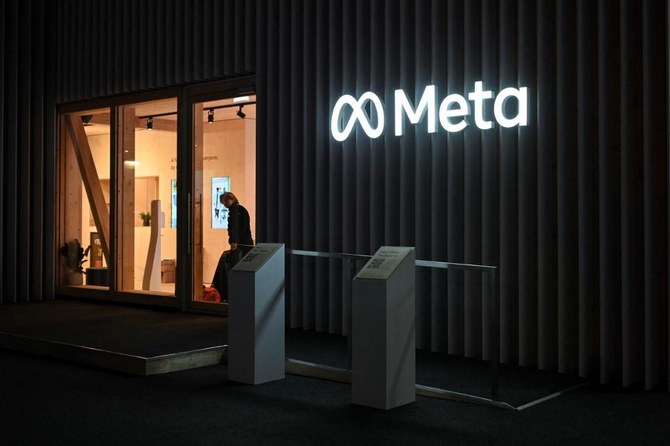
LONDON: Irish regulators on Wednesday hit Facebook parent Meta with hundreds of millions in fines for online privacy violations and banned the company from forcing European users to agree to personalized ads based on their online activity.
Ireland’s Data Protection Commission imposed two fines totaling 390 million euros ($414 million) in its decision in two cases that could shake up Meta’s business model targeting users with ads based on what they do online.
The watchdog fined Meta 210 million euros for violations of the European Union’s strict data privacy rules involving Facebook and an additional 180 million euros for breaches involving Instagram.
It’s the commission’s latest punishment for Meta for data privacy infringements, following four other fines for the company since 2021 that total more than 900 million euros.
The decision stems from complaints filed in May 2018 when the 27-nation EU’s privacy rules, known as the General Data Protection Regulation, or GDPR, took effect.
Previously, Meta relied on getting informed consent from users to process their personal data to serve them personalized, or behavioral, ads. When GDPR came into force, the company changed the legal basis under which it processes user data by adding a clause to the terms of service for advertisements, effectively forcing users to agree that their data could be used. That violates EU privacy rules.
The Irish watchdog initially sided with Meta but changed its position after the draft decision was sent to a board of EU data protection regulators, many of whom objected.
In its final decision, the Irish watchdog said Meta “is not entitled to rely on the ‘contract’ legal basis to deliver behavioral adverts on Facebook and Instagram.”
Meta said in a statement that “we strongly believe our approach respects GDPR, and we’re therefore disappointed by these decisions and intend to appeal both the substance of the rulings and the fines.”
The Irish watchdog is Meta’s lead European data privacy regulator because its regional headquarters is in Dublin.

Ireland fines Meta 390M euros in latest privacy crackdown
Short Url
https://arab.news/vhmdm
Ireland fines Meta 390M euros in latest privacy crackdown
- Watchdog accuses company of forcing users to agree to personalized ads in violation of European privacy rules
Malaysia, Indonesia become first to block Musk’s Grok over AI deepfakes
- Authorities in both countries acted over the weekend, citing concerns about non-consensual and sexual deepfakes
- Regulators say existing controls cannot prevent fake pornographic content, especially involving women and minors
KUALA LUMPUR: Malaysia and Indonesia have become the first countries to block Grok, the artificial intelligence chatbot developed by Elon Musk’s xAI, after authorities said it was being misused to generate sexually explicit and non-consensual images.
The moves reflect growing global concern over generative AI tools that can produce realistic images, sound and text, while existing safeguards fail to prevent their abuse. The Grok chatbot, which is accessed through Musk’s social media platform X, has been criticized for generating manipulated images, including depictions of women in bikinis or sexually explicit poses, as well as images involving children.
Regulators in the two Southeast Asian nations said existing controls were not preventing the creation and spread of fake pornographic content, particularly involving women and minors. Indonesia’s government temporarily blocked access to Grok on Saturday, followed by Malaysia on Sunday.
“The government sees non-consensual sexual deepfakes as a serious violation of human rights, dignity and the safety of citizens in the digital space,” Indonesia’s Communication and Digital Affairs Minister Meutya Hafid said in a statement Saturday.
The ministry said the measure was intended to protect women, children and the broader community from fake pornographic content generated using AI.
Initial findings showed that Grok lacks effective safeguards to stop users from creating and distributing pornographic content based on real photos of Indonesian residents, Alexander Sabar, director general of digital space supervision, said in a separate statement. He said such practices risk violating privacy and image rights when photos are manipulated or shared without consent, causing psychological, social and reputational harm.
In Kuala Lumpur, the Malaysian Communications and Multimedia Commission ordered a temporary restriction on Grok on Sunday after what it said was “repeated misuse” of the tool to generate obscene, sexually explicit and non-consensual manipulated images, including content involving women and minors.
The regulator said notices issued this month to X Corp. and xAI demanding stronger safeguards drew responses that relied mainly on user reporting mechanisms.
“The restriction is imposed as a preventive and proportionate measure while legal and regulatory processes are ongoing,” it said, adding that access will remain blocked until effective safeguards are put in place.
Launched in 2023, Grok is free to use on X. Users can ask it questions on the social media platform and tag posts they’ve directly created or replies to posts from other users. Last summer the company added an image generator feature, Grok Imagine, that included a so-called “spicy mode” that can generate adult content.
The Southeast Asian restrictions come amid mounting scrutiny of Grok elsewhere, including in the European Union, Britain, India and France. Grok last week limited image generation and editing to paying users following a global backlash over sexualized deepfakes of people, but critics say it did not fully address the problem.
The moves reflect growing global concern over generative AI tools that can produce realistic images, sound and text, while existing safeguards fail to prevent their abuse. The Grok chatbot, which is accessed through Musk’s social media platform X, has been criticized for generating manipulated images, including depictions of women in bikinis or sexually explicit poses, as well as images involving children.
Regulators in the two Southeast Asian nations said existing controls were not preventing the creation and spread of fake pornographic content, particularly involving women and minors. Indonesia’s government temporarily blocked access to Grok on Saturday, followed by Malaysia on Sunday.
“The government sees non-consensual sexual deepfakes as a serious violation of human rights, dignity and the safety of citizens in the digital space,” Indonesia’s Communication and Digital Affairs Minister Meutya Hafid said in a statement Saturday.
The ministry said the measure was intended to protect women, children and the broader community from fake pornographic content generated using AI.
Initial findings showed that Grok lacks effective safeguards to stop users from creating and distributing pornographic content based on real photos of Indonesian residents, Alexander Sabar, director general of digital space supervision, said in a separate statement. He said such practices risk violating privacy and image rights when photos are manipulated or shared without consent, causing psychological, social and reputational harm.
In Kuala Lumpur, the Malaysian Communications and Multimedia Commission ordered a temporary restriction on Grok on Sunday after what it said was “repeated misuse” of the tool to generate obscene, sexually explicit and non-consensual manipulated images, including content involving women and minors.
The regulator said notices issued this month to X Corp. and xAI demanding stronger safeguards drew responses that relied mainly on user reporting mechanisms.
“The restriction is imposed as a preventive and proportionate measure while legal and regulatory processes are ongoing,” it said, adding that access will remain blocked until effective safeguards are put in place.
Launched in 2023, Grok is free to use on X. Users can ask it questions on the social media platform and tag posts they’ve directly created or replies to posts from other users. Last summer the company added an image generator feature, Grok Imagine, that included a so-called “spicy mode” that can generate adult content.
The Southeast Asian restrictions come amid mounting scrutiny of Grok elsewhere, including in the European Union, Britain, India and France. Grok last week limited image generation and editing to paying users following a global backlash over sexualized deepfakes of people, but critics say it did not fully address the problem.
© 2026 SAUDI RESEARCH & PUBLISHING COMPANY, All Rights Reserved And subject to Terms of Use Agreement.


