

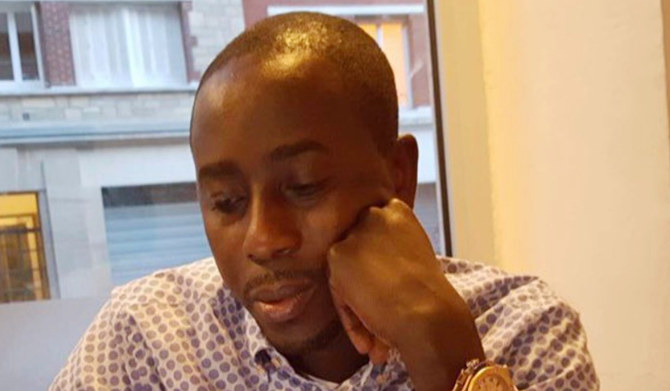
Senegalese journalist ‘extremely strained’ after hunger strike

Pape Ale Niang. (Twitter @papealeniang)
Short Url
Updated 03 January 2023
Follow

Senegalese journalist ‘extremely strained’ after hunger strike

  • The case against Niang arose after he wrote about rape charges faced by the country’s main opposition leader, Ousmane Sonko

DAKAR: A Senegalese journalist and prominent anti-government critic is “extremely strained” after a two-week hunger strike he launched in protest of his detention, his lawyer told AFP on Monday.
Pape Ale Niang, head of the Dakar Matin online news site, was arrested on November 6 and charged with “divulging information likely to harm national defense.”
Niang, widely followed in Senegal for his regular columns on current affairs, was released on December 14 but sent back to prison a week later. He has been on a hunger strike since his latest imprisonment on December 20.
“I pray that the irreparable does not happen,” Me Moussa Sarr told AFP.
The journalist has been at Dakar’s main hospital since December 24, with doctors concerned about his condition for the past five days, according to a local press body.
The case against Niang arose after he wrote about rape charges faced by the country’s main opposition leader, Ousmane Sonko.
He is accused of describing confidential messages about security arrangements for Sonko’s interview with investigators, according to trade unions.
His detention sparked a wave of criticism from the press, civil society groups and Senegal’s opposition, many of whom called for his release.
Senegal has a strong reputation for openness and press freedom in troubled West Africa, but this status is in decline, according to Reporters Without Borders (RSF).
Its 2022 Press Freedom Index ranked Senegal 73rd out of 180 countries — a fall of 24 places compared with the 2021 assessment.


Israel arrests 2 Turkish CNN journalists over live broadcast outside IDF HQ

Updated 03 March 2026
Follow

Israel arrests 2 Turkish CNN journalists over live broadcast outside IDF HQ

  • Police said reporter Emrah Cakmak and cameraman Halil Kahraman were detained on suspicion of filming a sensitive security facility
  • Since the Gaza war began, restrictions have expanded significantly, including tighter limits on filming soldiers on duty and sensitive or strategic sites

LONDON: Israeli police have arrested two Turkish CNN journalists who were broadcasting live outside the Israel Defense Forces’ headquarters in Tel Aviv.

Police said the pair were detained on suspicion of filming a sensitive security facility, according to the Israel Police Spokesperson’s Unit.

Reporter Emrah Cakmak and cameraman Halil Kahraman, from the network’s Turkish-language channel, had been reporting near the IDF’s Kirya military headquarters on Tuesday after Iran launched another missile barrage at Tel Aviv and other parts of central Israel.

During the live broadcast, two men believed to be soldiers approached the crew and seized the reporter’s phone, according to initial reports and a video circulating online that could not be independently verified.

Police said officers were dispatched after receiving reports of two people carrying cameras and allegedly broadcasting in real time for a foreign outlet.

Israel’s long-standing military censorship system, overseen by the IDF Military Censor, has long barred journalists and civilians from publishing material deemed harmful to national security.

Since the Gaza war began, restrictions have expanded significantly, including tighter limits on filming soldiers on duty and sensitive or strategic sites.

After a series of similar incidents involving foreign media — most of them Palestinian citizens of Israel working for Arab-language and international media, along with foreign journalists — during the 12-Day War, Israeli police halted live international broadcasts from missile impact sites, citing concerns that exact locations were being revealed.

The Government Press Office later imposed a blanket ban on live coverage from crash and impact areas.

Communications Minister Shlomo Karhi and National Security Minister Itamar Ben-Gvir subsequently ordered that all foreign journalists obtain prior written approval from the military censor before broadcasting — live or recorded — from combat zones or missile strike locations.

Police said that when officers asked the CNN Turk crew to identify themselves, they presented expired press cards and were taken in for questioning.

Burhanettin Duran, head of Turkiye’s Directorate of Communications, condemned the arrests as an attack on the press and said Ankara is working to secure the journalists’ release.