BEIRUT: The Israeli army carried out a missile strike on Damascus International Airport on Monday that killed four people, including two Syrian soldiers, according to a human rights monitor.
This is the second time in less than seven months that the Damascus airport, where Iranian-backed armed groups and Lebanese Hezbollah fighters are present, has been hit by Israel.
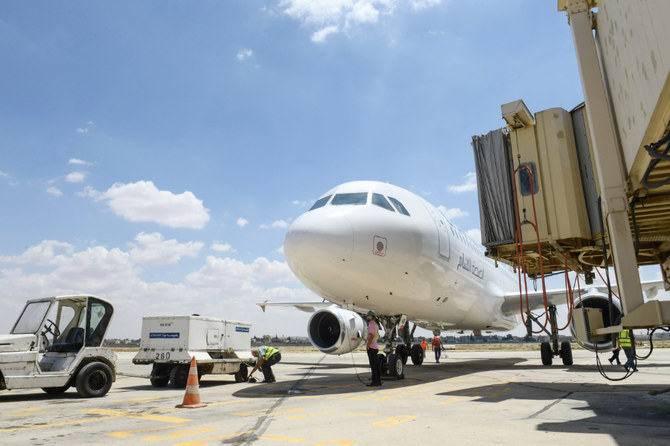
The attack — which occurred around 2:00 am (2300 GMT) — put the country’s main airport out of service, according to Syria’s state news agency SANA.
Israel carried out the strike with “barrages of missiles, targeting Damascus International Airport and its surroundings,” a military source told SANA, which reported that two Syrian soldiers were killed.
But the Britain-based Syrian Observatory for Human Rights — which relies on a wide network of sources on the ground in Syria — said a total of four people had died in the early morning attack.
“Four fighters including two Syrian soldiers were killed” by the Israeli strike, Rami Abdul Rahman, head of the Observatory, told AFP.
The missiles also hit “positions for Hezbollah and pro-Iranian groups inside the airport and its surroundings, including a weapons warehouse,” Abdul Rahman said.
Since civil war broke out in Syria in 2011, Israel has carried out hundreds of air strikes against its neighbor, targeting government troops as well as allied Iran-backed forces and fighters from Lebanon’s Shiite militant group Hezbollah.
While Israel rarely comments on specific reports of its attacks, it has repeatedly said it will not allow its archfoe Iran to gain a foothold in Syria.
Monday’s strike comes days after the head of the Israel Defense Forces Operations Directorate, Major General Oded Basiuk, presented the army’s operational outlook for 2023.
“We see that our course of action in Syria is an example of how continuous and persistent military action leads to shaping and influencing the entire region,” said tweets from the IDF on Basiuk’s presentation.
“We will not accept Hezbollah 2.0 in Syria.”
The airport is in a region south of Damascus where Iran-backed groups, including Hezbollah, regularly operate.
The last time the airport was out of service was in June 2022 — also after an Israeli missile strike.
The runway, control tower, three hangars, warehouses and reception rooms were badly damaged in that attack — forcing the airport to close for about two weeks and flights to be suspended.
Just as in Monday’s attack, the Observatory said at the time that the strikes had targeted nearby warehouses used as weapons depots by Iran and Hezbollah.
The conflict in Syria started with the brutal repression of peaceful protests and escalated to pull in foreign powers and global jihadists.
About half a million people have been killed, and the conflict has forced around half of the country’s pre-war population from their homes.
Though hostilities have largely abated in the last three years, sporadic fighting at times breaks out and jihadist attacks continue, mainly in the east of the country.
In 2022, Syria experienced its lowest yearly death toll since the conflict started over a decade ago.
At least 3,825 people died in Syria’s war in 2022, according to figures compiled by the Observatory — down from the previous year’s 3,882.
Among those killed in 2022 were 1,627 civilians, including 321 children, the Observatory said.

Israeli strike on Damascus airport kills 4 fighters: monitor
https://arab.news/m4nqj
Israeli strike on Damascus airport kills 4 fighters: monitor
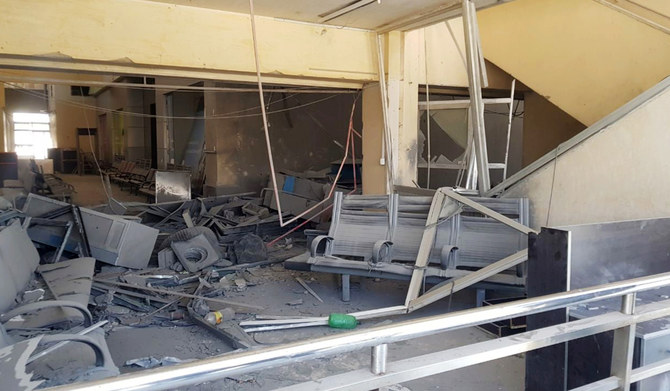
- On June 10, Israeli airstrikes that struck Damascus International Airport caused significant damage to infrastructure and runways. It reopened two weeks later after repairs
- Air traffic has returned after we restored work on one of the runways, while the process of repairing the second runway continues
Aoun hails disarmament progress: ‘Lebanon achieved in 1 year what it had not seen in 4 decades’
- President Joseph Aoun highlights achievements during first year in office despite many challenges
- Army announced this month it had successfully disarmed Hezbollah in the south of the country
BEIRUT: Lebanese President Joseph Aoun confirmed on Tuesday that the country’s armed forces “are now the sole operational authority south of the Litani River, despite doubts, accusations of treason, insults and slander.”
Speaking at the Presidential Palace in Baabda during a traditional New Year meeting with members of the diplomatic corps and the heads of international missions, he highlighted what he viewed as Lebanon’s achievements since he took office on Jan. 9, 2025.
The government’s approval in August and September last year of plans to bring all weapons in the country under state control, and ensure the authority of the state across all Lebanese territory using its own forces, was “no minor detail,” he said.
“Lebanon achieved in one year what it had not seen in four decades,” he added, as he recalled taking office in a “deeply wounded state” that has suffered decades of institutional paralysis and economic crises.
Despite campaigns of distortion, intimidation and misinformation, and Israel’s failure to abide by the November 2024 ceasefire agreement, the changed reality on the ground over the past 12 months speaks for itself, he said.
“The truth is what you see, not what you hear,” Aoun said, pointing out that “not a single bullet was fired from Lebanon during my first year in office, except for two specific incidents recorded last March, the perpetrators of which were swiftly arrested by official authorities.”
The army carried out “extensive operations” to clear large areas of the country of illegal weapons regardless of who controlled them, the president continued, in line with the terms of the Nov. 27 ceasefire agreement with Israel, which he described as “an accord Lebanon respects and that was unanimously endorsed by the country’s political forces.”
These efforts reflected a determination to spare the country a return to the “suicidal conflicts that have come at a heavy cost in the past,” he added.
Aoun stressed his commitment during the second year of his presidency to restoring control of all Lebanese territory to the exclusive authority of the state, securing the release of prisoners, and the reconstruction of war-ravaged areas.
He said that southern Lebanon, like all of the country’s international borders, would fall under the sole control of the Lebanese Armed Forces, putting a definitive end to any attempts “to draw us into the conflicts of others, even as those same parties pursue dialogue, negotiations and compromises in pursuit of their own national interests.”
The Lebanese Army Command announced early this month the completion of the first phase of its plans to disarm nonstate groups south of the Litani River. The government is now awaiting an army report next month detailing its next steps.
Gen. Rodolphe Haykal, the army’s commander, has said that the plan “does not have a specific time frame for completing this phase, which encompasses all Lebanese regions.”
A Lebanese official confirmed to Arab News that the army now has exclusive control of territory south of the Litani River, and no other armed forces or military factions have a presence there.
Aoun’s affirmation of his determination to “stay on course” came two days after Hezbollah leader Naim Qassem gave a sharply worded speech that delivered both implicit and explicit rebukes aimed at the president and Foreign Minister Youssef Raji.
His criticisms focused on their efforts to take control of weapons north of the Litani River, following a declaration by Aoun that “the time for arms is over,” a position that Hezbollah vehemently rejects in what appears to be an attempt to derail the gradual, phased disarmament strategy embraced by the Lebanese government and the international community.
Progress in the efforts of the military to take control of all weapons in the country hinges on securing vital logistical support for the country’s armed forces, a condition tied to the International Conference for Supporting the Lebanese Army and Internal Security Forces, which is due to take place on March 5 in Paris.
Aoun told the diplomats that the conference is the result of efforts led by the international Quintet Committee supporting Lebanon: the US, Saudi Arabia, France, Qatar and Egypt.
Archbishop Paolo Borgia, the papal ambassador to Lebanon, speaking in his role as dean of the diplomatic corps, said that the current crisis in the country serves “as a harsh test” that must remind political leaders of their duty to prevent history from repeating itself.
He called for respect for all electoral processes as a vital part of any nation’s democratic life, and for “genuine peace without weapons, one that can disarm enemies through the convincing power of goodness and the strength of meeting and dialogue.”
He added: “Those holding the highest public offices must give special attention to rebuilding political relationships peacefully, both nationally and globally, a process grounded in mutual trust, honest negotiations and faithful adherence to commitments made.”