

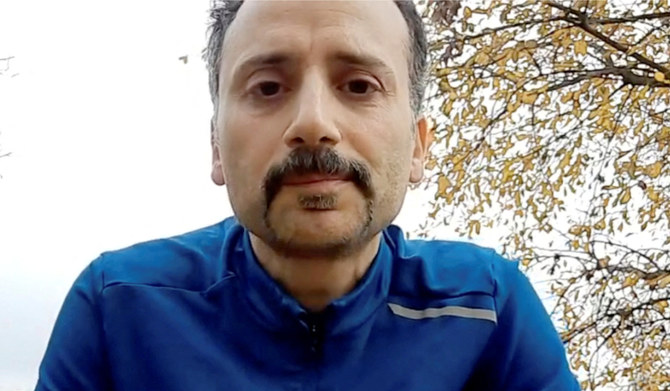

PARIS: When a 38-year-old man anguished over the protests in Iran took his own life in the French city of Lyon, fellow members of the Iranian diaspora felt his pain.
Three months into the anti-regime protests, Iranians abroad are going through a spectrum of emotions.
Activists and counselors hope Mohammed Moradi’s desperate act this week inspires others to reach out for help and to raise awareness of what is happening in Iran.
In videos in Farsi and French recorded before his death, Moradi criticized Iran’s leadership and called for solidarity from Western governments against it. The recordings featured him saying, “When you see this video, I will be dead.”
The Iranian Kurdish man arrived in France in 2019 with his wife and was pursuing a PhD in history.
BACKGROUND
Many members of the Iranian diaspora have experienced distress since the unprecedented protests began, sparked by the death of 22-year-old Mahsa Amini in September.
His death on Monday resonated near and far.
Other Iranians in the Lyon region, activists and friends brought flowers and candles to the site where he died in what police were investigating as an an apparent suicide.
Many members of the Iranian diaspora have experienced distress since the unprecedented protests began, sparked by the death of 22-year-old Mahsa Amini in Iranian police custody in September.
Police had detained Amini for allegedly violating Iran’s strict dress code for women.
“Mohammed Moradi is the image of all of us, what we live today, as the Iranian diaspora across the world,” Hengameh Yahyazadeh, said the lead organizer of solidarity protests against Iran’s clerics in the French city of Toulouse.
Moradi’s Instagram profile tells of a person interested in literature, poetry and politics.
Like many Iranians abroad, he took to Instagram to relay messages criticizing the regime’s clerical rule, chronicling his participation in demonstrations in Lyon, and expressing his indignation at the treatment of protesters in Iran.
The feeling is widespread.
“Some days I wake up and I’m scared,” Yahyazadeh said.
“I have a dozen friends in Iranian prisons, I’m scared of knowing how I will face the possible news that one of my friends was executed.”
Since the start of the protests, at least 507 protesters have been killed and more than 18,500 people have been arrested, according to Human Rights Activists, a group in Iran that has closely monitored the unrest.
Iranian authorities have not released figures for those killed or arrested.
A dozen people are also facing the death penalty for their involvement in the protests.
Hanae El-Bakkali, a psychotherapist who heads a France-based organization that works with migrants, says the news from back home has caused many Iranians in the diaspora to experience “decompensation,” a psychological state that results from being unable to process stressful events.
“When important events are happening back home, it reactivates past trauma, it pressurizes parts that are buried, that one thought they left on the side but actually didn’t,” said El-Bakkali told the AP.
“People relive what they experienced back home through flashbacks. They can have nightmares, looping thoughts, trouble sleeping, memory issues, anxious and depressive symptoms, and might harm themselves.”
As a result, those who become militant abroad “advocate with a deteriorated psychological state,” El-Bakkali said.
A prominent Iranian Kurdish activist in London, Halaleh Taheri, hopes Moradi’s death will encourage those experiencing distress to come together and to get involved politically.
“His name is with all of the people lost in the revolution,” said Taheri, who took part in the 1979 revolution against the shah of Iran and then fought against the clerics’ rule before she had to go into exile.
She is the founder of MEWS, a London-based charity advocating for the rights of women from the Middle East in the UK.
“I am hoping that in the future, instead of sacrificing blood and ourselves and our life, we just fight against the Iranian regime by helping each other, uniting, showing solidarity, working in groups, in networks, raising awareness about Iran,” Taheri said.
“The country needs us as well,” she said.
“We all know that there’s so much pain in our country, and we want to be part of this release. That’s why we are out in the streets.”


