

Pakistan court frees convicted rapist after deal to marry victim

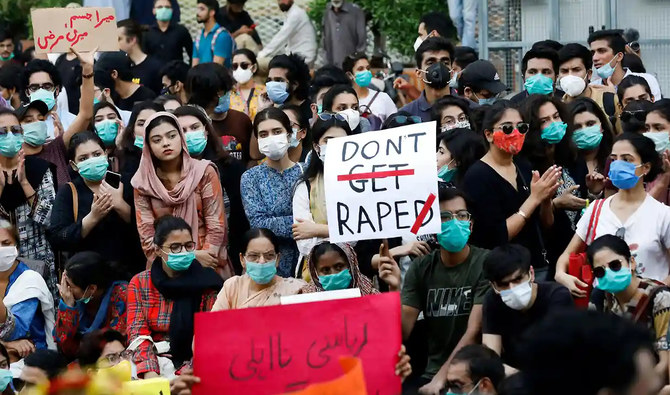
Members of civil society groups take part in a rally to condemn the incident of rape on a deserted highway, in Karachi, Pakistan, on September 12, 2020. (REUTERS)
Short Url
Updated 28 December 2022
Follow

Pakistan court frees convicted rapist after deal to marry victim

  • Decision has outraged rights activists who say it legitimizes sexual violence against women
  • In Pakistan, the conviction rate for rape is lower than three percent of cases that go to trial

PESHAWAR: A Pakistan court freed a rapist after he married his victim in a settlement brokered by a council of elders in the northwest of the country, his lawyer said Wednesday. 

The decision has outraged rights activists, who say it legitimises sexual violence against women in a country where a majority of rape cases go unreported.  

Dawlat Khan, 25, was sentenced in May to life imprisonment by a lower court in Buner district of Khyber Pakhtunkhwa province for raping a deaf woman. 

He was released from prison on Monday after the Peshawar High Court accepted an out-of-court settlement agreed by the rape survivor's family. 

"The rapist and the victim are from the same extended family," Amjad Ali, Khan's lawyer, told AFP. 

"Both families have patched up after an agreement was reached with the help of local jirga (traditional council)," he added. 

Khan was arrested after his unmarried victim delivered a baby earlier this year, and a paternity test proved he was the child's biological father. 

Rape is notoriously difficult to prosecute in Pakistan. According to the Asma Jahangir Legal Aid Cell – a group providing legal assistance to vulnerable women – the conviction rate is lower than three percent of cases that go to trial. 

Few cases are reported because of the associated social stigma, while lapses during investigations, shoddy prosecutorial practices, and out-of-court settlements also contribute towards abysmal conviction rates. 

"This is effectively the court's approval of rape and facilitation of rapists and rape mentality," Imaan Zainab Mazari-Hazir, a lawyer and human rights activist, said of the Peshawar court decision. 

"It is against the basic principles of justice and the law of the land which does not recognise such an arrangement," she told AFP. 

The Human Rights Commission of Pakistan said it was "appalled" by the ruling. 

"Rape is a non-compoundable offence that cannot be resolved through a feeble 'compromise' marriage," the group tweeted. 

In rural Pakistan, village councils known as jirgas or panchayats are formed of local elders who bypass the justice system, although their decisions have no legal value. 


Pakistan to begin first phase of Hajj 2026 trainings from today

Updated 31 December 2025
Follow

Pakistan to begin first phase of Hajj 2026 trainings from today

  • Training programs to be held in phases across Pakistan till February, says religion ministry
  • Saudi Arabia allocated Pakistan a total quota of 179,210 pilgrims for Hajj 2026

ISLAMABAD: Pakistan’s religious affairs ministry has said that it will begin the first phase of mandatory Hajj 2026 training for pilgrims intending to perform the pilgrimage from today, Thursday.

The one-day Hajj training programs will be held in phases across the country at the tehsil level until February. The ministry directed intending pilgrims to bring their original identity cards and the computerized receipt of their Hajj application to attend the training sessions.

“Pilgrims should attend the one-day training program according to their scheduled date,” Pakistan’s Ministry of Religious Affairs (MoRA) said in a statement.

The ministry said training schedules are being shared through the government’s Pak Hajj 2026 mobile application as well as via SMS. It added that details of the schedule are also available on its website.

According to the ministry, training programs will be held in Abbottabad on Jan. 2; Ghotki, Thatta and Kotli on Jan. 3; and Tando Muhammad Khan and Khairpur on Jan. 4.

Hajj training sessions will be held in Rawalakot, Badin and Naushahro Feroze on Jan. 5, while pilgrims in Fateh Jang, Dadu and Tharparkar will receive the training on Jan. 6.

The ministry said training programs will be conducted in Umerkot and Larkana on Jan. 7, followed by sessions in Mirpurkhas, Shahdadkot and Mansehra on Jan. 8.

Pakistan’s religious affairs ministry has previously said these trainings will be conducted by experienced trainers and scholars using multimedia.

It said the training has been made mandatory to ensure that intending pilgrims are fully aware of Hajj rituals and administrative procedures.

Saudi Arabia has allocated Pakistan a quota of 179,210 pilgrims for Hajj 2026, of which around 118,000 seats have been reserved under the government scheme, while the remainder will be allocated to private tour operators.

Under Pakistan’s Hajj scheme, the estimated cost of the government package ranges from Rs1,150,000 to Rs1,250,000 ($4,049.93 to $4,236), subject to final agreements with service providers.