

Pakistan’s Netline says designing solar projects for $500 billion Saudi NEOM zero-carbon city

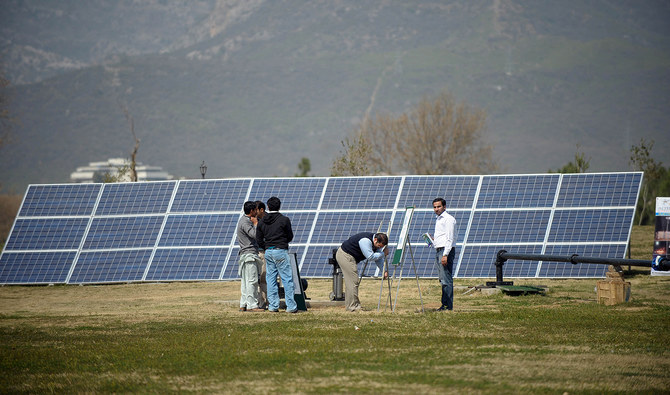
In this file photo taken on March 10, 2012, Pakistani company employees arrange solar panels for a marketing demonstration in a park in Islamabad. (Photo courtesy: AFP/File)
Short Url
Updated 27 December 2022
Follow

Pakistan’s Netline says designing solar projects for $500 billion Saudi NEOM zero-carbon city

  • NEOM is part of Vision 2030 reform plan, which aims to diversify Saudi Arabia's economy away from oil
  • Netline CEO says company has initially acquired a $3 million project to design NEOM’s electrical system

KARACHI:  Netline, a Pakistani critical power and energy solutions provider, is designing solar projects for the zero-carbon city that Saudi Arabia plans to build at NEOM, a company official said on Monday.

Saudi Crown Prince Mohammed bin Salman announced plans for the $500 billion NEOM business zone in 2017 as part of his Vision 2030 reform plan, which aims to diversify Saudi Arabia's economy away from oil. Saudi Arabia, the world's biggest crude exporter, aims to reach "net zero" greenhouse gas emissions by 2060.

The zero-carbon city at NEON, known as “The Line,” would extend over 170 km (105 miles) and be able to house a million residents in “carbon-positive urban developments powered by 100% clean energy.”

“The energy demand to power NEOM is around 20 gigawatts,” Umair Zavary, Group Director for Netline Group of Companies, told journalists in Karachi on Monday. “We are partnering with different companies, which are contractors in NEOM, for backend consultation, designing, and auditing of the project from Pakistan under an agreement that was signed last month.” 

Zavary said the company had initially acquired a $3 million project to design NEOM’s electrical system.

NetLine, a family-owned business in the energy and power sector, recently secured Series A funding at a $4.5 million valuation of the company’s energy business. Though the amount of funding was not disclosed, the company’s director said it would substantially support enhancing a footprint in Saudi Arabia and the UAE where an office has already been set up for global outreach with supply chain partners.

 “In February next year, we are going to Riyadh to grow more business and look for more partners and opportunities,” Zavary said, expressing hope that Pakistani engineers and experts would also go to the kingdom for installation purposes in the next phase. 

Netline has so far installed solar systems with a power generation capacity of over 10 MW at around 400 locations across the country. 

The company now plans to utilize its funding to expand and set up offices in other parts of the country and enhance manpower, install charging points for electric vehicles, and start solar panel manufacturing in Pakistan. 

“We are planning to start production of solar panels in the third or fourth quarter of the next year, 2023, at an estimated cost of $3.5 million in the first phase,” Uzair Zavary, another group director, said. 

The company plans to produce 180 MW solar panels in a joint venture with a Turkish company for which the manufacturing facilities have been acquired on the outskirts of Islamabad, he added.

By 2026, the company also plans to mine Quartz, a crystalline mineral composed of silica that is used for solar panel manufacturing.

To cut reliance on imported fossil fuel, Pakistan plans to increase the share of clean energy to 60% in its energy mix by 2030. Currently, the share of renewable energy is only about 4%, according to government data.

Pakistan’s energy imports during the last fiscal year were $23.3 billion, 29% of the country's total imports. During the current fiscal year, the country imported energy products worth $7.7 billion, according to the Pakistan Bureau of Statistics (PBS).


In Pakistan’s Bannu, people start their day with a sugar rush

Updated 5 sec ago
Follow

In Pakistan’s Bannu, people start their day with a sugar rush

  • While much of Pakistan favors savory breakfasts, residents of Bannu prefer a sweet, caramelized halwa
  • People line up before sunrise at the decades-old Speen Sar restaurant to cherish its signature dish

BANNU, Pakistan: Before sunrise, the narrow lane outside Speen Sar, a modest restaurant, fills with customers waiting for halwa, a dense sweet made from wheat starch, sugar and clarified butter, that serves as breakfast for many people in this northwestern city.

Inside the restaurant’s kitchen, the morning air is thick with the scent of caramelized sugar and heated ghee. A chef leans over a large metal vat, dissolving sugar into the hot fat before adding a slurry of flour and water. With rhythmic, heavy strokes, he stirs the mixture until it thickens into a glossy halwa.

He pours the sweet onto a tray and rushes toward the counter, where a crowd of patrons has already gathered. Three cooks work in quick succession to keep pace with demand, turning out batch after batch during the breakfast rush in Bannu, a city in Pakistan’s Khyber Pakhtunkhwa province.

While halwa is widely eaten as a dessert or festival sweet across South and Central Asia and the Middle East, Bannu stands apart for turning it into a morning staple. Across most of Pakistan, breakfast tends to be savory, typically consisting of omelets, parathas or puris, and in some places nihari, a slow-cooked meat stew. Here, however, halwa is not a side dish but the meal itself, eaten plain or with bread before the workday begins.

“We open the shop at the time of morning prayer, and after prayer, we start preparing,” says Zahid Khan, whose grandfather Akbar Ghulam opened the restaurant over six decades ago.

The shop’s name, Speen Sar — Pashto for “white-haired man” — dates back to its earliest days. Khan said the business began as a small stall run by his grandfather. As he grew older and his hair turned white, customers began directing others to the “speen sar” shop, the place where the white-haired man sold halwa. The nickname endured, eventually becoming the shop’s official identity.

Speen Sar relies on a labor-intensive process of extracting starch from wheat flour.

“In our halwa, we use ghee, sugar, flour and other ingredients. From the flour, the starch that comes out is what we use to make the halwa,” Khan explained before examining the cooking process in his kitchen.

Bannu sits at the crossroads between Pakistan’s former tribal areas and the settled plains of the northwest, and the halwa shop serves as a rare social equalizer, drawing laborers, traders, students and travelers to the same counter each morning. For many passing through the city, stopping for halwa is not optional.

“Whenever I come from Waziristan ... the first thing I do is start with halwa,” says Irafullah Mehsud, an expatriate worker. “I eat the halwa first, and only then move on to other things.”

The popularity of the dish is partly due to its shelf life and to what the owners call good quality. At Rs500 ($1.80) per kilogram, it is an affordable luxury as well.

“Our halwa is widely consumed with breakfast, and it does not spoil quickly. If you want, that you will eat it tomorrow, you can even set some aside for the next day,” Khan said, pointing to a tray of nishasta halwa, a variety made by extracting wheat starch before cooking.

While the region offers variations including sohan halwa, milk-based recipes, and carrot-infused batches, this halwa offered by Speen Sar remains the undisputed king of the breakfast table in this city.

“This is a tradition of the people of Bannu. Early in the morning, everyone eats it and comes here,” says Razaullah Khan, a student at a local college. “Eating halwa is a common practice here ... but this one is the most popular. People eat it for breakfast.”

For the elders of the city, the habit is as much about routine as it is about flavor.

“This tradition has been going on for the past forty to fifty years ever since I can remember,” says Sakhi Marjan, a local elder in his late sixties. “We first come to the Azad Mandi market and then come here to eat halwa. We really enjoy this halwa. It is delicious.”

As the sun rises over Bannu, this ‘sweet’ trade shows no sign of slowing. For those like Gul Sher, a regular from Jani Khel, a town in a neighboring tribal district, a day without the local sweet is a day started wrong.

“As soon as I step into Bannu, I start my day with halwa. After that, the rest of the day goes well,” Sher said before finishing his plate of halwa.

“It is a sweet dish, and it makes the day better. It is a good thing.”
