

Pakistan troops search for perpetrators after 6 soldiers killed in multiple attacks in southwest

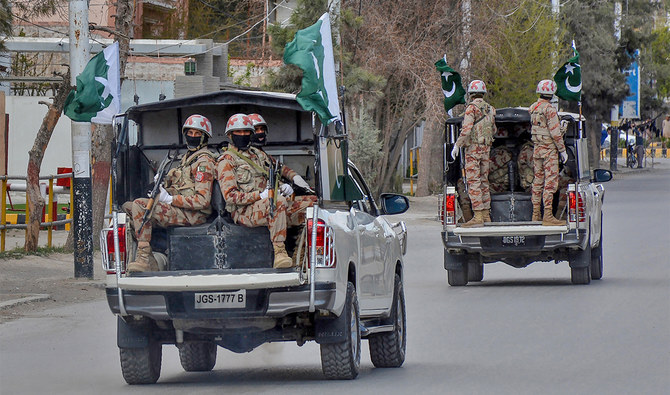
Security personnel patrol with vehicles in Quetta, Pakistan on March 25, 2020. (AFP/File)
Short Url
Updated 26 December 2022
Follow

Pakistan troops search for perpetrators after 6 soldiers killed in multiple attacks in southwest

  • A total of nine attacks took place in Balochistan province on Sunday
  • Pakistani Taliban have stepped up attacks across Pakistan since November

QUETTA: Pakistani forces on Monday expanded their search for the perpetrators behind multiple attacks that killed six troops and wounded 17 civilians in a restive southwestern province the previous day.

The top government official in the southwestern Balochistan province, Abdul Aziz Uqaili, said there a total of nine attacks in the province on Sunday. No civilians were killed in the attacks, he tweeted. Prime Minister Shahbaz Sharif condemned the violence in Balochistan.

Earlier, the military in a statement said five soldiers, including an army captain, were killed when a roadside bomb exploded near a security forces’ vehicle during a clearance operation in Kahan, a remote area in Balochistan bordering Afghanistan. No militant group has claimed responsibility for the bombing.

The sixth soldier was killed in a shootout with the Pakistani Taliban in the Sambaza area of Zhob district, according to Azfar Mohesar, a senior police official. A militant was also killed in the shootout, he said.

In the provincial capital of Quetta, 12 people were wounded when assailants threw a hand grenade in a bazaar near a residential area, Mohesar added. Elsewhere in Balochistan, five people were wounded in attacks in the towns of Kalat, Khuzdar and Hub.

The Pakistani Taliban — known also as Tehrik-e-Taliban Pakistan or TTP — have stepped up attacks across Pakistan since November, when they unilaterally ended a cease-fire after accusing the military of violating the truce.

The militant group is an ally of the Afghan Taliban, who seized power in neighboring Afghanistan last year as US and NATO troops were in the final stages of their pullout. The Taliban takeover in Afghanistan has emboldened the Pakistani Taliban.

Also, unrelated to TTP, separatists in Balochistan have long waged a low-level insurgency seeking independence from the central government in Islamabad.


Pakistan launches digital cash aid for low-income families during Ramadan, PM says

Updated 19 February 2026
Follow

Pakistan launches digital cash aid for low-income families during Ramadan, PM says

  • Ramadan relief moves from state-run Utility Stores to targeted digital wallet transfers
  • Government to transfer financial assistance through wallets to support sehri, iftar expenses

ISLAMABAD: Pakistan will provide financial assistance to low-income households through digital wallets during the fasting month of Ramadan, Prime Minister Shehbaz Sharif said on Thursday, announcing a government relief initiative aimed at helping families afford daily meals.

The support program comes as many Pakistanis continue to face elevated food and utility costs despite easing inflation, with Ramadan traditionally increasing household spending on staple foods, fruits and energy consumption.

For decades, government-run Utility Stores Corporation outlets were central to Ramadan relief in Pakistan, selling subsidized flour, sugar, ghee and pulses through special “Ramzan packages” that drew long queues in low-income neighborhoods. In recent years, however, authorities have steadily scaled back the system amid mounting losses, corruption complaints and logistical inefficiencies, shifting instead toward targeted cash transfers delivered through digital wallets and banking channels. 

The change reflects a broader policy move away from state-managed commodity distribution toward direct financial assistance intended to give households flexibility while reducing leakages in subsidy programs.

“The Government of Pakistan has launched a Ramadan package under which financial assistance will be transferred to deserving individuals through digital wallets so that households can maintain sehri and iftar meals,” Sharif said in a message issued by his office.

The prime minister said Ramadan encourages compassion and collective responsibility toward vulnerable segments of society, adding that welfare support was part of the state’s duty during the holy month.

Officials say the digital cash transfers approach improves transparency and reduces corruption risks while enabling faster payments nationwide, particularly in urban low-income communities.

But the shift to fully digital assistance also brings challenges. 

Access to smartphones and reliable mobile Internet remains uneven, particularly in rural areas and among older recipients, while many low-income households use SIM cards registered to someone else, complicating verification.