

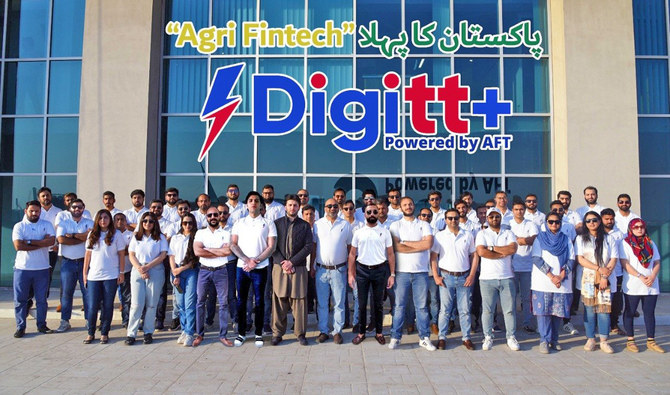

KARACHI: Pakistan’s first agriculture fintech, Digitt+, is all set to improve access of the country’s unbanked farmers to financial services and will go live within the next two weeks, the CEO of the firm said on Monday.
The State Bank of Pakistan last week formally granted approval to the pilot launch of Digitt+ as an Electronic Money Institution (EMI) powered by Akhtar Fuiou Technologies (AFT).
Digitt+ is supported by Fuiou Payment Service, a Shanghai-based company that provides domestic and cross-border payment services for merchants and financial institutions.
Pakistan has the third largest unbanked adult population globally, with about 100 million adults without a bank account in a population of 220 people, according to the World Bank. Pakistan’s agriculture sector contributes 22.7 percent to the GDP and provides employment to around 37.4 percent of the labor force.
“This is a farmers lifestyle app that is going to ease the life of farmers through the digitization of the country’s agricultural ecosystem,” Ahmed Saleemi, the CEO of Digitt+, told Arab News on Monday. “Farmers will now avail almost all financial services, including payment of utility bills, purchase of fertilizers, and credit at their threshold through digital means.”
The CEO said the pilot would be launched in the next two weeks, and would give around 10,000 people, mostly farmers, the opportunity to avail financial services as per the requirements of the central bank.
The services will start from Dera Ismail Khan, a district in Khyber Pakhtunkhwa province as well as Muzaffargarh and Kanjwani in Punjab where the country’s major sugar mills are located.
“We are using technology to develop innovative digital financial products focusing on micro services to build a comprehensive platform that will enable the delivery of these solutions to a wide range of users, not only for the retail Agri market but for the corporate sector as well,” Saleemi said.
Currently Pakistani farmers take credit from the informal sector, including from middlemen who mostly charge interest in the range of 60-70 percent. Exposing farmers to the formal digital banking sector would largely minimize the role of the middlemen, resulting in substantial savings.
“Going forward we will opt for a separate license for digital lending where the customers could avail services mostly based on their credit profile,” Saleemi said. “Digital lending would reduce the cost of borrowing.”
Qasim Akhtar Khan, the founder and Chief Strategy Officer of Digitt+, said enhanced access for farmers to digital banking channels would address the country’s food security issues as well.
“The approval from the State Bank of Pakistan is an important milestone in that direction,” Khan said in a statement issued last week. “This effort has the potential to solve food security issues, enhance crop yields, and improve human welfare in Pakistan, directly impacting thousands of farmers and merchants.”
Pakistan’s central bank, as part of financial inclusion efforts, is trying to bridge the divide between the banked and unbanked population, according to the governor of Pakistan’s central bank.
“Leveraging digital technology is essential not only to promote financial inclusion but also to ensure that the industry keeps pace with emerging global trends,” SBP governor Jameel Ahmed said earlier this month while speaking at an event.
“We have made great strides toward improving unique and active bank accounts. Despite this, bank accounts in Pakistan, especially of females, are still quite low compared to our peer countries.”


