Suspected militants kill 17 herders in northeast Nigeria

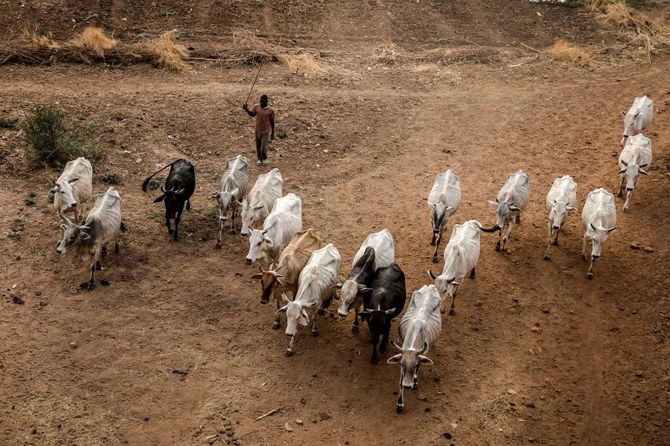
Nigerian herders who pay a levy to the militants are usually allowed to let their cattle graze safely in territory under militant control. (AFP file photo)
Short Url
Updated 26 December 2022
Follow

Suspected militants kill 17 herders in northeast Nigeria

  • Militants attack herders guarding their cattle in a pasture near Airamne village in Mafa district
  • Boko Haram and ISWAP have increasingly been targeting civilians, particularly loggers, farmers and herders

KANO, Nigeria: Boko Haram militants killed 17 herders and stole their cattle following clashes in the troubled northeastern Nigerian state of Borno, self-defense militia said Monday.
The militants on Saturday attacked herders guarding their cattle in a pasture near Airamne village in Mafa district, the militiamen said.
“Seventeen herders were killed in the fight and all their cattle taken away,” militia leader Babakura Kolo said.
“The herders put (up) resistance but were outgunned and outnumbered by the attackers, who had better weapons,” said Kolo.
Another militiaman, Ibrahim Liman, gave the same toll.
He said the militants launched the attack from camps in nearby Gajiganna forest, where they relocated after being partially forced out from their stronghold in Sambisa forest by militant rivals ISWAP and the Nigerian army.
ISWAP — Islamic State West Africa Province — split from Boko Haram in 2016 and rose to become the dominant group in the region’s long-running militant turmoil.
It seized swathes of territory under Boko Haram control after leader Abubakar Shekau was killed in clashes with ISWAP in May last year.
Boko Haram and ISWAP have increasingly been targeting civilians, particularly loggers, farmers and herders, accusing them of spying on them for the military and the local anti-militant militia.
But herders who pay a levy to the militants are usually allowed to let their cattle graze safely in territory under militant control.
Militant violence in the northeast has killed over 40,000 people and displaced around two million from their homes since 2009, according to the United Nations.
The conflict has spilled into neighboring Niger, Chad and Cameroon, prompting the creation of a regional military force to fight the militants.
The killings, abductions and looting in the northeast are part of an overall security crisis in Nigeria.
Voters go to the polls on February 25 to elect a successor to President Muhammadu Buhari, who is stepping down after two terms, the constitutional limit.


Venezuela aims to boost oil output but sanctions stand in the way, VP says

Updated 58 min 21 sec ago
Follow

Venezuela aims to boost oil output but sanctions stand in the way, VP says

  • Sanchez called the recent capture of Nicolas Maduro a “dark day” for the country

DUBAI: Venezuela’s Vice President for Economy Calixto Ortega Sanchez said on Wednesday that his country needed vast foreign investment and sanctions relief to tap its huge oil reserves and restart its ailing economy.

“We know that the reference for Venezuela is that (it is) the country with the biggest oil reserves, and we want to stop being known for this, and we want to be known as one of the countries with the highest production levels,” Sanchez said.

Responding to questions by American journalist Tucker Carlson, Sanchez called the recent capture of Nicolas Maduro a “dark day” for the country but said Venezuela was working to reestablish a relationship with the US, which he described as a “natural partner” for the country.

“The Venezuelan people and authorities have shown that they are ready to peacefully move forward and to build opportunities,” he said during a session at the World Government Summit.

Sanchez, who headed Venezuela’s central bank, said the most pertinent issue facing his country is continued US sanctions.

Despite failing to result in regime change, the sanctions had effectively stifled the economy from growing, he added.

He said the Venezuelan government was now working to reform its laws to allow foreign investment and hoped the US would ease sanctions to aid their work.

“The first decisions that interim President Rodriguez took was to go to the National Assembly and ask for reform to the hydrocarbon law … this law will allow international investors to go to Venezuela with favorable conditions, with legal assurance of their investments,” he added.

“The economy is ready for investment. The economy is ready for the private sector; it is ready to build up a better future for the Venezuelan people.”

Sanchez played down inferences by Carlson that his government had been taken over, insisting that the regime still held authority in the country. He said the country had set up two funds to receive money from oil production that would fund better welfare and social conditions for Venezuelans.

“Allow us to have access to our own assets … we don’t have access to our own money,” he added.

“If you allow us to function like a regular country, Venezuela will show extraordinary improvement and growth.”