Myanmar junta court verdict in Aung San Suu Kyi trial set for Friday

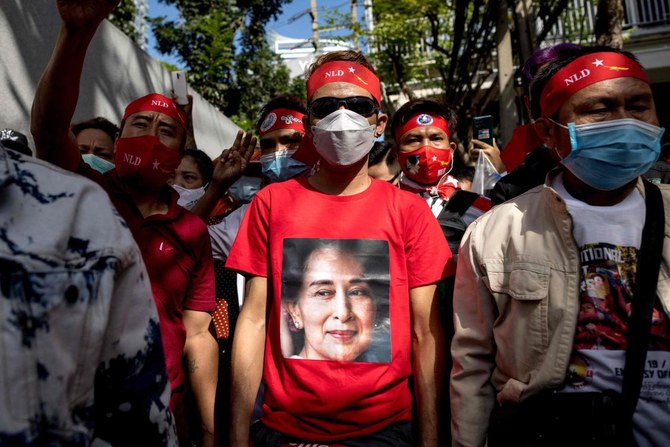
More than 2,600 people have been killed in Myanmar military’s crackdown on dissent, according to a local monitoring group. (AFP)
Short Url
Updated 26 December 2022
Follow

Myanmar junta court verdict in Aung San Suu Kyi trial set for Friday

  • Democracy leader has been a prisoner since military toppled her government in February 2021
  • Nobel laureate already found guilty on 14 charges ranging from corruption to illegally importing walkie-talkies

YANGON: A Myanmar junta court will give its verdicts on five remaining charges in the 18-month trial of jailed civilian leader Aung San Suu Kyi on Friday, a legal source told AFP.

Suu Kyi has been a prisoner since the military toppled her government in February last year, ending the Southeast Asian nation’s brief period of democracy.

The Nobel laureate, 77, has already been found guilty on 14 charges ranging from corruption to illegally importing walkie-talkies and breaching the official secrets act, and has been jailed for 26 years.

“Both sides gave final arguments today at court,” said a source with knowledge of the case on Monday who requested anonymity as they were not authorized to speak to the media.

“There will be a verdict on coming Friday (30th) December.”

Suu Kyi appeared in good health, the source added.

Rights groups have slammed the trial as a sham, and on Wednesday the UN Security Council called on the junta to release Suu Kyi in its first resolution on the situation in Myanmar since the coup.

The resolution marked a moment of relative council unity after permanent members and close junta allies China and Russia abstained, opting not to wield vetoes following amendments to the wording.

The remaining five corruption charges Suu Kyi faces relate to the rental of a helicopter for a government minister, a case in which she had allegedly not followed regulations and caused “a loss to the state.”

Each carries a maximum jail term of 15 years. In previous corruption cases, the court has generally sentenced Suu Kyi to three years per charge.

Suu Kyi is currently imprisoned in a compound in the capital Naypyidaw, close to the courthouse where her trial is being held, and has been deprived of her household staff and pet dog Taichido.

Since the coup, she has largely disappeared from view, seen only in grainy state media photos from the bare courtroom.

The country has been plunged into turmoil, with some established ethnic rebel groups renewing fighting with the military in border areas, and the economy in tatters.

Dozens of “People’s Defense Forces” eschewing Suu Kyi’s strict policy of non-violence have also sprung up to battle the junta and have surprised the military with their effectiveness, analysts say.

There are almost daily killings of low-level junta officials or anti-coup fighters, with details murky and reprisals often following quickly.

Analysts say the junta may allow Suu Kyi to serve some of her sentence under house arrest while it prepares for elections it has said it will hold next year.

The military alleged there was widespread voter fraud during 2020 elections won resoundingly by Suu Kyi’s National League for Democracy party, although international observers said the poll was largely free and fair.

More than 2,600 people have been killed in the military’s crackdown on dissent, according to a local monitoring group.

Rights groups have accused the military of extrajudicial killings and launching air strikes on civilians that amount to war crimes.

The latest civilian death toll issued by the junta stands at over 4,000.


Prabowo, Trump expected to sign Indonesia-US tariff deal in January 2026

Updated 23 December 2025
Follow

Prabowo, Trump expected to sign Indonesia-US tariff deal in January 2026

  • Deal will mean US tariffs on Indonesian products are cut from a threatened 32 percent to 19 percent
  • Jakarta committed to scrap tariffs on more than 99 percent of US goods

JAKARTA: Indonesia expects to sign a tariff deal with the US in early 2026 after reaching an agreement on “all substantive issues,” Jakarta's chief negotiator said on Tuesday.

Indonesia’s Coordinating Minister for Economic Affairs Airlangga Hartarto met with US trade representative Jamieson Greer in Washington this week to finalize an Indonesia-US trade deal, following a series of discussions that took place after the two countries agreed on a framework for negotiations in July.

“All substantive issues laid out in the Agreement on Reciprocal Trade have been agreed upon by the two sides, including both the main and technical issues,” Hartarto said in an online briefing.

Officials from both countries are now working to set up a meeting between Indonesian President Prabowo Subianto and US President Donald Trump. 

It will take place after Indonesian and US technical teams meet in the second week of January for a legal scrubbing, or a final clean-up of an agreement text.

“We are expecting that the upcoming technical process will wrap up in time as scheduled, so that at the end of January 2026 President Prabowo and President Trump can sign the Agreement on Reciprocal Trade,” Hartarto said.  

Indonesian trade negotiators have been in “intensive” talks with their Washington counterparts since Trump threatened to levy a 32 percent duty on Indonesian exports. 

Under the July framework, US tariffs on Indonesian imports were lowered to 19 percent, with Jakarta committing to measures to balance trade with Washington, including removing tariffs on more than 99 percent of American imports and scrapping all non-tariff barriers facing American companies. 

Jakarta also pledged to import $15 billion worth of energy products and $4.5 billion worth of agricultural products such as soybeans, wheat and cotton, from the US. 

“Indonesia will also get tariff exemptions on top Indonesian goods, such as palm oil, coffee, cocoa,” Hartarto said. 

“This is certainly good news, especially for Indonesian industries directly impacted by the tariff policy, especially labor-intensive sectors that employ around 5 million workers.” 

In the past decade, Indonesia has consistently posted trade surpluses with the US, its second-largest export market after China. 

From January to October, data from the Indonesian trade ministry showed two-way trade valued at nearly $36.2 billion, with Jakarta posting a $14.9 billion surplus.