

Pakistan hands over financial compensation to family of taxi driver killed in Islamabad bombing

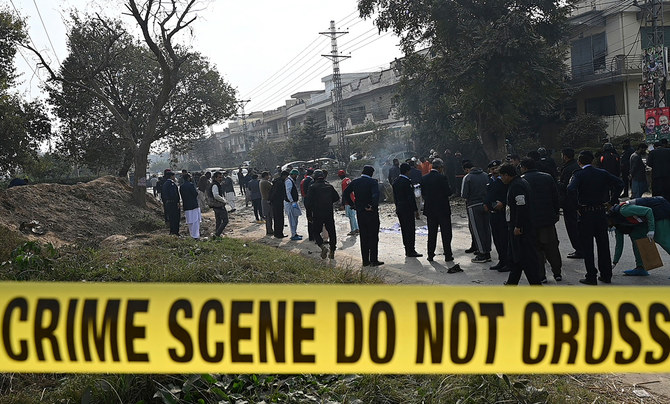
Policemen gather at the suicide blast site in Islamabad on December 23, 2022. (AFP)
Short Url
Updated 25 December 2022
Follow

Pakistan hands over financial compensation to family of taxi driver killed in Islamabad bombing

  • Powerful car bomb detonated in residential area in Islamabad on Friday, killing two suspected militants and a police officer
  • Latest violence comes days after Pakistani Taliban detainees overpowered guards at counterterrorism center in northwest Pakistan

ISLAMABAD: Prime Minister Shehbaz Sharif on Sunday announced a financial package of one crore rupees for the family of a cab driver killed on Friday in an attack in the Pakistani capital.

A powerful car bomb detonated in a residential area in Islamabad, killing two suspected militants and a police officer, police said, raising fears that militants had established a presence in one of the country’s safest cities.

Pakistani Taliban have stepped up attacks on security forces since November, when they unilaterally ended a months-long ceasefire with the country’s government.

"On the instructions of the Prime Minister, the check of the financial package was handed over to the family of Syed Sajjad Haider Shah," a statement from the PM Office said, adding that investigators had concluded Shah had no connection with the terror plot. 

The cab driver belonged to District Chakwal and lived in the garrison city of Rawalpindi, neighbouring Islamabad. He is survived by his wife and four children.

Authorities say Pakistani militants were believed to be on their way to carrying out a suicide bombing in Islamabad's government district when a police pursued the taxi cab they were travelling in.

The interior ministry said the vehicle was on its way towards for a high-value target in the capital, without giving details, while Prime Minister Shehbaz Sharif said timely intervention by the police had averted a "bloodbath."

The car exploded near police headquarters on a main road leading to a government sector where parliament and the offices of senior officials are located. The Pakistani Taliban, or TTP, claimed the car bombing, saying it was revenge for the killing of one of their leaders.

The latest violence comes days after several Pakistani Taliban detainees overpowered their guards at a counterterrorism center in northwestern Pakistan, snatching police weapons and taking three officers hostage.

On Tuesday, Pakistan’s special forces raided the detention center, triggering an intense shootout in which the military later said 25 detainees linked to the Pakistani Taliban were killed in Bannu, a district in the Khyber Pakhtunkhwa province and part of a former tribal region.

Three troops and at least three hostages were killed in that incident.

The government has since stepped up security across the country, based on intelligence reports that the TTP had dispatched fighters to carry out attacks at public places and police stations.

The Pakistani Taliban are separate but allied with the Afghan Taliban, who seized power in neighboring Afghanistan last year as US and NATO troops withdrew after 20 years of war. Since then, top TTP leaders and fighters have been hiding in Afghanistan.


Curfew extended in Gilgit-Baltistan, probe ordered after deadly Khamenei protests

Updated 03 March 2026
Follow

Curfew extended in Gilgit-Baltistan, probe ordered after deadly Khamenei protests

  • At least 15 people were killed in clashes with law enforcement agencies over the weekend in Gilgit-Baltistan
  • Government also announces a de-weaponization campaign, crackdown on hate speech and cybercrime in region

ISLAMABAD: The government in Pakistan’s Gilgit-Baltistan (GB) region on Tuesday extended a curfew in Gilgit district and ordered a judicial probe into violent protests over the killing of Iranian Supreme Leader Ali Khamenei in US-Israeli strikes last week, an official said.

At least 15 people were killed in clashes with law enforcement agencies over the weekend in GB, where protesters torched and vandalized several buildings, including United Nations regional offices, an army-run school, software technology park and a local charity building.

The violence prompted regional authorities to impose curfew in Gilgit and Skardu districts on March 2-4 as officials urged people to stay indoors and cooperate with law enforcers, amid widespread anger in Pakistan, particularly among members of the Shiite minority, over Khamenei’s killing.

On Tuesday, the GB government convened to review the situation and announced the extension of curfew in Gilgit among a number of security measures as well as ordered the establishment of a judicial commission to investigate the weekend violence in the region.

“The government has made it clear that the law will strictly take its course against elements involved in vandalism at government institutions, private properties and incidents of vandalism in Gilgit and Skardu and no kind of mischief will be tolerated,” Shabbir Mir, a GB government spokesperson, said in a statement.

“In view of the security situation, curfew will remain in force in Gilgit, while the decision to extend the curfew in Skardu will be taken keeping the ground realities and the changing situation in view.”

The statement did not specify how long the curfew will remain in place in Gilgit.

Besides the formation of the judicial commission to investigate the violent clashes, the government also decided to launch a large-scale de-weaponization campaign in the entire Gilgit district, for which relevant institutions have been directed to immediately complete all necessary arrangements, according to Mir.

In addition, a crackdown has been ordered on hate speech, spread of fake news and cybercrime.

“The aim of these decisions is to ensure the rule of law, protect the lives and property of citizens and crack down on miscreants,” he said. “Approval has also been given to immediately survey the affected infrastructure and start their restoration work on priority basis.”

Demonstrators in Pakistan’s southern port city of Karachi also stormed the US Consulate on Sunday, smashing windows and attempting to burn the building. Police responded with batons, tear gas, and gunfire, leaving 10 people dead and more than 50 injured.

Pakistani authorities have since beefed up security at US diplomatic missions across the country, including around the US consulate building in Peshawar, to avoid any further violence.