

Journalists in Somalia slam government restrictions, arrests

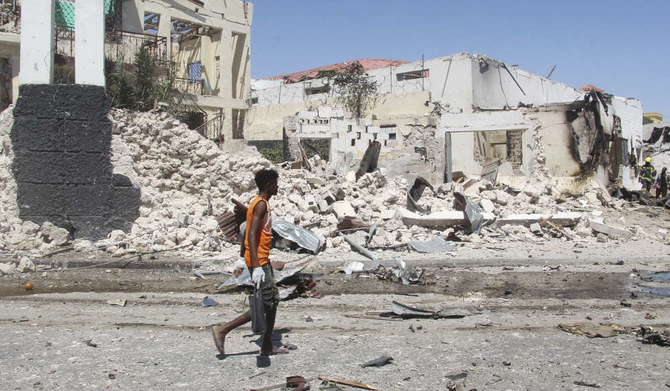
The government has declared an all-out war against Al-Shabab terrorists. (AFP)
Short Url
Updated 24 December 2022
Follow

Journalists in Somalia slam government restrictions, arrests

  • A joint statement by the Somali Journalists Syndicate, the Somali Media Association and Somalia Mechanism for Safety of the Journalists condemned the raid and demanded the journalists’ immediate release

NAIROBI: Journalists in Somalia say the government is further restricting their work amid a significant military offensive against the Al-Shabab extremist group, with a new directive to submit content for approval before publication.
In the latest incident, police in the central state of Hirshabelle detained four media personnel in Beledweyne for reporting that Al-Shabab attacked rural areas after local militias fighting them withdrew over pay issues, media groups said.
Chief editor Mustaf Ali Adow of the independent Radio Hiiraanweyn and three colleagues were detained on Thursday and the station was taken off the air.
A joint statement by the Somali Journalists Syndicate, the Somali Media Association and Somalia Mechanism for Safety of the Journalists condemned the raid and demanded the journalists’ immediate release.

FASTFACT

Media organizations have expressed concern about the new directive by the office of Somali president that instructs media outlets to submit news content for consent before it is aired.

“State security personnel should not use the continuing security operations as a justification to impose restrictions on press freedom,” said Mohammed Ibrahim, president of the Somali Journalists Syndicate.
Media organizations have expressed concern about the new directive by the office of Somali President Hassan Sheikh Mohamud that instructs media outlets to submit news content for consent before it is aired.
Many journalists have denounced the order and said that submitting content for government approval would obstruct editorial independence and the public’s right to know.
“The president’s communication office issued a new order to local news outlets on Saturday demanding they submit their content for permission before any broadcast. We all refused,” said the secretary-general of the Somali Media Association, Mohammed Osman Makaran.
Authorities have not publicly acknowledged the directive.
Since the government declared an all-out war against Al-Shabab earlier this year, there has been growing pressure on local journalists.
The government has said journalists reporting on Al-Shabab’s activities should either go to the scene or abide by authorities’ restrictions.
Abdalla Ahmed Mumin, the secretary-general of the Somalia Journalists Syndicate, an independent journalists’ union based in Mogadishu, was arrested earlier this year after criticizing a government decree telling journalists not to report on Al-Shabab propaganda.
He was later released on bail pending his court hearing on Jan. 4.
Somalia is considered one of the most dangerous places in the world to be a journalist.
According to media watchdogs, journalists face risks including detentions, attacks and threats.


EU warns Meta it must open up WhatsApp to rival AI chatbots

Updated 49 min 11 sec ago
Follow

EU warns Meta it must open up WhatsApp to rival AI chatbots

  • The EU executive on Monday told Meta to give rival chatbots access to WhatsApp after an antitrust probe found the US giant to be in breach of the bloc’s competition rules

BRUSSELS: The EU executive on Monday told Meta to give rival chatbots access to WhatsApp after an antitrust probe found the US giant to be in breach of the bloc’s competition rules.
The European Commission said a change in Meta’s terms had “effectively” barred third-party artificial intelligence assistants from connecting to customers via the messaging platform since January.
Competition chief Teresa Ribera said the EU was “considering quickly imposing interim measures on Meta, to preserve access for competitors to WhatsApp while the investigation is ongoing, and avoid Meta’s new policy irreparably harming competition in Europe.”
The EU executive, which is in charge of competition policy, sent Meta a warning known as a “statement of objections,” a formal step in antitrust probes.
Meta now has a chance to reply and defend itself. Monday’s step does not prejudge the outcome of the probe, the commission said.
The tech giant rejected the commission’s preliminary findings.
“The facts are that there is no reason for the EU to intervene,” a Meta spokesperson said.
“There are many AI options and people can use them from app stores, operating systems, devices, websites, and industry partnerships. The commission’s logic incorrectly assumes the WhatsApp Business API is a key distribution channel for these chatbots,” the spokesperson said.
Opened in December, the EU probe marks the latest attempt by the 27-nation bloc to rein in Big Tech, many of whom are based in the United States, in the face of strong pushback by the government of US President Donald Trump.
- Meta in the firing line -
The investigation covers the European Economic Area (EEA), made up of the bloc’s 27 states, Iceland, Liechtenstein and Norway — with the exception of Italy, which opened a separate investigation into Meta in July.
The commission said that Meta is “likely to be dominant” in the EEA for consumer messaging apps, notably through WhatsApp, and accused Meta of “abusing this dominant position by refusing access” to competitors.
“We cannot allow dominant tech companies to illegally leverage their dominance to give themselves an unfair advantage,” Ribera said in a statement.
There is no legal deadline for concluding an antitrust probe.
Meta is already under investigation under different laws in the European Union.
EU regulators are also investigating its platforms Facebook and Instagram over fears they are not doing enough to tackle the risk of social media addiction for children.
The company also appealed a 200-million-euro fine imposed last year by the commission under the online competition law, the Digital Markets Act.
That case focused on its policy asking users to choose between an ad-free subscription and a free, ad-supported service, and Brussels and Meta remain in discussions over finding an alternative that would address the EU’s concerns.
