

Where We Are Going Today: Quantum Specialty Coffee

Photo by Jasmine Bager
Short Url
Updated 23 December 2022
Follow

Where We Are Going Today: Quantum Specialty Coffee

  • They serve hot and cold sandwiches, cookies, bagels — as well as the usual coffees you'd expect. They have the lattes and the cappaccions and the like from a selection of beans

Upon entering Dhahran’s Tamimi Markets, known locally by its former name, Safeway, you’ll see Quantum Specialty Coffee directly to the left of the entrance.

One of the things I craved most after returning to live in Dhahran after nearly a decade abroad was boba. I struggled to find a good spot locally, so decided to try to make my own — a time-consuming and messy process.

When Quantum Specialty Coffee opened up, I had hope that I could once again sip my favorite dessert in a cup. I could purchase my groceries at the store and then take a boba to-go to sip in the car on the way home after shopping.

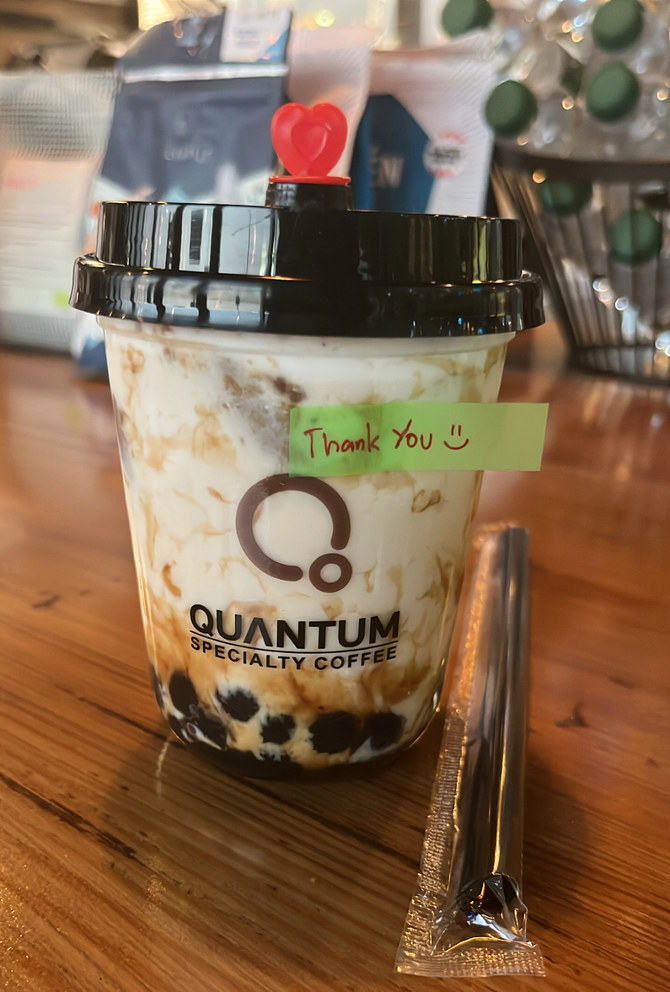
The first time I tried Quantum’s brown sugar boba, it wasn’t a smash hit. The tapioca balls were knotted into one large goopy mess in the bottom of the cup and I had a hard time getting the balls to emerge from the milky liquid.

I thought maybe it was just bad luck so gave it another shot. Since then, they have immensely improved their preparation and now it’s enjoyable. The ration of milk tea to boba is now better, too. It isn’t too sweet nor is it too lumpy. You just need to make sure to shake it a bit before starting on your boba drinking journey.

They have also introduced such boba flavors as watermelon, grape and matcha. I tend to go for the more classic cups.

What is cool about this spot is that they also sell a variety of the popular Eastern European braided bread, babka, in flavors such as the more typical chocolate and cinnamon, but also with a regional twist in varieties such as zataar and cheese.

They also serve hot and cold sandwiches, cookies, bagels — as well as the usual coffees you'd expect. They have the lattes and the cappaccions and the like from a selection of beans.

What is also unique about this cafe is that each visitor is handed a free bottle of water upon ordering. You can sip it and stay hydrated while you wait for your custom drink or your food item.

Visit @quantumcoffeesa on Instagram for more details.


Book Review: ‘Padma’s All American’ Cookbook

Updated 19 December 2025
Follow

Book Review: ‘Padma’s All American’ Cookbook

  • For her, the true story of American food proves that immigration is not an outside influence but the foundation of the country’s culinary identity

Closing out 2025 is “Padma’s All American: Tales, Travels, and Recipes from Taste the Nation and Beyond: A Cookbook,” a reminder that in these polarizing times within a seemingly un-united US, breaking bread really might be our only human connection left. Each page serves as a heaping — and healing — helping of hope.

“The book you have before you is a personal one, a record of my last seven years of eating, traveling and exploring. Much of this time was spent in cities and towns all over America, eating my way through our country as I filmed the shows ‘Top Chef’ and ‘Taste the Nation’,” the introduction states.

“Top Chef,” the Emmy, James Beard and Critics Choice Award-winning series, which began in 2006, is what really got Padma Lakshmi on the food map.

“Taste the Nation,” of course, is “a show for immigrants to tell their own stories, as they saw fit, and its success owes everything to the people who invited us into their communities, their homes, and their lives,” she writes.

Working with producer David Shadrack Smith, she began developing a television series that explored American immigration through cuisine, revealing how deeply immigrant food traditions shaped what people considered American today.

She was the consistent face and voice of reason — curious and encouraging to those she encountered.

Lakshmi notes that Americans now buy more salsa and sriracha than ketchup, and dishes like pad Thai, sushi, bubble tea, burritos and bagels are as American as apple pie — which, ironically, contains no ingredients indigenous to North America. Even the apples in the apple pie came from immigrants.

For her, the true story of American food proves that immigration is not an outside influence but the foundation of the country’s culinary identity.

“If I think about what’s really American … it’s the Appalachian ramp salt that I now sprinkle on top of my Indian plum chaat,” she writes.

In this book Lakshmi tells the tale of how her mother arrived in the US as an immigrant from India in 1972 to seek “a better life.”

Her mother, a nurse in New York, worked for two years before Lakshmi was brought to the US from India. At 4 years old, Lakshmi journeyed alone on the 19-hour flight.

America became home.

Now, with visibility as a model and with a noticeable scar on her arm (following a horrific car accident), she is using her platform for good once again.

Lakshmi is merging her immigrant advocacy with her long career in food media.

The photo of her on the cover, joined by a large American flag, is loud, proud and intentional.

The book contains pages dedicated to ingredients and their uses, actual recipes and, most deliciously, the stories of how those cooks came to be.
