

‘You are crazy like us!’: How Messi superfans resurrected Bangladesh-Argentina ties

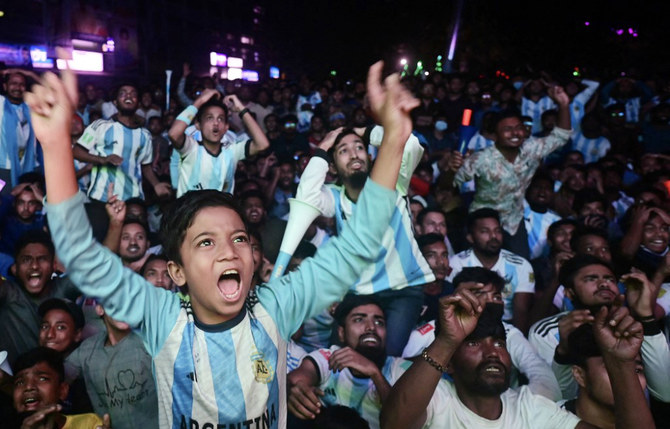
Bangladeshi football fans react as they watch the Qatar 2022 World Cup Group C football match between Poland and Argentina on a big screen in Dhaka on Dec. 1, 2022. (AFP)
Short Url
Updated 24 December 2022
Follow

‘You are crazy like us!’: How Messi superfans resurrected Bangladesh-Argentina ties

  • Bangladeshi support for Argentina during Qatar World Cup made international headlines
  • Argentine FM is expected in Bangladesh in March, ahead of the reopening of Dhaka Embassy

DHAKA: When the outpouring of Bangladeshi support for Argentina went viral during the Qatar World Cup, it brought closer not only football fans in the two countries but also their governments, which are now planning to establish a new bond after a four-decade lull.

Bangladesh’s love for the Argentina team dates back to the 1986 World Cup in Mexico, the first world cup to be screened in color in the South Asian country. Argentina won the tournament with a historic performance of the legendary Diego Maradona, its then captain.

It was Maradona who turned cricket-mad Bangladeshis into Argentine football fans and who had smitten them in a way no other player ever had. It took years for another footballer to win Bangladeshi hearts, and it was also a superstar Argentinian captain: Lionel Messi.


Bangladeshi football fans react as they watch the Qatar 2022 World Cup Group C football match between Poland and Argentina on a big screen in Dhaka on Dec. 1, 2022. (AFP)

As Argentina were proceeding to their 2022 World Cup win, Bangladeshi support for Messi to reach his crowning achievement, a FIFA World Cup trophy, spiked with every game.

Despite chilly winter temperatures, hundreds of thousands of fans in Dhaka and other Bangladeshi cities would gather, waving Argentina flags and wearing the team’s sky blue and white jersey to watch matches on giant screens set up at key squares, roads and football grounds.

Their cheering did not go unnoticed, and after images of Bangladeshi celebrations for the team’s victories at Qatar 2022 went viral, La Albiceleste themselves took to social media to say “Thank you for supporting our team!! You are crazy like us!”

The two countries, thousands of miles away, have little in common, but this year’s World Cup brought them closer together.

As Bangladeshi support for Argentina made headlines worldwide, Argentinians — who traditionally do not watch cricket — took to social media to support the Bangladesh team in its ODI series against India.

And a political development came soon as well: Argentine Foreign Minister Santiago Cafiero announced that the South American nation will renew its ties with Bangladesh and in 2023 will reopen its embassy in Dhaka.

Bangladesh has an ambassador to Argentina in Brazil, while Argentina maintains its ambassador to Bangladesh resident in New Delhi. There has been no direct diplomatic representation since Buenos Aires closed its mission in 1978, only six years after establishing official ties with Dhaka.   

Bangladeshi Foreign Minister A.K. Abdul Momen announced on Thursday that Cafiero is expected to visit Dhaka in March.

“I received a mail this morning about the Argentine foreign minister traveling to Bangladesh,” Momen said during an event in Dhaka, adding that the Argentine team will be also invited.

“We want to shower Messi with the utmost hospitality of our country.”

The news has already sparked enthusiasm in the Bangladeshi football community.
Mohammad Aslam, former captain and striker of the country’s national football team, said the visit would be a “historic moment” that could be a game changer for the country that is currently 192nd in the FIFA Men’s World Ranking.

“If Messi comes here along with the Argentine team, it will…boost football in Bangladesh…For attracting the new generation to football, this visit will create momentum,” he told Arab News, as he already envisioned cooperation involving Argentinian-run training at Bangladesh Krira Shikkha Protisthan, the state-run sports school that has groomed the country’s most iconic athletes.

“If we can appoint the chief football coach from Argentina, under his supervision, our boys will grow and learn the techniques and tactics of football, which will definitely help them play better football. We have all infrastructure there, but finding a competent coach is always difficult.”

Abdul Salam Murshedi, lawmaker and senior vice president of the Bangladesh Football Federation, saw also other aspects of the unexpected mutual attention that the South American and South Asian nations have lately poured on each other.

“With this sports diplomacy, a new horizon of bilateral relations will be explored, which will boost cooperation in terms of business, politics and diplomacy also. I think with this world cup, we can begin a new level of relationship with Argentina,” he said, adding that it also has potential for Bangladesh’s top export industry: textiles.

Bangladesh is already a global major producer of sportswear and a supplier for international brands such as Nike, Adidas and Puma.

“With this visit, we can also explore the opportunities of exporting Argentine football fan jerseys to Argentina since we have all the facilities here as a leading garment exporter to the world market,” Murshedi told Arab News.

“I will say this visit will create a revival of football in our country, which will also boost trade.”


Funerals for people slain in Australian antisemitic mass shooting begin as suspected gunman charged

Updated 8 sec ago
Follow

Funerals for people slain in Australian antisemitic mass shooting begin as suspected gunman charged

SYDNEY: A suspected gunman in Sydney’s Bondi Beach massacre was charged with 59 offenses including 15 charges of murder on Wednesday, as hundreds of mourners gathered in Sydney to begin funerals for the victims.
Two shooters slaughtered 15 people on Sunday in an antisemitic mass shooting targeting Jews celebrating Hanukkah at Bondi Beach, and more than 20 other people are still being treated in hospitals. All of those killed by the gunmen who have been identified so far were Jewish.
Police said that Naveed Akram, the 24-year-old suspected shooter, was charged on Wednesday after waking from a coma in a Sydney hospital, where he has been since police shot him and his gunman father at Bondi. His 50-year-old father Sajid Akram died at the scene.
The charges include one count of murder for each fatality and one count of committing a terrorist act.
Akram was also charged with 40 counts of causing harm with intent to murder in relation to the wounded and with placing an explosive near a building with intent to cause harm.
Police said the Akrams’ car, which was found at the crime scene, contained improvised explosive devices.
Funerals began as a country reeling from its deadliest hate-fueled massacre of modern times turned to searching questions, growing in volume since the attack, about how it was able to happen. As investigations unfold, Australia faces a social and political reckoning about antisemitism, gun control and whether police protections for Jews at events such as Sunday’s were sufficient for the threats they faced.
First, however, was a day of anguish for families from Sydney’s close-knit Jewish community who gathered, one after another, to begin to bury their dead. The victims of the attack ranged in age from a 10-year-old girl to an 87-year-old Holocaust survivor.
A father of 5 who ministered in prisons is buried
The first farewelled was Eli Schlanger, 41, a husband and father of five who served as the assistant rabbi at Chabad-Lubavitch of Bondi and organized Sunday’s Chanukah by the Sea event where the attack unfolded. The London-born Schlanger also served as chaplain in prisons across New South Wales state and in a Sydney hospital.
“After what happened, my biggest regret was — apart from, obviously, the obvious – I could have done more to tell Eli more often how much we love him, how much I love him, how much we appreciate everything that he does and how proud we are of him,” said Schlanger’s father-in-law, Rabbi Yehoram Ulman, who sometimes spoke through tears.
“I hope he knew that. I’m sure he knew it,” Ulman said. “But I think it should’ve been said more often.”
Funerals draw heavy police presence
Outside the funeral, not far from the site of the attack, the mood was hushed and grim, with a heavy police presence. Jews are usually buried within 24 hours from their deaths, but funerals have been delayed by coronial investigations.
One mourner, Dmitry Chlafma, said as he left the service that Schlanger was his longtime rabbi.
“You can tell by the amount of people that are here how much he meant to the community,” Chlafma said. “He was warm, happy, generous, one of a kind.”
Among others killed were Boris and Sofia Gurman, a husband and wife aged in their 60s who were fatally shot as they tried to disarm one of the gunmen when he got out of his car to begin the attack. Another Jewish man in his 60s, Reuven Morrison, was gunned down by one shooter while he threw bricks at the other, his daughter said.
Many children attended the Hanukkah event, which featured face painting, treats and a petting zoo. The youngest killed was Matilda, 10, whose parents urged attendees at a vigil on Tuesday night to remember her name.
“It stays here,” said Matilda’s mother, who identified herself only as Valentyna, pressing her hand over her heart. “It just stays here and here.”
Authorities are probing a suspected connection to the Daesh group
Authorities believe that the shooting was “a terrorist attack inspired by Islamic State,” Australia’s federal police commissioner Krissy Barrett said Wednesday.
The authorities have said that Naveed Akram came to the attention of the security services in 2019 but have supplied little detail of their previous investigations. Now authorities will probe what was known about the men.
That includes examining a trip the suspects made to the Philippines in November. The Philippines Bureau of Immigration confirmed Tuesday that the two suspected shooters traveled to the country from Nov. 1 to Nov. 28, giving the city of Davao as their final destination.
Groups of Muslim separatist militants, including Abu Sayyaf in the southern Philippines, once expressed support for IS and have hosted small numbers of foreign militants from Asia, the Middle East and Europe in the past. Philippine military and police officials say there has been no recent indication of any foreign militants in the country’s south.
The younger suspect was Australian-born. Indian police on Tuesday said the older suspect was originally from the southern city of Hyderabad, migrated to Australia in 1998 and held an Indian passport.
Leader pledges action on guns and antisemitism
The news that the suspects were apparently inspired by DAESH provoked more questions about whether Australia’s government had done enough to stem hate-fueled crimes, especially directed at Jews. In Sydney and Melbourne, where 85 percent of Australia’s Jewish population lives, a wave of antisemitic attacks has been recorded in the past year.
After Jewish leaders and survivors of Sunday’s attack lambasted the government for not heeding their warnings of violence, Prime Minister Anthony Albanese vowed Wednesday to take whatever government action was needed to stamp out antisemitism.
Albanese and the leaders of some Australian states have pledged to tighten the country’s already strict gun laws in what would be the most sweeping reforms since a shooter killed 35 people in Port Arthur, Tasmania, in 1996. Mass shootings in Australia have since been rare.
Albanese announced plans to further restrict access to guns, in part because it emerged the older suspect had amassed six weapons legally. Proposed measures include restricting gun ownership to Australian citizens and limiting the number of weapons a person can hold.
Australians come together to grieve
Meanwhile, Australians seeking ways to make sense of the horror settled on practical acts. Hours-long lines were reported at blood donation sites and at dawn on Wednesday, hundreds of swimmers formed a circle on the sand, where they held a minute’s silence. Then they ran into the sea.
Not far away, part of the beach remained behind police tape as the investigation into the massacre continued, shoes and towels abandoned as people fled still strewn across the sand.
One event that would return to Bondi was the Hanukkah celebration the gunmen targeted, which has run for 31 years, Ulman said. It would be in defiance of the attackers’ wish to make people feel like it was dangerous to live as Jews, he added.
“Eli lived and breathed this idea that we can never ever allow them not only to succeed, but anytime that they try something we become greater and stronger,” he said.
“We’re going to show the world that the Jewish people are unbeatable.”