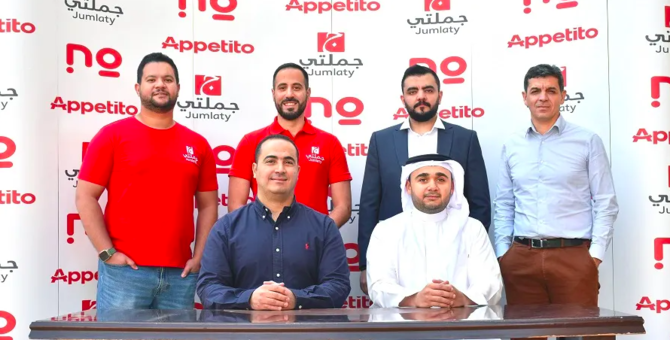
CAIRO: Saudi Arabia-based grocery delivery startup Jumlaty has announced a cross-border merger with Egyptian counterpart Appetito to form a new company NOMU that will be headquartered in Riyadh.
Founded in 2020 by Salman Attieh, Jumlaty provides a grocery delivery platform for consumers and businesses. Appetito was founded in the same year and recently signed a partnership with Saudi-based IT company Purity Information Technology to expand into the Kingdom.
“Appetito and Jumlaty have been, separately but similarly, working hard to reinvent the grocery supply chain. Both have focused on reliability, speed, and affordability, building a solid reputation and a loyal customer base of families and F&B businesses,” CEO of Appetito, Sheham Mokhtar, said in a statement.
Mokhtar will be the CEO of NOMU as he stated that the merger is set to put the company on course to reach $25 million in revenue and achieve a positive earning income by 2023.
Aiming to become the leading foodtech platform in the Middle East and North Africa region, NOMU is currently present in Saudi Arabia, Egypt, Tunisia, and Morocco.
“Together we capture the entire value chain, from monthly shopping to weekly refills and outdoor dining. Most importantly our journey now as one company will be accelerated thanks to an incredible team of international talents and supportive investors,” Attieh, now chairman of NOMU, said in a statement.
The new company will have a holding structure in Abu Dhabi’s International Financial Centre as it plans to expand into Pakistan and sub-Saharan countries in the near future.
Saudi Arabia’s Nama Ventures crafts Muqbis’ pre-seed round
Saudi Arabia-based venture capital firm Nama Ventures has invested in Egypt-based online handicrafts marketplace Muqbis for an undisclosed amount.
Launched in 2021 by Iman El Wasifi, Mohamed Nasser, and Kareem Hussein, Muqbis positions itself as the Etsy of the MENA region providing a platform for local artisans to sell their products online.
“We are super excited to be one of Nama’s Portfolio companies in our first round. Nama is an extraordinary VC that showed a strong belief in what we do and aim to deliver, even before we signed the final agreement for the investment, they bridged all possible ways to support our business growth through recommendations and business matchmaking,” El-Wasifi said in a statement.
Nama Ventures has been one of the most active venture capitals in the region supporting startups in their earliest stages with a focus on investing in pre-seed rounds.
We’ve always wanted to make a bet on ‘the Etsy of Mena’ for a while now, the opportunities are massive and our region enjoys a great deal of artists and talented craftsmen that need the right medium to monetise their craft. Yet we were always challenged in finding the right complementary team to go after the opportunity,” said Mohammed Alzubi, Founder of Nama Ventures.
The funding will support Muqbis in providing the right facilities for their artisans to reach more customers.
Uniting the food and beverage industry
Saudi Arabia’s venture builder Revival Lab signed an investment agreement worth $13.6 million with the Kingdom’s United Investments company to support startups in the food and beverage sector.
Founded in 2022, United Investments supports scalable brands to find market opportunities and seeks to acquire more than 30 F&B companies in Saudi Arabia.
“We seek to strengthen local brands in the food and beverage sector and help build their plans for growth and expansion inside and outside the Kingdom by improving expenditure efficiency and developing operational excellence plans,” Mohammed bin Abdulhadi Al-Qahtani, CEO of United, said in a statement.
Al-Qahtani co-founded Shawarma Hilayel and led its expansion to reach more than 26 branches in addition to 20 other brands with almost 100 branches in total.
“The agreement will provide unique opportunities to support male and female entrepreneurs as the industry shifts to cloud kitchens. It also seeks to develop startups in this field by building an integrated system that supports financial sustainability and good return on investment for investors,” CEO of Revival Lab, Mohammed Al-Maghlouth, stated.
The partnership will aim to encourage the growth of new ventures in the F&B sector in the Kingdom while promoting the shift towards cloud Kitchens.
Supplies simplified by Suplyd
Egypt-based restaurant logistics startup Suplyd secured $1.6 million in a pre-seed funding round led by Endure Capital, Seedstars, Camel Ventures, and Falak Startups.
Established in 2022, the company provides a platform to digitise the procurement supply chain process for hotels, restaurants, and cafes to buy stock directly from suppliers.
“Suplyd offers a smooth purchasing experience, clarity of product availability, guaranteed delivery dates as well as transparent pricing. Coupling that with its useful analytics, reporting, and digital records enables suppliers to handle their complex internal logistics and optimize their assets,” Ahmed El-Mahdy, COO of Suplyd, said in a statement.
The company will utilize its acquired funding to support its tech stack, grow its team, and scale its operations.