

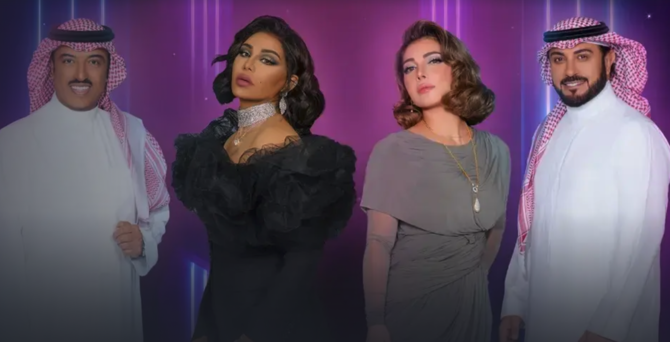
Special moments as the curtain rises on first season of MBC’s Saudi Idol

The opening two episodes included some emotional moments as the would-be stars performed for the judges. (Shahid)
Short Url
Updated 23 December 2022
Follow

Special moments as the curtain rises on first season of MBC’s Saudi Idol

  • The opening two episodes included some emotional scenes as would-be stars auditioned for the four judges in the hope of receiving the votes they needed to progress
  • The show is hosted by Saudi musician Rajeh Alharthi, and the celebrity judges are singers Aseel Abu Bakr, Ahlam Al-Shamsi, Assala Nasri and Majid Al-Mohandes

RIYADH: The first season of MBC’s “Saudi Idol” began this week with a look at the first batches of aspiring singers who auditioned for judges in the hope of being chosen to proceed to the next phase of the contest.

In common with other editions of the reality TV singing competition around the world, hopefuls across a range of musical genres began by auditioning for a panel of expert judges who decided which ones deserved the chance to progress and perform in front of a live audience.

The Kingdom’s version of the show is hosted by musician and TV presenter Rajeh Alharthi, and the celebrity judges are Yemeni singer and composer Aseel Abu Bakr, Emirati singer Ahlam Al-Shamsi, Syrian singer Assala Nasri, and Iraqi singer and composer Majid Al-Mohandes.

The opening two episodes, filmed in Riyadh and broadcast on Tuesday and Wednesday night on MBC1 and MBC Iraq, included some emotional moments as the would-be stars performed for the judges in the hope of receiving the minimum of three “yes” votes they needed to move on to the next phase.

The contestants in the first episode included Lamar Ali from Jizan, Khaled Gharibi from Taif, and Thikra Al-Hadi from Riyadh, all of whom impressed the entire panel of judges and received four yes votes. Issa bin Saleh, 19, progressed with three yeses; the no came from from Al-Shamsi, who said she aimed, through her rejection, to provide the young singer with an incentive to improve.

Saad Al-Kaltham looked to be out of luck when he received two rejections, from Nasri and Al-Shamsi, but was given a second chance to sing again and this time he was voted through to the next stage.

Each contestant had a story to tell about their lives and desire to sing, such as Ali Al-Nimri from Taif, who revealed that he has had health problems. That did not prevent him from impressing most of the judges as he claimed three yes votes, with only Al-Shamsi not convinced that he deserved to proceed.

Rinad Al-Mahdi from Jizan told how she discovered her talent for singing at an early age but her father had insisted that she prioritize her academic studies. She said hoped Saudi Idol would make her dreams come true; she got off to a good start by making it through the first test with four yeses.

The first episode concluded with Abdullah Al-Amiri from Jeddah, who said he comes from a family of artists and plays several musical instruments. He also impressed the whole panel and received four votes of approval.

The auditions continued in Wednesday night’s second episode. Saud Sharif and Monirah Al-Ali progressed with three yeses, while Mouna Khoury, Afnan Abdullah, Fahd Al-Jomhour, Saad Al-Naji, Ziad Lahtha and Ziad Abdul Kader each impressed all four of the judges.

The episode ended on a moving note as contestant Bushra Hammoud, a young woman with hemiplegia, which is paralysis of one side of the body, secured the three yeses she needed to proceed. Only Abu Bakr voted no. Other contestants who made it through included Rakan Al-Harbi, Jaber Othman and Hassan Asiri.

Saudi Idol airs on MBC 1 on Tuesday and Wednesday at 9:30 p.m. in Saudi Arabia and on MBC Iraq at at 11:00 p.m. Iraq time.


BBC slammed for ‘shameful’ cut to ‘free Palestine’ comment at BAFTA Awards

Updated 24 February 2026
Follow

BBC slammed for ‘shameful’ cut to ‘free Palestine’ comment at BAFTA Awards

  • Broadcaster removes from broadcast part of filmmaker Akinola Davies Jr.’s acceptance speech at the British Academy Film Awards
  • Amnesty UK praises filmmaker for speaking up for those ‘facing and fleeing from persecution and mass atrocities’

LONDON: The BBC was accused on Monday of a “shameful” decision after it cut part of an acceptance speech at the previous night’s British Academy Film Awards in which a filmmaker uttered the phrase “free Palestine.”

British-Nigerian director and co-writer Akinola Davies Jr. and his brother, co-writer Wale Davies were collecting the award for outstanding debut by a British writer, director or producer for their film “My Father’s Shadow” when the former made the comment.

The BBC chose not to include the final part of his speech when it broadcast the BAFTAs ceremony later in the evening. However, the corporation did broadcast an inadvertent racist slur shouted by a person with Tourette syndrome while Black actors Michael B. Jordan and Delroy Lindo were presenting an award.

Akinola thanked industry figures and family for their support as he accepted the award, before dedicating it to “all those whose parents migrated to obtain a better life for their children.”

In the final part of his speech, cut by the BBC, he said: “To the economic migrant, the conflict migrant, those under occupation, dictatorship, persecution and those experiencing genocide, you matter and your stories matter more than ever.

“Your dreams are an act of resistance. To those watching at home, archive your loved ones, archive your stories yesterday, today and forever. For Nigeria, for London, Congo, Sudan, free Palestine. Thank you.”

The BBC, which broadcast the ceremony with a two-hour time delay, said the cut was made for timing reasons.

A spokesperson told Deadline: “The live event is three hours, and it has to be reduced to two hours for its on-air slot. The same happened to other speeches made during the night, and all edits were made to ensure the program was delivered to time. All winners’ speeches will be available to watch via BAFTA’s YouTube Channel.”

Human rights campaign group Amnesty UK described the decision by the BBC to cut part of the speech as “shameful.”

It added: “Thank you Akinola Davies Jr. for using your platform to speak out for the rights of migrants and people facing and fleeing from persecution and mass atrocities, from the Congo to Sudan to Palestine.”

In June last year, the BBC was at the center of a row after it broadcast a Glastonbury Festival performance by the duo Bob Vylan, during which the lead singer chanted “death to the IDF” in protest against the Israeli Defense Forces’ assault on Gaza.