
ISLAMABAD: A showdown between the coalition government led by Prime Minister Shehbaz Sharif at the Center and the provincial government in Pakistan’s largest province of Punjab continued on Thursday, heightening political uncertainty as the South Asian nation struggles to stave off financial default.
Former Pakistani Prime Minister Imran Khan, whose PTI party rules in the Punjab and Khyber Pakhtunkhwa provinces, announced last week his party would dissolve the provincial assemblies this week in an attempt to build pressure on the federal government to hold early general elections. Punjab chief minister Chaudhry Parvez Elahi, a key Khan ally, has repeatedly said he would comply with the ex-premier's request to dissolve the legislative assembly.
To stop Elahi from dissolving the Punjab assembly, Punjab Governor Baligh-ur-Rehman, who is an ally of the Sharif government, used Article 130(7) of the constitution on Monday to ask the Punjab CM to seek a vote of confidence from the assembly, convening a session for the vote on Wednesday, December 21.
But PTI leader and speaker of the assembly, Sibtain Khan, disposed the governor’s order, saying the instructions were “against the Constitution and Rules of Procedure.” On Wednesday, Governor Rehman shot back and called the speaker’s ruling “unconstitutional,” while senior members of the coalition government hinted at the imposition of governor’s rule in Punjab.
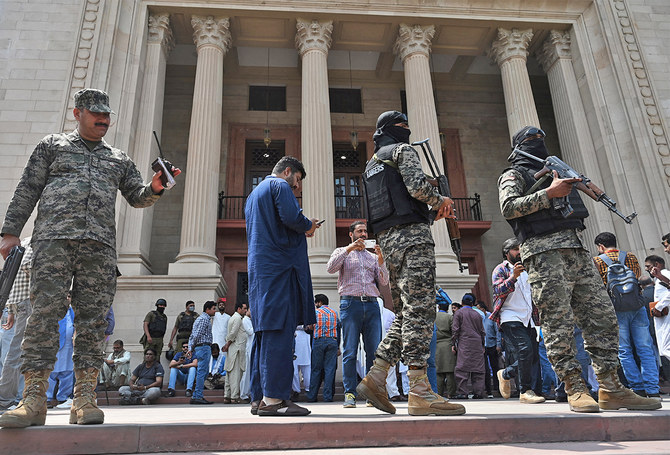
Supporters of Khan's PTI party staged a large demonstration outside the Punjab Governor's House on Thursday. Khan addressed his supporters, reiterating that free, fair and transparent elections were the only solution to Pakistan's political and economic problems.
Khan said he wanted to dissolve the assemblies as he feared that if early elections were not held, "the country will slip out of our hands."
"They [government] have a one-point agenda to hide their theft and they will hurt the country in the process. They won’t think about Pakistan once," he added.
Separately, KP Chief Minister Mahmood Khan said the PTI has decided to postpone the dissolution of the KP provincial assembly until the fate of the Punjab Assembly isn't decided.
“Right now, consultations on the issue of the Punjab Assembly is underway," the chief minister said. "The decision regarding the Khyber Pakhtunkhwa Assembly will be taken after these discussions.”
Khan has campaigned for snap polls since being ousted from power in a parliamentary vote in April. His party controls two of the country's four provincial assemblies. The other two are controlled by his political opponents, who also control the federal government under PM Sharif and who have said they will not hold national and local polls before they are due in November 2023.
Interior Minister Rana Sanaullah said since Elahi had not obtained a vote of confidence asper the governor's directives, he is no longer the chief minister constitutionally.
“If any commotion or law and order situation takes place in Punjab today [by the PTI], the government is fully ready to take them on," he said.
Responding to Sanaullah’s comments, senior PTI leader Asad Umar once again accused the government of trying to avoid elections.
“They are only scared of seeking the public’s help [through elections] and asking for their votes,” he said.
Punjab is the country's most populous province and makes up nearly half of the country's population of 220 million. The dissolutions of the Punjab and KP assemblies could thus create a fresh constitutional crisis in the country.
Historically, polls for the federal and provincial governments are held at the same time in a general election every five years. If the two provincial assemblies are dissolved earlier, separate polls would have to be held for them within 90 days, which could throw up legal problems.
Khan, who was injured in an apparent assassination bid last month, says he is willing to "sacrifice" his two provincial governments for the sake of the country's future.
Elections in the two provinces would mean holding polls in 66% of the country, Khan has argued, and so the government might as well hold general elections.