

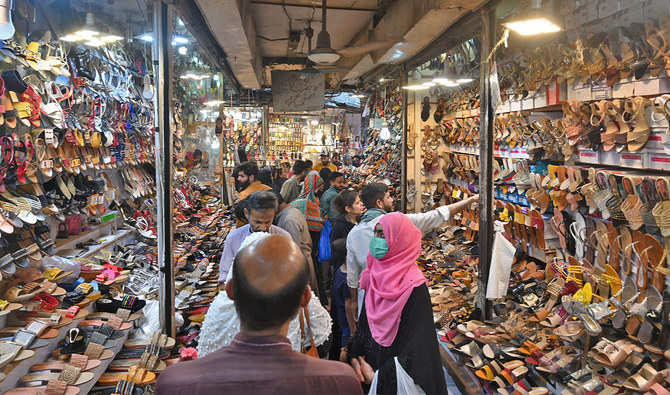

KARACHI: Business leaders in Pakistan this week rejected government plans to pull down the shutters on marketplaces and restaurants earlier than usual business hours to conserve energy, saying they had not been consulted on the measures which would badly hit already struggling businesses.
Under the national energy-conservation program announced by Defense Minister Khawaja Asif on Tuesday, markets and restaurants will have to close by 8 p.m. and wedding halls by 10 pm. The measures have been announced as the South Asian nation suffers acute energy shortages amid high costs of imports, soaring inflation and depleting forex exchange reserves and remittances.
The government expects it will save Rs62 billion ($274 million) annually through the measures. Federal Minister for Power, Khurram Dastagir, was repeatedly contacted for this story but did not respond.
Ahead of a final decision on the plan, to be taken on today, Thursday, business leaders said they “outrightly rejected the measures.
“The decision has been taken without consultation with the stakeholders and we have outrightly rejected this plan because it is not practical,” Kashif Chaudhry, president of the Markazi Tanzeem-e-Tajran Pakistan, a central body of traders, told Arab News on Wednesday.
Chaudhry said traders were expecting a plan for the revival of the ailing economy but were instead offered one that would further ravage their businesses, warning that enforcing the decision would be met with a strong reaction, including countrywide protests.
Pakistani restaurant owners said they were already reeling from the impact of the COVID-19 pandemic and the new plan would lead to the “total collapse” of their businesses.
“The restaurant business depends 70 percent on evening hours, which includes dinner, so practically it is not possible to close restaurants earlier,” Ather Chawla, chairman of the All Pakistan Restaurant Association (APRA), told Arab News.
“The restaurant business is still suffering from the impacts of COVID-19 despite the passage of more than two years and no support has come from the government,” he said. “And keeping people at homes will actually increase electricity consumption.”
Retail sector stakeholders said the government’s decision would impact revenue generation and also hit the livelihoods of three million people associated with the sector.
“Whenever there is talk of energy savings, the retail sector which provides three million jobs becomes the target of policymakers,” Rana Tariq Mehboob, chairman of the Chainstore Association of Pakistan (CAP), told Arab News. “The government wants to save Rs62 billion but this decision may hit the economy with Rs3.6 trillion in losses.”
Mehboob said if there were fewer sales, there would be lower production, which would further slowdown the economy: “We are the first country that shuts down business as a first step.”
The government had announced similar measures to conserve energy in June this year, but the plan was not fully implemented and did not produce the desired results, traders and experts said.
“It was to be done earlier this year when the new government had assumed charge because at that time it was peak [summer] season and the country was facing an energy crisis,” economist Ammar Habib Khan told Arab News.
“But at that time they were unable to implement the plan and it also seems difficult it will be implemented this time [as] such decisions are not data driven.”
Khan also questioned the rationale of making a plan to conserve energy in the winter season when electricity demand traditionally remains low as fans and air conditioners are not running.
“I don’t understand why this decision is being taken in December when there is already surplus energy. Such a decision ideally should be taken in June-July when demand peaks,” Khan said.
He did however admit that if implemented, the plan could help the country save around 10 percent of energy.
Pakistan mainly relies on imported fuel to produce electricity. The share of Regasified Liquefied Natural Gas (RLNG) in the energy mix of Pakistan was 23.8 percent in the last fiscal year, according to official data.
Pakistan’s energy imports during the last fiscal year were $23.3 billion, accounting for more than 29 percent of the country’s total imports. During the current fiscal year, the country imported energy products worth $7.7 billion, according to the Pakistan Bureau of Statistics.


