

Pakistan ‘disappointed’ over Taliban’s ban on women’s varsity education, still wants engagement

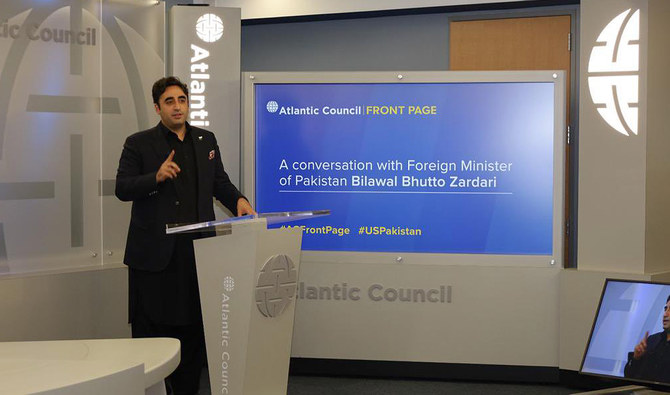
Pakistan Foreign Minister Bilawal Bhutto-Zardari gestures during an address at the Atlantic Council's Front Page event in Washington, US on December 20, 2022. (Photo courtesy: Twitter/BBhuttoZardari)
Short Url
Updated 21 December 2022
Follow

Pakistan ‘disappointed’ over Taliban’s ban on women’s varsity education, still wants engagement

  • The Taliban banned university education Tuesday after already closing down secondary schooling for girls
  • FM Bhutto-Zardari says there are no alternatives to Taliban, warns of further instability in Afghanistan

WASHINGTON: Pakistan’s foreign minister on Tuesday voiced disappointment over the Taliban’s ban on university education for women but said the best approach remained engagement with Afghanistan’s Islamist rulers.

“I’m disappointed by the decision that was taken today,” Foreign Minister Bilawal Bhutto-Zardari said on a visit to Washington.

But he said: “I still think the easiest path to our goal — despite having a lot of setbacks when it comes to women’s education and other things — is through Kabul and through the interim government.”

Bhutto-Zardari said there were no alternatives to the Taliban, warning of further instability in Afghanistan or the rise of the Daesh group.

“Is the alternative for us to imagine that we can somehow artificially stitch together an alternate opposition that can command the same sort of legitimacy?”

The Taliban, who had initially promised a softer approach than during their 1996-2001 regime, on Tuesday banned university education for women after already closing down secondary schooling for girls.

The United States, whose troop withdrawal from Afghanistan last year precipitated the collapse of the Western-backed government, warned that the Taliban decision could permanently end any hopes by the militants for a positive relationship.

But Bhutto-Zardari said it was even more crucial to ensure economic support “to create the political space necessary for those within the Afghan regime who actually believe that they should deliver” on rights issues.

Pakistan has a complicated relationship with the Taliban, officially backing the two-decade US war in Afghanistan but facing wide accusations in Washington of supporting the militants.


Uzbekistan president to arrive in Pakistan today to strengthen trade, energy cooperation

Updated 7 sec ago
Follow

Uzbekistan president to arrive in Pakistan today to strengthen trade, energy cooperation

  • Uzbek President Shavkat Mirziyoyev to lead high-level delegation of ministers, business leaders on Feb. 5-6 visit, says Pakistan foreign office
  • Visit takes place days after Pakistan, Uzbekistan reaffirmed $2 billion trade target during intergovernmental commission meeting

ISLAMABAD: Uzbekistan President Shavkat Mirziyoyev will arrive in Pakistan today, Thursday, with a high-level delegation to identify new avenues for bilateral cooperation in trade, defense, energy and other avenues, Pakistan's foreign ministry said. 

The visit takes place after the 10th session of the Pakistan–Uzbekistan Intergovernmental Commission (IGC) on Trade, Economic and Scientific-Technical Cooperation in Islamabad on Feb. 2. Both sides reaffirmed their $2 billion trade target and areed to push for regional connectivity, develop trade routes and accelerate cooperation in several sectors. 

Mirziyoyev will lead a high-level delegation comprising senior ministers and business leaders on a two-day state visit, Pakistan's foreign ministry said. 

"Discussions will focus on reviewing the entire gamut of bilateral relations and identifying new avenues to further deepen cooperation in diverse sectors including trade, energy, defense, education, people-to-people exchange and regional connectivity," the statement said. 

The Uzbek leader's visit takes place two days after Kazakhstan President Kassym-Jomart Tokayev arrived in Islamabad to hold talks on trade, business and connectivity. 

Pakistan and Kazakhstan signed 37 memoranda of understanding (MoUs) and set a target of raising bilateral trade to $1 billion within a year during Tokayev's visit. 

Pakistan and Uzbekistan have steadily increased economic ties in recent years as Islamabad seeks greater access to landlocked Central Asian markets, aiming to position itself as a regional transit and trade hub linking South Asia with Central Asia.

Pakistan was the first Central Asian partner with which Uzbekistan signed a bilateral Transit Trade Agreement, along with a Preferential Trade Agreement in March 2022, covering 17 items, which became operational in 2023.

Pakistan's finance ministry said last month that Azerbaijan's state energy company SOCAR was set to finalize an investment in the country’s oil and gas sector following high-level engagements at the World Economic Forum in Davos.
