


KARACHI: Despite the age of social media and the Internet where kids are exposed to a lot of screen time, Pakistani authors are convinced that books have an “untapped” potential to add color to children’s lives and the content that entertains children has enough demand in Pakistan.
In Pakistan, there has been a growing concern among parents that children are increasingly taking to electronic gadgets than books, with smartphones making video-streaming platforms, such as YouTube, and games more popular and easily accessible for people of all ages, particularly kids.
But authors feel there is still a lot of potential in children’s books and there is no substitute of the entertainment they provide to the younger generation.
Art and culture journalist Sonya Rehman recently published her first book for children, ‘Wolfie,’ which follows the journey and adventures of a dog and is themed around animal kindness and self-belief.
“I wanted to make children in Pakistan happy about reading a book. Locally, we don’t have a lot of books in Pakistan that have Pakistani or Muslim names,” Rehman told Arab News this week.
“This is one area that is completely untapped.”

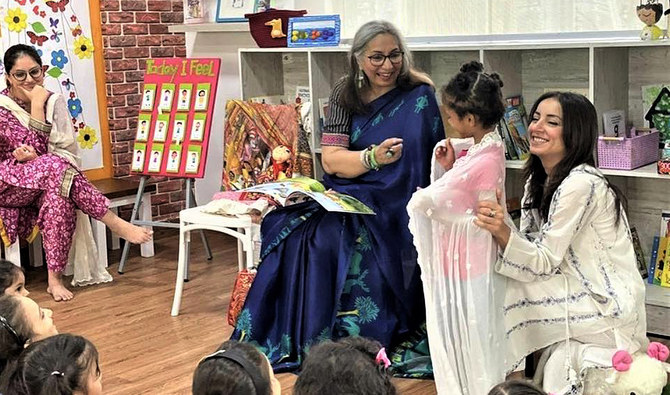
Pakistani author Rumana Husain is pictured during a storytelling session for children at Indus Hospital in Karachi on May 21, 2022. (Photo courtesy: Facebook/Rumana Husain)
Published in November by ZUKA Books, Wolfie has been receiving “amazing” feedback and has had a hundred copies sold within a span of two-and-a-half weeks, according to Rehman.
Rehman is planning to write a series of children’s books over the next couple of years and hopes to release at least two more titles in 2023.
“I want it [Wolfie] to be in every school library in Pakistan. I want to get this book translated to Urdu as well and that’s one of my biggest priorities in 2023 so we break out of the niche market of an English-only book for children,” she said.
Rumana Husain, another author of children’s books, says whenever parents or schools place value in books, children remain interested in reading them.
“Sadly, in Pakistan, we hardly create any alternate content for children in terms of movies, theater, songs, etc. so they depend on imported digital games, cartoons, and so on,” Husain told Arab News.
Husain’s first children’s book, ‘Hasan ki Gali,’ which she also illustrated, was published in the late ‘80s. Since then, she has written and illustrated over 65 books for kids in both Urdu and English languages.
Husain believes in writing books that are fun to read, have humor in them and ones that contain subtle messages: “I do not believe in overtly thrusting morals down children’s throats.”
She has preferred to write and speak about the environment. Some of her most prominent works that highlight this theme include ‘Kala Bhoot’ that gave “life and personality to the ubiquitous plastic bag” in the ‘90s.
Husain is associated with the Children’s Literature Festival, which was launched by the Idara-e-Taleem-o-Aagahi (ITA) public trust in 2011, to develop storybooks for children.
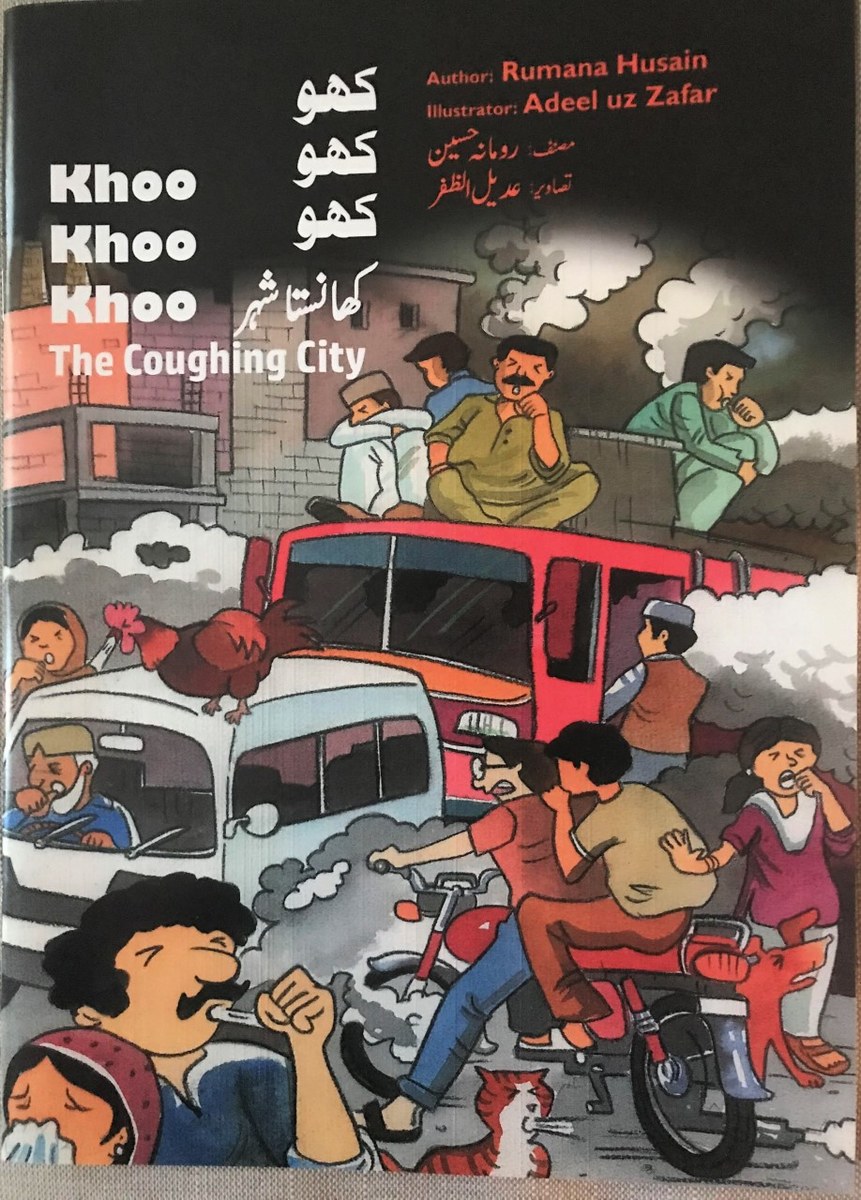
In this courtesy image provided to Arab News on December 16, 2022 by Pakistani author Rumana Husain: Coverpage of the bilingual book, "Khoo Khoo Khoo - The Coughing City", published in February 2021 is shown that deals with overpopulation, air and sound pollution, and infrastructure development that leaves little room for animals and trees.
“The ITA recently adapted into Urdu, Sindhi, Pushto and Darri [languages] several great storybooks with stunning illustrations, published by a non-profit, called Room to Read (RtR), and originally created in different Asian and African countries,” she said.
The author said she was looking forward to developing original books in Pakistan, adding that the technical assistance local writers, illustrators, editors and publishers would receive through the project would enhance the quality of children’s books.
Mina Malik, a mother of four who has been reading books for children for the last six years, appreciated the initiative and said parents have a desire for their kids to “read and enjoy books”.
“There is no dearth of demand for children’s books. There is a lot of potential and a lot of places where we can fill the gaps,” she told Arab News.
Malik started out with a weekly, English-language story program at ‘The Last Word’ bookstore in Lahore. The sessions would draw a large number of children and their parents to the bookstore for the readings.
Currently, she has been doing readings for kids in the Urdu language for journalist Maria Memon’s YouTube channel, ‘The Maria Memon Edit.’ Malik said the content in Urdu varies in nature, from stories that are fun to read to those embellished with morals.
“We have a lot of expat kids watching from all over the world whose parents want them to have some story content in Urdu, to improve their vocabulary,” she said.
Malik said the quality of work in Urdu had improved quite a lot, with many stories featuring smart illustrations. Some, she said, did not try to preach and weren’t even dark in theme.

Mina Malik at the Alif Laila library in Lahore recording Kahani Corner, the storytelling show she hosts for The Maria Memon Edit. (Photo courtesy: Bilal Mughal)
Illustrations play a really big role in engaging children with books, according to her.
Malik has started writing a series of stories that revolves around a character, Zeenat, and her dog, Freddy. She will soon be putting out a magazine for children named ‘Risala.’
However, publishing books has its own set of challenges, according to Malik.
“There are a lot of issues with publishing in Pakistan, such as paper and ink that have to be imported,” she said.
“Distribution for small publications is a challenge. It is difficult to get your product out there.”
She cited a lack of public libraries in Pakistan as a major challenge, adding that not many bookstores have children’s books.
Nonetheless, Malik is optimistic and feels the future of children’s books in Pakistan is “bright”.
Husain shared some of Malik’s concerns too.
“Publishers have always complained that in an over-populated country like ours, they are unable to sell more than 1,000 to 2,000 copies of any book, whether they are for children or for adults,” she said.
She called for publishers to be aggressive when it comes to marketing and promoting their products, saying this would enable parents to realize that books, beyond textbooks, are necessary for their children’s imagination.
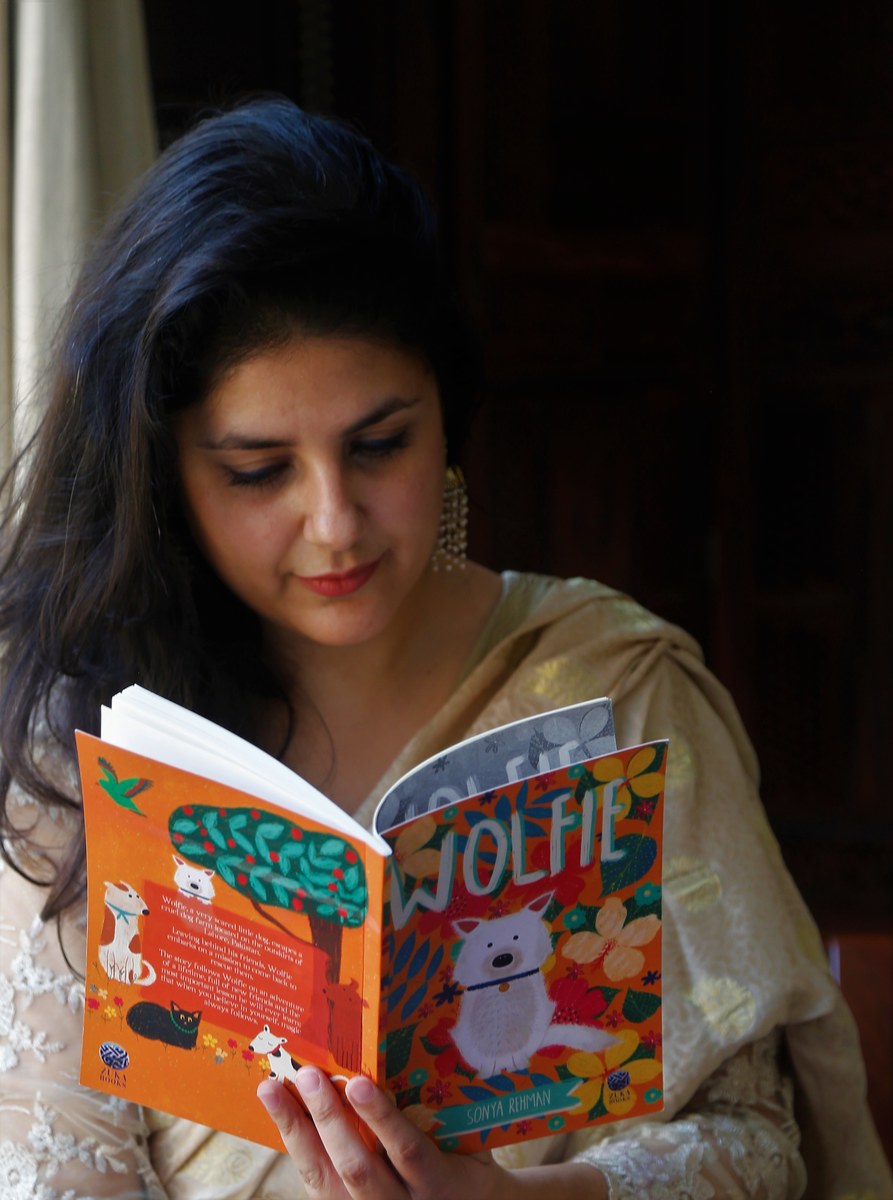
Art and Culture journalist Sonya Rehman reads her first children's book, Wolfie, published in November 2022. (Photo courtesy: Sonya Rehman)


