

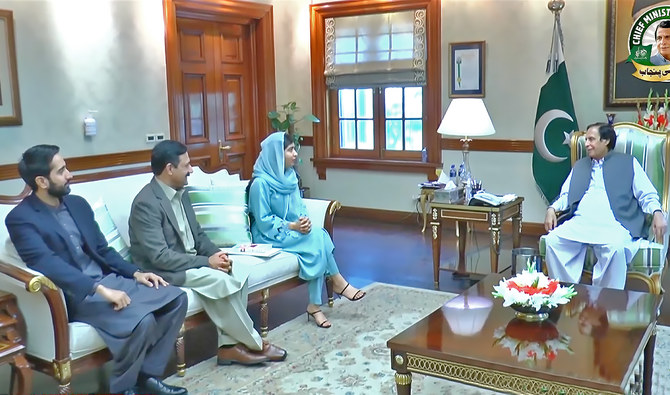
Punjab CM meets Malala, announces province will pass law banning corporal punishment in schools

Chief Minister of Punjab, Chaudhry Parvez Elahi (right), meets Nobel Laureate Malala Yousafzai (third left) in Lahore, Pakistan, on December 14, 2022. (Screengrab from the video shared on CM Punjab Facebook page)
Short Url
Updated 15 December 2022
Follow

Punjab CM meets Malala, announces province will pass law banning corporal punishment in schools

  • Chaudhry Parvez Elahi says the new law would be approved by the Punjab assembly this month
  • This is Malala’s second visit to Pakistan in 2022, she visited flood-hit parts of the country in October

ISLAMABAD: The Chief Minister of Punjab, Chaudhry Parvez Elahi, said on Thursday on the request of Nobel Laureate Malala Yousafzai, the government in his province would introduce a law to ban corporal punishment in schools and seminaries across the province.

Corporal punishment is a widely accepted means of maintaining discipline in Pakistani schools and religious institutions but rights advocates have called for its banning in recent years.

A law passed in February 2021 banning corporal punishment only applied to schools and seminaries in the Pakistani capital of Islamabad and came amid a number of high-profile cases of schoolchildren being badly beaten and even killed in schools, religious institutions and workplaces.

In January 2021, an eight-year-old boy was beaten to death by his teacher for not memorizing a lesson at a religious school in Punjab. In June 2020, another eight-year-old, a girl working as a maid in Islamabad, was beaten to death by her employers for letting their pet parrots escape.

“On Malala’s request, a law will be brought to ban corporal punishment in schools and madrassas,” Elahi tweeted on Thursday, a day after he met the education advocate in Lahore.

“Giving corporal punishment to students, especially female students in madrassas and schools is absolutely not acceptable. The implementation of the law prohibiting corporal punishment will be ensured in all cases and this law will be approved by the Punjab Assembly this month.”

The chief minister also announced that 25,000 teachers would be recruited across primary schools in Punjab and the mother tongue would be used as the medium of instruction to increase the rate of literacy rate.
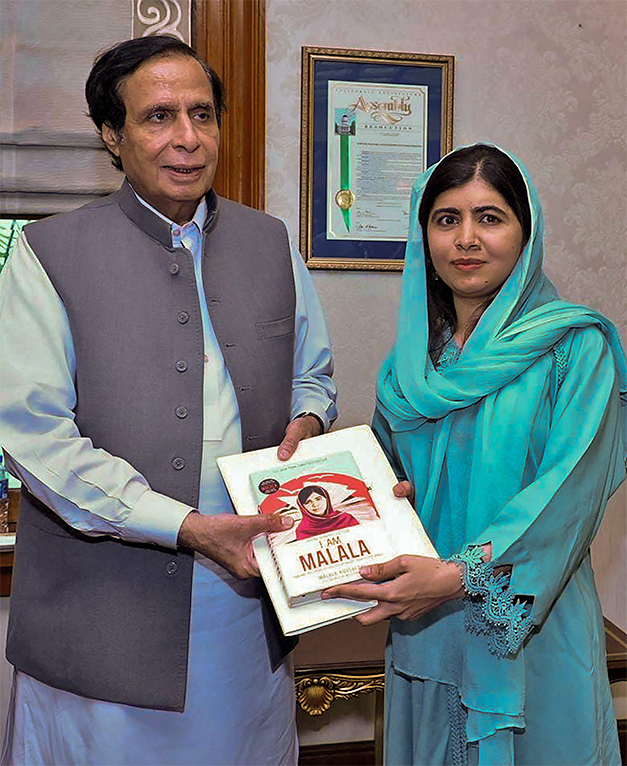


This handout picture taken and released by the Chief Minister House Office of Pakistan's Punjab Province on December 14, 2022, shows Nobel Peace laureate Malala Yousafzai (R) presenting her book to Chief Minister of Punjab province Chaudhry Pervez Elahi (L) in Lahore. (AFP/Chief Minister House Office of Pakistan’s Punjab Province)

This is Malala’s second visit to Pakistan this year. She was earlier in Pakistan in October 2022 to mark the 10th anniversary of being shot in her hometown of Swat by a Taliban gunman for her advocacy for girls’ education.

During the trip, she visited flood-affected areas of the country to help keep international attention focused on the disaster and reinforce the need for critical humanitarian aid.


Pakistan says defense pact with Saudi Arabia elevated brotherly ties to ‘new heights’

Updated 25 February 2026
Follow

Pakistan says defense pact with Saudi Arabia elevated brotherly ties to ‘new heights’

  • Pakistan, Saudi Arabia signed strategic defense pact last year pledging aggression against one will be treated as attack on both
  • Deputy PM Ishaq Dar says enduring bonds with Islamic and Arab nations form vital pillar of Pakistan’s foreign policy 

ISLAMABAD: Deputy Prime Minister Ishaq Dar said on Wednesday that Pakistan’s defense pact with Saudi Arabia elevated its brotherly ties with the Kingdom to “new heights,” stressing that close ties with Arab and Islamic nations form a key pillar of Islamabad’s foreign policy. 

Pakistan and Saudi Arabia signed a Strategic Mutual Defense Agreement on Sept. 17 last year, pledging that aggression against one country would be treated as an attack on both, enhancing joint deterrence and formalizing decades of military and security cooperation.

Both nations agreed in October 2025 to launch an economic cooperation framework to strengthen trade and investment ties. 

“In the Middle East, our landmark Strategic Mutual Defense Agreement with Saudi Arabia has elevated our brotherly ties to new heights,” Dar said while speaking at the Pakistan Governance Forum 2026 event in Islamabad. 

The Pakistani deputy prime minister was speaking on the topic “Navigating International Relations Amidst Changing Geo-Politics.”

Dar noted that Pakistan has reinforced partnerships with other Middle Eastern nations such as the UAE, Qatar, Jordan, Oman, Egypt and Bahrain. He said these partnerships have yielded “concrete agreements” in investment, agriculture, infrastructure, and energy sectors. 

“Our enduring bonds with Islamic and Arab nations form a vital pillar of our foreign policy, and we will continue to expand our partnerships across Asia, Latin America, and Africa,” he said. 

Dar pointed out that the presidents of Kazakhstan, Uzbekistan and Kyrgyzstan have undertaken visits to Pakistan in recent months, reflecting Central Asian nations’ desire to boost cooperation with Islamabad.

On South Asia, the Pakistani deputy PM said Pakistan has successfully transformed its fraternal ties with Bangladesh into “a substantive partnership.”

“Similarly, the trilateral mechanism involving China, Pakistan, and Bangladesh has been launched with a view to expanding and deepening regional cooperation and synergy,” the Pakistani minister said. 

He said Islamabad has strengthened its “all-weather” partnership with China via the second phase of the multi-billion-dollar China-Pakistan Economic Corridor agreement and “unwavering support” from both sides for each other’s core interests. 

Dar said Pakistan had also reinvigorated its partnership with the US, advancing cooperation in trade, technology, investment, and regional stability. 

“This calibrated approach has enhanced our ability to navigate complexity with skill and confidence, ensuring that our national interests are served without compromising our core foreign policy principles,” he said.