

Bombing kills 2, injures 14 in Pakistan’s restive northwest

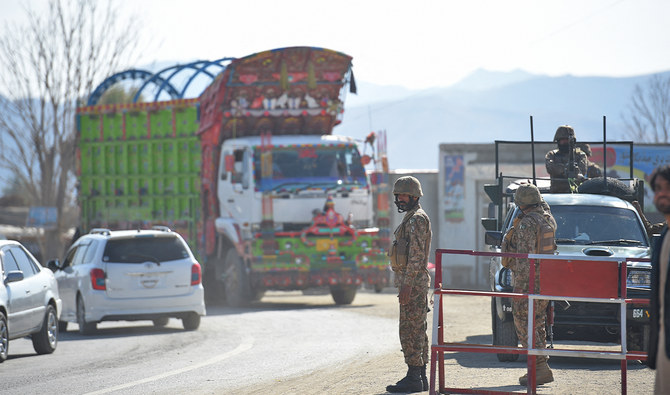
A Pakistani army soldiers stand guard at a check point in Miran Shah, a town in North Waziristan, on January 27, 2019. (AFP/File)
Short Url
Updated 15 December 2022
Follow

Bombing kills 2, injures 14 in Pakistan’s restive northwest

  • The bomb appeared to target a convoy of security forces in northwestern town of Miran Shah
  • No claim of responsibility, but the mountainous area is a former stronghold of Pakistani Taliban

PESHAWAR: A roadside bomb killed a soldier and a passerby and wounded at least 14 others in Pakistan’s northwest border area on Wednesday, the military and police said Thursday. 

A local police official, Khalid Wazir, said the bombing appeared to target a convoy of security forces passing by the town of Miran Shah in Khyber Pakhtunkhwa province near the Afghan frontier. The blast damaged nearby shops but the injured were mostly troops, the official added. 

No group immediately claimed responsibility for the attack, but the mountainous and isolated area is a former stronghold of the Pakistani Taliban, known as Tehrik-e-Taliban Pakistan or TTP, which is allied with neighboring Afghanistan’s rulers. 

Local Taliban have stepped up attacks on security forces in recent weeks after unilaterally ending a monthslong cease-fire with Pakistan’s government last month. 

Pakistan has repeatedly complained that Afghanistan’s Taliban rulers have failed to secure the frontier areas and are giving shelter to Pakistani Taliban fighters and leaders across the unruly border. The Pakistani Taliban have been emboldened by the return to power of Afghanistan’s Taliban, who took power in Kabul after the US troop withdrawal last year. 


Pakistan bank enables Shariah-compliant digital payment facility for passengers at Islamabad airport

Updated 23 February 2026
Follow

Pakistan bank enables Shariah-compliant digital payment facility for passengers at Islamabad airport

  • Pakistan is a cash-dominated market where a significant portion of transactions in the informal sector are made without any taxes, officials say
  • The move comes amid Pakistan’s efforts to introduce a cashless model at airports under which only digital service providers can provide services

KARACHI: Aik, Pakistan’s first Islamic digital bank, has enabled fully digital payments at Islamabad International Airport to offer travelers and passengers secure, Shariah compliant digital transaction facility.

The development comes amid Pakistan’s efforts to introduce a cashless model at airports across the country, under which only digital service providers can provide services to customers.

Aik, a subsidiary of Bank Islami, said it has onboarded merchants across the Islamabad airport and integrated QR code deployments at key touchpoints to allow passengers and visitors to make secure, seamless, and Shariah-compliant digital transactions at all counters, retail outlets, and service points.

It said the implementation complies with the regulations and framework set by the State Bank of Pakistan (SBP) and is a working model for a large-scale adoption of cashless systems in public infrastructure.

“This deployment reflects our commitment to building practical digital infrastructure that improves everyday transactions,” Aik Chief Officer Ashfaque Ahmed said in a statement.

“By enabling a fully cashless environment at a major national gateway, we are supporting efficiency, transparency, and financial inclusion at scale. This is not only a project; it is a foundation for Pakistan’s cashless future.”

Pakistan is a cash-dominated market where a significant portion of transactions, particularly in the informal sector, are conducted in cash. Officials say many of these transactions are aimed at avoiding taxes.

In recent years, the SBP has taken steps to ensure a transition toward a more cashless economy so that transactions are more traceable, reducing chances of tax evasion and corruption.

By digitizing Islamabad airport, aik said it continues to invest in secure and accessible financial solutions that “expand digital participation and support national economic modernization.”