

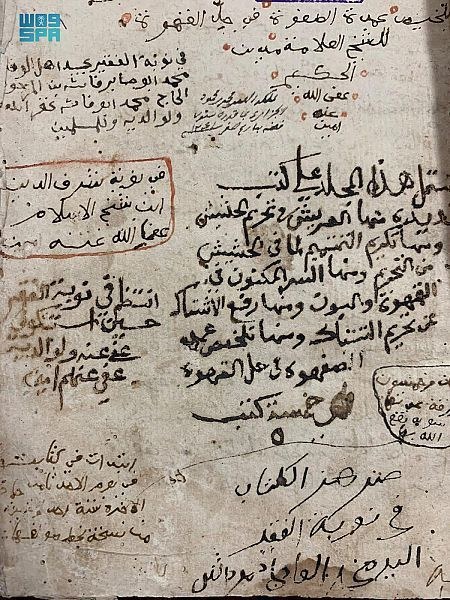
King Abdulaziz Public Library shows off rare, 400-year-old manuscript about coffee

1 / 3
King Abdulaziz Public Library has revealed a 400-year-old manuscript that highlights the importance of coffee in Arabic culture. (SPA)
2 / 3
King Abdulaziz Public Library has revealed a 400-year-old manuscript that highlights the importance of coffee in Arabic culture. (SPA)
3 / 3
King Abdulaziz Public Library has revealed a 400-year-old manuscript that highlights the importance of coffee in Arabic culture. (SPA)
Short Url
Updated 14 December 2022
Follow

King Abdulaziz Public Library shows off rare, 400-year-old manuscript about coffee

  • The library shared the document with the public for the first time as part of the celebrations for the 2022 Year of Saudi Coffee
  • It was written by Madyan Qusuni, who was Egypt’s chief physician and was also known for his love of literature and history

JEDDAH: A rare, 400-year-old manuscript that highlights the important role of coffee in Arab culture has been shared with the public for the first time. It was written by Madyan Qusuni, a renowned Egyptian physician, writer, and historian during the Ottoman era.

King Abdulaziz Public Library decided to show off the document, which is safely preserved and stored in its private collection, as part of the celebrations for the 2022 Year of Saudi Coffee, which celebrates the role of the beverage in the identity, heritage, customs and traditions of the Kingdom.

The manuscript, which has the numeric reference “1213,” summarizes two books by different authors. The first is “Umdat Al-Safwa fi Hill Al-Qahwa” by Abdulqadir bin Muhammad Al-Jaziri, an Iraqi scholar and historian. The second is a book by scholar Ahmad Shihab Addin Al-Maliki, the first chapter of which is titled “On the Meaning of Coffee.”

The manuscript has a poem in praise of coffee that tells how it has spread to the far corners of the earth, gaining prominence even in China.

Qusuni was the chief physician in Egypt. He was also known for his love of literature and history, and wrote many books in which he combined his knowledge of the medicine of the time with literature. He died in Egypt in 1634.

In its role as a preserver of history and ancient manuscripts, the library in 2020 issued a two-part manuscript index. The first discusses the library’s work to preserve and document the historical manuscripts it holds and make the details available to scholars and researchers. The 664-page volume contains information about 300 manuscripts.

The second part includes details of 646 Arabic manuscripts and 19 in other ancient languages, including Turkish, Bosnian and Persian. They cover a wide range of topics including the arts, religion, jurisprudence, Hadith, biographies of the Prophet Muhammad, literature, poetry, philosophy, astronomy, dictionaries, general knowledge, logic, grammar, history and rhetoric.

The Year of Saudi Coffee initiative was launched by the Ministry of Culture, with the support of the Quality of Life Program, in keeping with the aims of the Kingdom’s Vision 2030 development and diversification agenda.


Director Kaouther Ben Hania rejects Berlin honor over Gaza

Updated 20 February 2026
Follow

Director Kaouther Ben Hania rejects Berlin honor over Gaza

DUBAI: Kaouther Ben Hania, the Tunisian filmmaker behind “The Voice of Hind Rajab,” refused to accept an award at a Berlin ceremony this week after an Israeli general was recognized at the same event.

The director was due to receive the Most Valuable Film award at the Cinema for Peace gala, held alongside the Berlinale, but chose to leave the prize behind.

On stage, Ben Hania said the moment carried a sense of responsibility rather than celebration. She used her remarks to demand justice and accountability for Hind Rajab, a five-year-old Palestinian girl killed by Israeli soldiers in Gaza in 2024, along with two paramedics who were shot while trying to reach her.


A post shared by @artists4ceasefire

“Justice means accountability. Without accountability, there is no peace,” Ben Hania said.

“The Israeli army killed Hind Rajab; killed her family; killed the two paramedics who came to save her, with the complicity of the world’s most powerful governments and institutions,” she said.

“I refuse to let their deaths become a backdrop for a polite speech about peace. Not while the structures that enabled them remain untouched.”

Ben Hania said she would accept the honor “with joy” only when peace is treated as a legal and moral duty, grounded in accountability for genocide.