

IMF shareholders divided over request by Pakistan, other borrowers to suspend surcharges

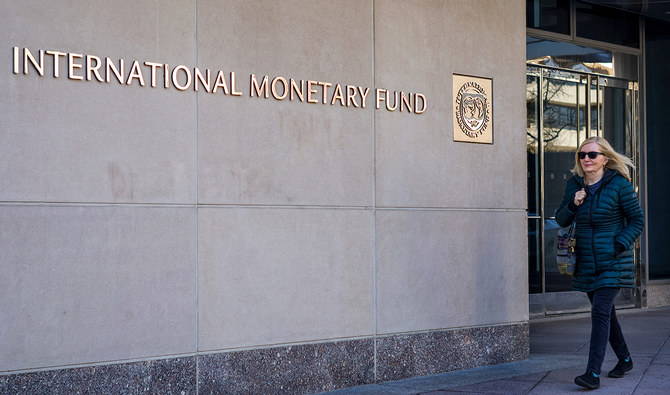
A woman walks past the International Monetary Fund (IMF) headquarters building in Washington, DC on March 11, 2022. (Photo courtesy: AFP/File)
Short Url
Updated 13 December 2022
Follow

IMF shareholders divided over request by Pakistan, other borrowers to suspend surcharges

  • Argentina, Pakistan and others are pushing IMF to drop, or temporarily waive, surcharges
  • IMF estimates surcharges will cost borrowers $4bln on top of interest payments and fees

WASHINGTON: The International Monetary Fund’s executive board on Monday discussed the surcharges it collects from mostly middle- and lower-income countries on larger loans that are not repaid quickly, but failed to agree to launch a formal review.

Argentina, Pakistan and others are pushing the IMF to drop — or at least temporarily waive — the surcharges, which the IMF estimates will cost affected borrowers $4 billion on top of interest payments and fees from the start of the COVID-19 pandemic through the end of 2022.

The United States, Germany, Switzerland and other advanced economies oppose a change, arguing that the fund should not change its financing model at a time when the global economy is facing significant headwinds.

An IMF spokesperson said the board discussed potential changes to the policy during its regular review of the global lender’s precautionary balances, but failed to reach consensus on reviewing the policy.

“Overall, views on changes to the surcharge policy continued to diverge, including on the merits of a temporary waiver of surcharges,” the spokesperson said.

No details were provided, but the fund said it would publish a staff paper and a press release in coming days that would provide a fuller account of the board’s deliberations. No date was set for any further board discussion.

Kevin Gallagher, who heads the Global Development Policy Center at Boston University, said big shareholders should rethink their opposition, given the global economic outlook.

“This is the most urgent time to address a fundamentally flawed business model where the IMF is generating revenues by taxing those most in need,” Gallagher said.

But it was notable, he said, that the IMF’s shareholders had failed to outright reject a review.

“One silver lining is that the biggest shareholders ... didn’t have enough strength to kill the proposal,” he said.


Pakistan PM calls for faster CPEC implementation, pledges security for Chinese workers

Updated 27 February 2026
Follow

Pakistan PM calls for faster CPEC implementation, pledges security for Chinese workers

  • Shehbaz Sharif pushes expanded cooperation in agriculture, IT and mining under CPEC phase two
  • Chinese envoy reaffirms Beijing’s support for Pakistan’s sovereignty and economic development

ISLAMABAD: Prime Minister Shehbaz Sharif on Friday called for speeding up projects under the China-Pakistan Economic Corridor (CPEC) and pledged stronger security guarantees for Chinese workers and investments, during a meeting with China’s ambassador in Islamabad.

Sharif made the remarks as the two countries strive to launch the second phase of CPEC, a multibillion-dollar infrastructure and energy initiative launched in 2015 as part of China’s Belt and Road Initiative (BRI).

CPEC’s first phase focused largely on power generation and transport infrastructure aimed at easing Pakistan’s chronic energy shortages and improving connectivity. The second phase seeks to expand cooperation into industrial development, with an emphasis on special economic zones and export-oriented growth.

“While highlighting the importance of accelerating ongoing CPEC projects, the Prime Minister stressed on the need to enhance cooperation in agriculture and IT and mining & minerals,” said a statement circulated by the PM Office after the meeting.

“He also underscored Pakistan’s resolve to provide a secure and conducive environment for Chinese personnel, investments, and institutions in Pakistan,” it added.

Chinese nationals and projects in Pakistan have faced security threats in the past, including attacks by militant groups targeting infrastructure sites and convoys. Islamabad has repeatedly vowed to tighten security and has deployed special protection units for Chinese workers.

China is Pakistan’s closest ally in the region and a key economic partner, with CPEC widely regarded by Islamabad as central to long-term economic growth.

During the meeting, the prime minister conveyed greetings to Chinese President Xi Jinping and Premier Li Qiang, particularly on the occasion of the Chinese New Year.

China’s Ambassador to Pakistan, Jiang Zaidong, reiterated Beijing’s support for Pakistan’s sovereignty and socioeconomic development, according to the statement. Both sides also exchanged views on regional and international issues and agreed to maintain close coordination.