

IMF shareholders divided over request by Pakistan, other borrowers to suspend surcharges

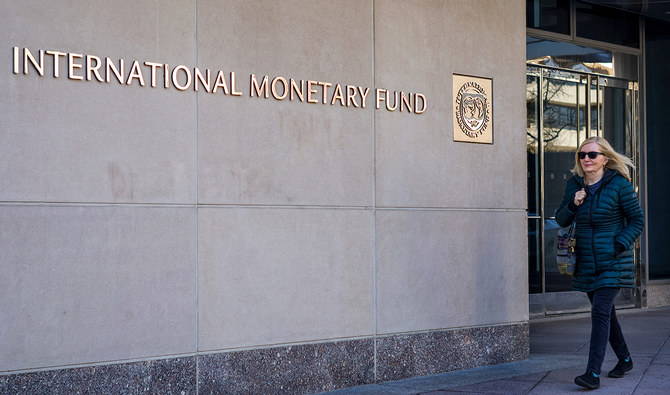
A woman walks past the International Monetary Fund (IMF) headquarters building in Washington, DC on March 11, 2022. (Photo courtesy: AFP/File)
Short Url
Updated 13 December 2022
Follow

IMF shareholders divided over request by Pakistan, other borrowers to suspend surcharges

  • Argentina, Pakistan and others are pushing IMF to drop, or temporarily waive, surcharges
  • IMF estimates surcharges will cost borrowers $4bln on top of interest payments and fees

WASHINGTON: The International Monetary Fund’s executive board on Monday discussed the surcharges it collects from mostly middle- and lower-income countries on larger loans that are not repaid quickly, but failed to agree to launch a formal review.

Argentina, Pakistan and others are pushing the IMF to drop — or at least temporarily waive — the surcharges, which the IMF estimates will cost affected borrowers $4 billion on top of interest payments and fees from the start of the COVID-19 pandemic through the end of 2022.

The United States, Germany, Switzerland and other advanced economies oppose a change, arguing that the fund should not change its financing model at a time when the global economy is facing significant headwinds.

An IMF spokesperson said the board discussed potential changes to the policy during its regular review of the global lender’s precautionary balances, but failed to reach consensus on reviewing the policy.

“Overall, views on changes to the surcharge policy continued to diverge, including on the merits of a temporary waiver of surcharges,” the spokesperson said.

No details were provided, but the fund said it would publish a staff paper and a press release in coming days that would provide a fuller account of the board’s deliberations. No date was set for any further board discussion.

Kevin Gallagher, who heads the Global Development Policy Center at Boston University, said big shareholders should rethink their opposition, given the global economic outlook.

“This is the most urgent time to address a fundamentally flawed business model where the IMF is generating revenues by taxing those most in need,” Gallagher said.

But it was notable, he said, that the IMF’s shareholders had failed to outright reject a review.

“One silver lining is that the biggest shareholders ... didn’t have enough strength to kill the proposal,” he said.


Pakistan PM speaks to UAE president, calls for enhanced cooperation

Updated 13 February 2026
Follow

Pakistan PM speaks to UAE president, calls for enhanced cooperation

  • Shehbaz Sharif lauds UAE’s economic support in challenging times
  • Both leaders discuss a range of issues, agree to stay in close contact

ISLAMABAD: Prime Minister Shehbaz Sharif on Friday praised the United Arab Emirates for what he described as steadfast financial and political support during Islamabad’s recent economic crisis, as both sides signaled plans to deepen bilateral cooperation.

In a statement issued after Sharif spoke with UAE President Sheikh Mohamed bin Zayed Al Nahyan, the Prime Minister’s Office said the two leaders discussed matters of mutual interest and agreed to stay in close contact.

“The Prime Minister lauded the UAE’s consistent and unwavering support to Pakistan, that had helped the country navigate through difficult challenges,” the statement said, adding the two leaders “reaffirmed their shared desire to further enhance mutually beneficial cooperation between Pakistan and the UAE.”

The UAE, along with other friendly nations in the region, provided critical financial assistance to the South Asian country during a balance-of-payments crisis that strained Pakistan’s foreign exchange reserves and pressured its currency. Islamabad subsequently secured an International Monetary Fund program as part of broader stabilization efforts.

Sharif, in a post on X, described the exchange as positive.

“We fondly recalled our recent meetings and reaffirmed our shared resolve to further strengthen the historic, fraternal ties between Pakistan and the United Arab Emirates, and to expand mutually beneficial cooperation,” he wrote.

Millions of Pakistanis live and work in the UAE, forming one of the largest expatriate communities in the Gulf state.

Remittances from the UAE rank among Pakistan’s top sources of foreign currency inflows and play a significant role in supporting the country’s external accounts.

UAE-based companies are also investing in Pakistan, helping Islamabad develop its seaports to facilitate regional trade.
