

Morocco’s tactical masterplan ignites unlikely World Cup run

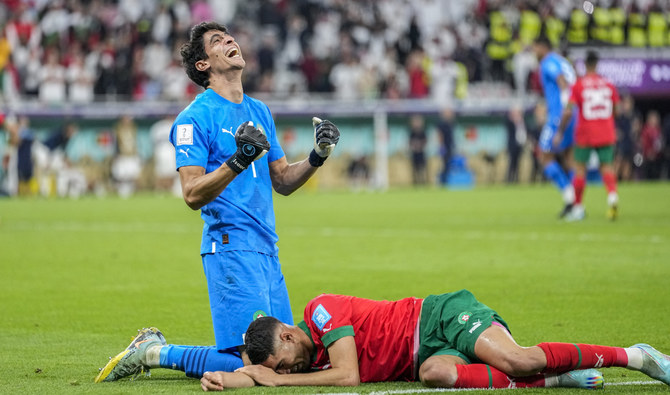
Morocco's goalkeeper Yassine Bounou, left, celebrates with his teammate Achraf Hakimi their team victory over Portugal during their World Cup quarterfinal at Al Thumama Stadium in Doha Saturday. (AP)
Short Url
Updated 12 December 2022
Follow

Morocco’s tactical masterplan ignites unlikely World Cup run

  • Before arriving in Qatar, the north African nation had only ever won two of its previous 16 matches at the World Cup
  • Regragui sets his team up in a 4-1-4-1 formation, with the defense typically in a deep, low block

DOHA, Qatar: Morocco goalkeeper Yassine Bounou leaned back in his chair, shook his head and said: “Pinch me, I’m dreaming.”

Yes, Morocco really are in the World Cup semifinals.

Before arriving in Qatar, the north African nation had only ever won two of its previous 16 matches at the World Cup. The team’s coach had been in position for just four months. Their players were talented but battling a culture of underachievement by the country at major soccer tournaments.

So, how has Morocco managed to top a group containing second-ranked Belgium and 2018 finalist Croatia and then eliminate Spain and Portugal — two of Europe’s soccer powerhouses — to become Africa’s first World Cup semifinalist and the pride of the Arab world?

The answer lies in a bold decision by its soccer federation and recently installed coach Walid Regragui’s unwavering belief in a game plan that’s being followed to the letter by a selfless and gifted group of players.

No team has been able to crack the code. Can France in the semifinals?

COACHING CHANGE

The foundation to this unlikely underdog story was built in August when Vahid Halilhodzic — an experienced Bosnian coach who guided Morocco serenely through African qualifying — was fired by the federation essentially because of his refusal to select Hakim Ziyech, one of the country’s best players. The federation cited “divergent visions” as the reason for firing Halilhodzic and replaced him with Regragui, a former Morocco international who had just led Wydad Casablanca to the African Champions League title. Regragui was about to inherit the most talented Morocco squad in a generation.

SQUAD DEPTH

The team has never had so many players from top European clubs. The two fullbacks, Achraf Hakimi and Noussair Mazraoui, are starters for Paris Saint-Germain and Bayern Munich, respectively; winger Ziyech plays for Chelsea, albeit not so regularly; goalkeeper Bounou and striker Youssef En-Nesyri are at Sevilla in Spain; Sofyan Amrabat is the defensive midfielder at Fiorentina in Italy; center backs Nayef Aguerd is at West Ham in the Premier League, where captain Romain Saiss was recently playing for Wolverhampton. Regragui’s task was two-fold: To get his players functioning in a system that could get results at the World Cup and to get them believing they could shock the world. “I told them, ‘You don’t come to the World Cup only to play three games,” he said. He has created a masterpiece.

TACTICS

Regragui sets his team up in a 4-1-4-1 formation, with the defense typically in a deep, low block and Amrabat sitting directly in front, never venturing forward. Against the supposedly bigger teams this World Cup, the four-man midfield line also has dropped further back to create another defensive shield, leaving En-Nesyri as the lone striker. When the opponent loses possession, Regragui has drilled his players to break forward on the counterattack at pace, using the energy of fullbacks Hakimi and Mazraoui to complement the mercurial skills of Ziyech and fellow winger Sofiane Boufal. From being isolated, En-Nesyri suddenly finds five or six teammates with him. The approach requires discipline and high levels of mental concentration. “We have a clear game plan — everyone has to work,” Regragui. “We are showing the world you can succeed even if you don’t have as much talent and money.”

THE NUMBERS

The statistics behind Morocco’s run are extraordinary. The team has only conceded one goal — and that was an own-goal by Aguerd against Canada — meaning Croatia, Belgium, Spain and Portugal have failed to break down Morocco. They have only allowed 10 shots on target in five games. They are averaging less than three shots on goal and surviving on an average possession of just 29.8 percent per game. Against Spain, Morocco had 343 passes and its opponent had 1,041. “I don’t think they have ever run as much in their lives,” Regragui said. “When you put in so much heart, you give yourselves a chance.”

FANS

Helping Morocco’s players is the backing they are getting at each game from fans who are streaming into Qatar to watch the historic run of the team nicknamed the Atlas Lions. Every match has felt like a home game for Morocco, whose passionate supporters greeted all the spells of possession by Spain and Portugal with ear-piercing whistles and jeers. The supporters have been ubiquitous in Doha, proudly carrying around the Morocco flag and wearing the team’s red jerseys. Their national’s team’s only major title was at the African Cup of Nations in 1976. Morocco are two wins away from dwarfing that and becoming the most unlikely World Cup champion.


Own goal enough for Al-Ahli as Matchday 24 win keeps pressure on Al-Nassr

Updated 27 February 2026
Follow

Own goal enough for Al-Ahli as Matchday 24 win keeps pressure on Al-Nassr

  • Al-Ahli eke out 1-0 win over Al-Riyadh to keep pressure on Al-Nassr
  • Milan Borjan own goal separated the sides at Prince Faisal bin Fahd Stadium

RIYADH: Matchday 24 of the Saudi Pro League kicked off on Thursday, less than 24 hours after the conclusion of the delayed Matchday 10. With the FIFA Arab Cup, World Cup Qualifiers and FIFA World Cup sandwiching the 2025/26 campaign, resting periods have been few and far between outside the international breaks.

With fixtures coming thick and fast, Al-Ahli opted to rest Riyad Mahrez and Enzo Millot for their clash with Al-Riyadh in the capital. Ramadan has further challenged the league schedule, with Matthias Jaissle’s side only arriving in Riyadh at 5:30pm — just hours before kick-off.

With their previous outing against Damac still dominating conversation, Jaissle was keen to ensure his players did not fall into the same trap — namely, being caught off guard by an opponent’s unexpectedly proactive style.

To his relief, Al-Ahli were largely in control this time. Yet the absence of Mahrez limited their creative spark. Relying heavily on Wenderson Galeno down the left, Al-Riyadh did well to crowd the Brazilian and deny him space to operate.

The bane of any expansive side is a compact 5-4-1, and that is precisely how Al-Riyadh’s recently appointed Brazilian manager Mauricio Dulac set his team up. A long-time assistant to former Al-Riyadh coach Odair Hellmann, this marks Dulac’s first managerial role.

Al-Ahli’s attacking routes were severely restricted throughout the first half. Al-Riyadh denied them the opportunity to press high, Mahrez’s trademark diagonals were absent, and finding Ivan Toney in the six-yard box proved a difficult task.

On the rare occasions the visitors broke the defensive line, Milan Borjan stood firm in goal — there was no getting past the Canadian.

That was until first-half stoppage time. Al-Ahli had one more weapon in their arsenal: set-pieces. A lofted delivery from Galeno’s free-kick met the head of Roger Ibañez, who nodded the ball towards goal. Borjan pushed it away, but it was too late — the ball crossed the line.

VAR intervened within seconds. Ibañez was a shoulder offside, and the opener was chalked off. It was a notable twist, particulary as the simultaneous fixture between Al-Fateh and Damac in Al-Ahsa featured a celebration aimed squarely at Al-Ahli and VAR.

Earlier in the week, Damac equalised late against Al-Ahli via Yakou Méïté, only for the goal to be overturned. Méïté reacted angrily and lashed out at referees, but Al-Ahli escaped with the three points. Méïté followed up with a goal against Al-Fateh, and celebrated by mimicking the referee’s VAR signal.

Back in Riyadh, Al-Ahli returned for the second half with renewed intensity. Zakaria Hawsawi grew more adventurous from left-back, threading lofted balls over the Al-Riyadh defence.

In the 53rd minute, he found Toney behind the last defender, but the Englishman’s volley was adeptly saved by Borjan. Five minutes later, Galeno latched onto Hawsawi’s cross and thought he had broken the deadlock — only for the linesman’s flag to rise once again.

Al-Ahli pushed, but as time ticked away, it seemed the coveted winner would elude them. However, once again, set pieces proved decisive.

In the 75th minute, a corner from Saleh Abu Al-Shamat was parried by Borjan, only for his effort to be bundled into his own net, sending the travelling supporters into a frenzy.

After last week’s scare, Al-Ahli knew they had to finish the job. Cue Ibañez, who surged forward from deep before slipping the ball through to Toney to seal the game with what would have been his 24th goal of the season. The run itself deserved a goal, but Toney was flagged inches offside.

Despite another difficult outing, Al-Ahli did enough to secure a clean sheet and grind out a 1-0 victory to move top on 59 points — one ahead of Al-Nassr, who are yet to play this weekend.

Elsewhere, Méïté’s equaliser was later cancelled out by a 77th-minute Mourad Batna penalty, in a match that saw fans commemorate him for surpassing 100 goal contributions with Al-Fateh.

Batna had earlier missed from the spot to the frustation of the home fans, but Al-Fateh’s undefeated streak against Damac at home remains intact as the encounter ended 1-1.

Saudi Pro League action resumes on Friday, with Al-Hazem hosting Al-Ettifaq, Al-Ittihad welcoming Al-Khaleej, and one of Riyadh’s top derbies in Al-Shabab and Al-Hilal. All games kick-off at 10:00pm, in the league’s unified Ramadan schedule.