


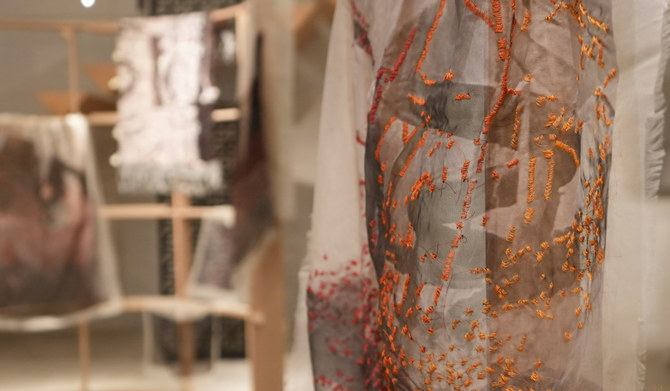

RIYADH: As one of 22 collaborating galleries of the Misk Art Week, Lakum Art Space’s “Performing Bodies” exhibition brings six female regional artists together to experiment with various folkcraft techniques, bringing the region’s rich history to life.
“Not only does Misk Art Week give artists exposure but it gives them a chance to tell their story and that’s what is important. It also allows artists to connect and have this one week of a year to converse and tell their own story whether that’s through a group exhibition or a residency,” 26-year-old exhibiting artist Hana Almilli told Arab News.
“It fosters an environment for us all to be in one platform — collaborating galleries and collaborating artists,” Almilli added.
Held from Dec. 5-10, Misk Art Week aims to create opportunities for artists to gather and work together in workshops, exhibitions and forums to cultivate creativity and further engage with the community.
The “Performing Bodies” exhibition looks into the themes of memory and ritual to explore tactile art techniques that have been passed down from generation to generation, highlighting the ancestral relationship and practice of rituals.
HIGHLIGHT
The artists featured in the exhibition are from different parts of the region and include Afshan Daneshvar (Iran), Dina Haddadin (Jordan), Ghizlane Sahli (Morocco), Hadeyeh Badri (UAE), Hana Almilli (Saudi Arabia) and Nojoud Al-Sudairi (Saudi Arabia). The art techniques featured in the exhibition bring the creative minds of artists together in a vital role of unity that highlights the cultural and social identity of the region.
“We’re very proud to be an all-female-led team and to work with these six female artists on producing an exhibition that is so rich in history and tradition, but also reflects the contemporary aesthetic and techniques in textile arts,” Neama A. Al-Sudairi, founding director of Lakum Artspace, said.
The crafts depicted in the exhibition were historically developed by women and are linked to a sense of bonding where techniques and rituals would be passed down through generations.
The artists use weaving, knitting, folding, stitching, embroidering and crocheting to examine the rich culture and social identity of the Middle East.
“Within the flourishing contemporary art and design disciplines in the Middle East, we see an attempt to reconcile ruptures between past and present in the form of an intergenerational investigation into practices that link the human body with craft,” Rana Beiruti, the exhibition curator, said.
Almilli was a part of a group art show in Lakum Art Space collaborating gallery of Misk Art Week. She has two artworks, titled “If the voice has a memory” and “The echoes of my alienation.”
She told Arab News: “I felt proud to be a part of such an esteemed event two years in a row in a different way this time, surrounded by artists that I love in this group show.”
The artists featured in the exhibition are from different parts of the region and include Afshan Daneshvar (Iran), Dina Haddadin (Jordan), Ghizlane Sahli (Morocco), Hadeyeh Badri (UAE), Hana Almilli (Saudi Arabia) and Nojoud Al-Sudairi (Saudi Arabia).
The art techniques featured in the exhibition bring the creative minds of artists together in a vital role of unity that highlights the cultural and social identity of the region.
Almilli said that all of her artwork is inspired by themes of nostalgia and heritage.
“Being quarter Kurdish, Turkish, Saudi and Syrian I have always wanted to express and learn about my own background. Textiles and incremental making was my way of exploring my identity,” she said.
Her work “If the voice has a memory” explores avenues such as touch, sound and more to engulf visitors in her memories.
“The woven piece is woven with natural dyes from all the different countries I come from. The sounds are also from those different countries,” she said.
Her second piece, “The echoes of my alienation,” is a series of embroidered self-portrait photographs printed on silk that explore the use of embroidery to tackle alienation — something relevant to Almilli’s own life.
“Through embroidering I was able to find myself pondering, expressing and escaping two different sides of alienation. The collection was an acceptance of that feeling with the positives and negatives,” she said.
Almilli added that this year’s Misk Art Week creates an opportunity for collaboration between diverse artists, whether they are veterans or just beginning their careers.
“Misk Art Week this year accumulates all different avenues to showcase works of younger artists to even more established artists. Putting them in one platform causes an exposure for younger artists and now that they are even collaborating with galleries, it’s so beautiful to see galleries collaborating,” she said.
Almilli took part in Misk Art Week in 2021 in the Masaha Residency and has also collaborated with Misk Art Institute and Berlin Art Institute in a Berlin show titled “Next Wave.”
She left a message to aspiring artists, saying: “Never give up, although it sounds cliche. Always keep experimenting and making it through ups and downs; this is what makes great art.”


