

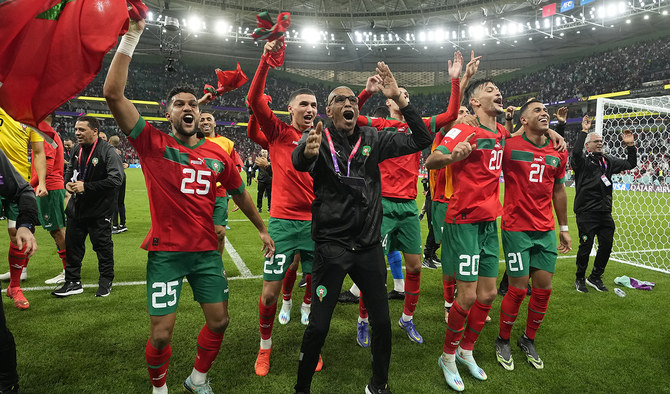

DOHA: Morocco’s unexpected march to the World Cup semi-finals can be attributed partly to a policy of deliberately seeking out talent in the Diaspora to strengthen the national team and give them a better chance of success.
Fourteen of Morocco’s 26-man squad were born outside the country, more than any other team at the tournament in Qatar, providing an eclectic mix of players from growing migrant communities across Europe who have helped them break new ground.
The shock 1-0 quarter-final win over Portugal on Saturday made Morocco the first African and Arab country to reach the last four of a World Cup.
Canadian-born goalkeeper Younes Bounou has conceded only one goal, Madrid-born Achraf Hakimi has been outstanding on the right flank, Dutch-born Sofyan Amrabat a powerful midfield enforcer and French-born Sofiane Boufal a menace on the left.
Finding eligible players in countries like Belgium, France, Germany, Italy, the Netherlands and Spain is now a structured exercise, as opposed to the haphazard system when the first foreign-born Moroccans competed for the national team at the 1998 World Cup in France.
Moroccans are one of the largest migrant populations in Europe, estimated at some five million, and have close ties with the country. A study by the Council of the Moroccan Community Abroad, a government agency, concluded that 61% of Moroccans in Europe between the ages of 18 and 35 visit the kingdom every year.
The Royal Moroccan Football Federation has talent scouts dotted around Europe and move quickly when there is a potential clash of loyalties. Dutch-born Hakim Ziyech had talks with both the Moroccans and Netherlands coach Ronald Koeman about which country he would commit his international future to before deciding on Morocco.
Amrabat, who like Ziyech represented the Netherlands at junior level, switched allegiance for family reasons.
"My parents are Moroccan and my grandparents are Moroccan. Every time I go there I can't describe the feeling inside me in words, it's my home. The Netherlands is also my home, but Morocco is special," he said.
HONEST DISCUSSION
"The players are approached very early in order to attract them to the Moroccan side. We never force things, it's an honest discussion with the player and his family," explains Noureddine Moukrim, a youth coach in Belgium who scouted for Morocco for nine years.
But there are doubters about the policy, who feel this assiduous courting of overseas-born players retards opportunity for home-born footballers.
"Before this World Cup we had a lot of problems about the guys born in Europe and guys not born in Morocco and a lot of journalists said, ‘Why don’t we play with guys born in Morocco?’,” said coach Walid Regragui, himself a former foreign-born international.
"Today we have shown that every Moroccan is Moroccan. When he comes to the national team he wants to die, he wants to fight. As the coach, I was born in France, but nobody can have my heart for my country.”


