ISLAMABAD: A team set up by the Pakistani government to probe the killing of a well-known Pakistani journalist in Nairobi said it found several contradictions in the version given by Kenyan authorities, and believes it was a case of pre-meditated murder.
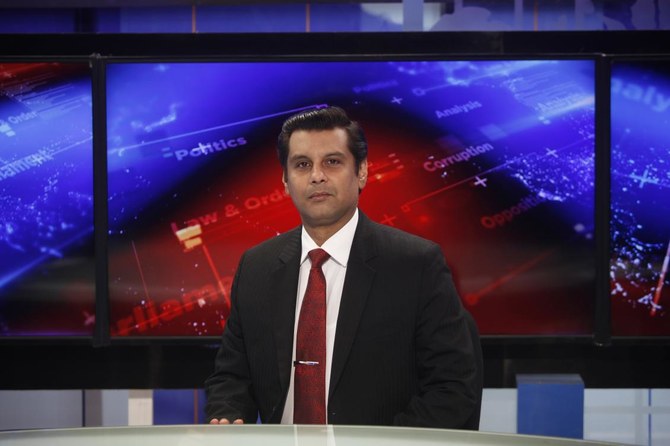
TV journalist Arshad Sharif, who had fled Pakistan citing threats to his life, was shot dead in Nairobi in October. Kenyan officials said it was a case of mistaken identity and police hunting car thieves opened fire on his vehicle as it drove through a roadblock without stopping.
A two-member fact-finding team from Pakistan that traveled to Kenya and conducted a number of interviews, examined and reconstructed the crime scene and examined the deceased’s phones and computers, said in a 600-page report that Sharif’s killing was a pre-planned murder.
“Both the members of the (fact-finding team) have a considered understanding that it is a case of planned targeted assassination with transnational characters rather than a case of mistaken identity,” said the report, copies of which were submitted to Pakistan’s Supreme Court.
“It is more probable that the firing was done, after taking proper aim, at a stationary vehicle,” it said.
Kenyan authorities declined comment on the specifics of the report.
“The investigation into the matter is still ongoing, so there is not much I can tell,” said Resila Onyango, spokesperson for the Kenya National Police Service.
A multi-agency team is conducting the investigation, he said, adding that the team will apprise authorities when they are done with the probe.
The chairperson of the Kenyan police watchdog Independent Police Oversight Authority, Anne Makori, also said investigations were still ongoing.
Pakistan’s Interior Minister Rana Sanaullah had said before the release of the report that Sharif’s body had bruises and torture marks, suggested it was a targeted killing.
The fact-finding team highlighted one wound in particular on Sharif’s back, saying it appeared to have been inflicted from relatively close range.
The report noted there was no corresponding penetration mark of a bullet on the seat on which Sharif was sitting when the shooting purportedly took place, calling it a “ballistic impossibility.”
“The injury had to have been caused either before the journalist got into the vehicle, or the shot was fired from a relatively close range, possibly from inside the vehicle, and almost certainly not a moving vehicle,” the report said.
Sharif had fled from Pakistan citing threats to his life after the government registered several treason cases against him.
One of the treason cases stemmed from reporting Sharif did that led to an accusation he had spread a call from an official in a previous government, led by former cricket star Imran Khan, for members of the armed forces to mutiny.
Both Sharif and the official in the previous government denied inciting mutiny.
Former prime minister Khan said Sharif had been murdered for his journalistic work. He and his successor Prime Minister Shehbaz Sharif, not related to the journalist, had called for a judicial investigation.
The fact-finding team’s report also pointed out apparent contradictions in the autopsy reports in Kenya and Pakistan.
The post-mortem report in Pakistan identified 12 injuries on Sharif’s body whereas the Kenyan report identified just two injuries pertaining to gunshot wounds.
The fact-finding team report said doctors believed the injures may be the result of torture or a struggle, but it could not be established until verified by the doctor who conducted the post mortem in Kenya.


Pakistani journalist’s killing in Kenya a pre-meditated murder – report
https://arab.news/yc7un
Pakistani journalist’s killing in Kenya a pre-meditated murder – report

- TV journalist Arshad Sharif earlier fled Pakistan citing threats to his life
- Team of Pakistani probers believe it was a case of pre-meditated murder


Israel arrests 2 Turkish CNN journalists over live broadcast outside IDF HQ
- Police said reporter Emrah Cakmak and cameraman Halil Kahraman were detained on suspicion of filming a sensitive security facility
- Since the Gaza war began, restrictions have expanded significantly, including tighter limits on filming soldiers on duty and sensitive or strategic sites
LONDON: Israeli police have arrested two Turkish CNN journalists who were broadcasting live outside the Israel Defense Forces’ headquarters in Tel Aviv.
Police said the pair were detained on suspicion of filming a sensitive security facility, according to the Israel Police Spokesperson’s Unit.
Reporter Emrah Cakmak and cameraman Halil Kahraman, from the network’s Turkish-language channel, had been reporting near the IDF’s Kirya military headquarters on Tuesday after Iran launched another missile barrage at Tel Aviv and other parts of central Israel.
During the live broadcast, two men believed to be soldiers approached the crew and seized the reporter’s phone, according to initial reports and a video circulating online that could not be independently verified.
Police said officers were dispatched after receiving reports of two people carrying cameras and allegedly broadcasting in real time for a foreign outlet.
עיתונאים של CNN טורקיה נעצרו לאחר שצילמו את בסיס הקרייה@NoamIhmels pic.twitter.com/t8a5P9yXfw
— גלצ (@GLZRadio) March 3, 2026
Israel’s long-standing military censorship system, overseen by the IDF Military Censor, has long barred journalists and civilians from publishing material deemed harmful to national security.
Since the Gaza war began, restrictions have expanded significantly, including tighter limits on filming soldiers on duty and sensitive or strategic sites.
After a series of similar incidents involving foreign media — most of them Palestinian citizens of Israel working for Arab-language and international media, along with foreign journalists — during the 12-Day War, Israeli police halted live international broadcasts from missile impact sites, citing concerns that exact locations were being revealed.
The Government Press Office later imposed a blanket ban on live coverage from crash and impact areas.
Communications Minister Shlomo Karhi and National Security Minister Itamar Ben-Gvir subsequently ordered that all foreign journalists obtain prior written approval from the military censor before broadcasting — live or recorded — from combat zones or missile strike locations.
Police said that when officers asked the CNN Turk crew to identify themselves, they presented expired press cards and were taken in for questioning.
Burhanettin Duran, head of Turkiye’s Directorate of Communications, condemned the arrests as an attack on the press and said Ankara is working to secure the journalists’ release.


