

Pakistan’s chief election commissioner says in favor of using technology for voting

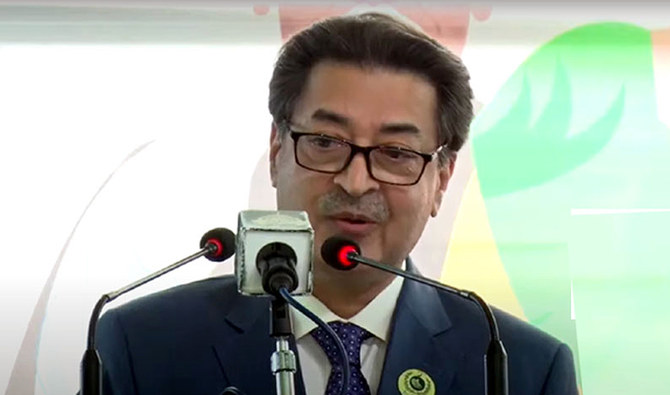
Pakistan's chief election commissioner Sikandar Sultan Raja addresses an event to mark National Voters' Day in Islamabad on December 7, 2022. (Photo courtesy: Radio Pakistan)
Short Url
Updated 07 December 2022
Follow

Pakistan’s chief election commissioner says in favor of using technology for voting

  • Sikandar Sultan Raja maintains electronic voting machines should be easy to use and ensure secrecy of vote
  • The chief election commissioner says all political stakeholders should have concensus on the voting devices

ISLAMABAD: Pakistan’s top election official said on Wednesday he was in favor of using technology to strengthen the polling process in the country, though he added that such a shift should help fulfil certain basic requirements to ensure transparent voting exercise.

The country’s previous administration of former prime minister Imran Khan sanctioned the use of electronic voting machines (EVMs) in February, though its political rivals resisted the move and vowed to challenge it in the country’s top court.

Pakistan’s election regulatory authority also opposed the introduction of EVMs on technical grounds while pointing out that their potential for misuse and tampering was too high.

However, Chief Election Commissioner Sikandar Sultan Raja told a gathering in Islamabad that his institution was not against EVMs and had taken steps to ensure electoral transparency under his tenure.

“The election commission supports the use of technology in the electoral process,” Radio Pakistan quoted him as saying while addressing an event to mark National Voters’ Day. “But the technology should be such on which all the stakeholders have consensus.”

He added the devices used for voting purposes should help people exercise their right to franchise easily while ensuring secrecy of vote.

“We have not opposed the EVMs or the voting right of overseas Pakistanis, but there should be a method for this,” he continued. “We cannot make general elections controversial in haste.”

Raja said the election commission had tried to make sure that the code of conduct for electoral process was duly implemented by taking action against violators across the board.

He noted that his institution was also serious about holding local bodies polls.


Pakistan says defense pact with Saudi Arabia elevated brotherly ties to ‘new heights’

Updated 25 February 2026
Follow

Pakistan says defense pact with Saudi Arabia elevated brotherly ties to ‘new heights’

  • Pakistan, Saudi Arabia signed strategic defense pact last year pledging aggression against one will be treated as attack on both
  • Deputy PM Ishaq Dar says enduring bonds with Islamic and Arab nations form vital pillar of Pakistan’s foreign policy 

ISLAMABAD: Deputy Prime Minister Ishaq Dar said on Wednesday that Pakistan’s defense pact with Saudi Arabia elevated its brotherly ties with the Kingdom to “new heights,” stressing that close ties with Arab and Islamic nations form a key pillar of Islamabad’s foreign policy. 

Pakistan and Saudi Arabia signed a Strategic Mutual Defense Agreement on Sept. 17 last year, pledging that aggression against one country would be treated as an attack on both, enhancing joint deterrence and formalizing decades of military and security cooperation.

Both nations agreed in October 2025 to launch an economic cooperation framework to strengthen trade and investment ties. 

“In the Middle East, our landmark Strategic Mutual Defense Agreement with Saudi Arabia has elevated our brotherly ties to new heights,” Dar said while speaking at the Pakistan Governance Forum 2026 event in Islamabad. 

The Pakistani deputy prime minister was speaking on the topic “Navigating International Relations Amidst Changing Geo-Politics.”

Dar noted that Pakistan has reinforced partnerships with other Middle Eastern nations such as the UAE, Qatar, Jordan, Oman, Egypt and Bahrain. He said these partnerships have yielded “concrete agreements” in investment, agriculture, infrastructure, and energy sectors. 

“Our enduring bonds with Islamic and Arab nations form a vital pillar of our foreign policy, and we will continue to expand our partnerships across Asia, Latin America, and Africa,” he said. 

Dar pointed out that the presidents of Kazakhstan, Uzbekistan and Kyrgyzstan have undertaken visits to Pakistan in recent months, reflecting Central Asian nations’ desire to boost cooperation with Islamabad.

On South Asia, the Pakistani deputy PM said Pakistan has successfully transformed its fraternal ties with Bangladesh into “a substantive partnership.”

“Similarly, the trilateral mechanism involving China, Pakistan, and Bangladesh has been launched with a view to expanding and deepening regional cooperation and synergy,” the Pakistani minister said. 

He said Islamabad has strengthened its “all-weather” partnership with China via the second phase of the multi-billion-dollar China-Pakistan Economic Corridor agreement and “unwavering support” from both sides for each other’s core interests. 

Dar said Pakistan had also reinvigorated its partnership with the US, advancing cooperation in trade, technology, investment, and regional stability. 

“This calibrated approach has enhanced our ability to navigate complexity with skill and confidence, ensuring that our national interests are served without compromising our core foreign policy principles,” he said.