

Pakistan's Justice Ayesha Malik among BBC's 100 most influential women list for 2022

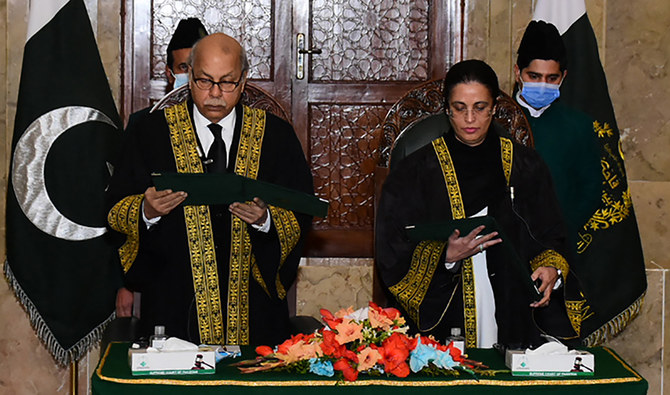
This handout photograph taken on January 24, 2022 and released by the Pakistan’s Press Information Department (PID) shows chief justice Gulzar Ahmed (L) administering the oath to justice Ayesha Malik as Pakistan's first female supreme court judge in Islamabad. (Photo courtesy: AFP)
Short Url
Updated 07 December 2022
Follow

Pakistan's Justice Ayesha Malik among BBC's 100 most influential women list for 2022

  • Justice Ayesha A. Malik, who wrote landmark judgments upholding women’s rights, was recently elevated to the top court
  • The BBC list also mentions women who have gained recognition in politics, activism, science, sports, advocacy and culture

ISLAMABAD: Justice Ayesha Malik, the first female judge of the Supreme Court of Pakistan, on Tuesday made it to the British Broadcasting Cooperation’s list of 100 inspiring women from around the world.

The BBC said it had been compiling the list for about a decade, adding that a number of steps had been taken by nations across the world to recognize women’s rights. However, it warned that there were still places where women did not have basic rights and had a long way to go.

The list included women from different parts of the world who have recognized in politics, education, activism, advocacy, health, science, sports and culture. From Pakistan, Justice Malik was the only woman who was named in the 10th season of 100 Women.

“Appointed this year as the first female judge of the Supreme Court of Pakistan, Justice Ayesha A. Malik has authored judgments protecting the rights of women,” the BBC said while writing her brief introduction. “This includes her landmark judgment which banned the so-called two-finger test of rape victims. These ‘virginity tests’ used to be performed during the examinations of sexual assault cases until they were outlawed in 2021.”

It noted Justice Malik was not only playing an active role in the Supreme Court but was also conducting training for judges around the world.

The BBC said her appointment to Pakistan’s top court encouraged debate about gender perspective in the justice system of the country.

“Women must build a new narrative — one that includes their perspective, shares their experience, and includes their stories,” she was quoted as saying.

The list also reflected the role of women at the heart of conflict around the world in 2022 – from the protesters demanding change in Iran, to the female faces of conflict and resistance in Ukraine and Russia.


Pakistan’s deputy PM discusses ways to boost economic, trade ties with Iran

Updated 8 sec ago
Follow

Pakistan’s deputy PM discusses ways to boost economic, trade ties with Iran

  • Both countries agreed in August to increase bilateral trade to $10 billion by 2028
  • Pakistan and Iran have been working to stabilize relations after strained security ties

ISLAMABAD: Pakistan’s Deputy Prime Minister Ishaq Dar presided over a meeting to discuss economic and trade cooperation with Iran, the foreign office said on Friday, as the neighboring countries seek to expand ties.

The development took place during an inter-ministerial meeting on Pakistan-Iran bilateral relations chaired by Dar in Islamabad. Pakistan and Iran have been working to stabilize ties following a period of strained security relations.

Both countries have been working to enhance bilateral trade, setting up border markets and exploring barter trade to circumvent banking and currency restrictions. Sanctions and foreign exchange shortages remain key hurdles for Iran, making these alternative systems central to its trade strategy with Pakistan.

“The meeting reviewed ongoing cooperation across a range of sectors and discussed ways to further enhance economic and trade ties,” the foreign office said in a statement.

“The DPM/FM reaffirmed Pakistan’s commitment to deepening engagement with Iran in key priority areas.”

In December, the foreign ministers of Iran and Pakistan vowed to strengthen bilateral cooperation in trade and connectivity while working for regional peace.

Iranian President Dr. Masoud Pezeshkian also visited Pakistan in August, during which both countries signed agreements to increase bilateral trade to $10 billion by 2028.