

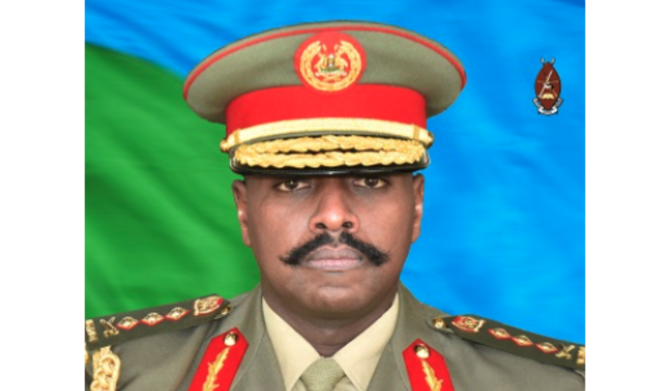
Ugandan president’s son agrees to take over from his father — if he gets enough likes on Twitter

Muhoozi Kainerugaba. (Wikipedia)
Short Url
Updated 07 December 2022
Follow

Ugandan president’s son agrees to take over from his father — if he gets enough likes on Twitter

  • Muhoozi Kainerugaba said he has no ambition to lead his country but could be convinced to do it if there was good enough response to his offer on the social media platform
  • As of Tuesday evening, a day after the tweet was posted, it had racked up more than 2,100 retweets and 7,400 likes; Uganda has a population of more than 47 million

DUBAI: Muhoozi Kainerugaba, the son of Uganda’s President Yoweri Museveni, said that he will succeed his father — if he gets enough likes on Twitter.

Kainerugaba, a general in his country’s armed forces and a prolific tweeter, wrote on Monday: “Okay, let those who want me to be president after my father retweet and like. If you convince me, I will do it.”

As of Tuesday evening, the tweet had racked up more than 2,100 retweets and 7,400 likes. Uganda has a population of more than 47 million.

Kainerugaba, who is commonly referred to by his first name, which means “avenger,” has a track record of ambitious tweets. For example, he previously offered to give Italian prime minister Giorgia Meloni a gift of 100 cows. “In our culture you give a girl you like a cow,” he wrote. He has also shared musings about the possibility of invading Kenya.

In response to previous criticism of his tweets, and an apparent suggestion by a journalist in Kenya that he be banned from Twitter, Kainerugaba posted a message in October that said: “I am an adult and NO ONE will ban me from anything!”

While Kainerugaba’s latest tweet might seem to be just his latest bizarre and outrageous comment, some observers have suggested that it might very well be part of a carefully considered political strategy, as his 78-year-old father, who has been Uganda’s ruler since 1986, is thought to be grooming him to take the reins of power.

“That family controls Uganda,” said Peter Kagwanja, president and CEO of the Africa Policy Institute. “His mother is in the cabinet and he is the prince, waiting to succeed his father.

“Muhoozi provokes, then his father arranges for him to go and apologize, and in this way he is introduced into the circles of leaders.”

However, Kainerugaba denies any ambition to rule his country. In a message posted immediately before the one saying that he would take over from his father if he got enough retweets and likes, he wrote: “Some people keep saying I want to be president? Frankly speaking that has never been in my mind.”

Time will tell whether he gets enough likes and retweets to convince him to change his mind.

Not everyone in Uganda enjoys as much freedom on Twitter. Kakwenza Rukirabashaija, a prominent Ugandan author and lawyer, has said he was tortured while in detention after sharing a series of tweets that were judged to be insulting to Kainerugaba and his father.


59-kilogram monster fish catches eyes at Nigerian fishing festival

Updated 15 February 2026
Follow

59-kilogram monster fish catches eyes at Nigerian fishing festival

  • Over the decades, the festival grew into one of Nigeria’s biggest cultural events, drawing international visitors, before insecurity and funding shortages reduced it to an occasional celebration

ARGUNGU: Local fisherman Abubakar Usman’s 59-kilogram monster catch was the major highlight of the UNESCO-listed Argungu fishing festival, which returned after a six-year hiatus because of the insecurity in northwestern Nigeria’s Kebbi state.
Thousands of people, including a handful of women and children, defied the blistering 39-degree heat to take part. Fishermen from Nigeria’s West African neighbors Niger, Chad, and Togo also came to compete.
The fishing festival was first staged in 1934 by the then traditional ruler of Argungu, Mohammed Sama. It was held to mark an end to a century-old history of hostility and distrust between his people and the region’s most powerful ruler, the Sultan of Sokoto, then Hassan Dan-Mu’azu.

FASTFACT

The festival has grown into one of Nigeria’s biggest cultural events, drawing international visitors, before insecurity and funding shortages reduced it to an occasional celebration.

Over the decades, the festival grew into one of Nigeria’s biggest cultural events, drawing international visitors, before insecurity and funding shortages reduced it to an occasional celebration. The last full edition was held six years ago, say organizers.
On Saturday, fishermen floated on brown, round gourds as they hunted for the biggest catch in Matan Fada river, using only their hands and nets in the river’s murky waters.
Thousands of spectators lined the riverbank cheering loudly.
For the Emir of Argungu, Al-Hajji Samaila Mohammed Mera, hosting the festival this year was a victory of some sort.
Parts of Kebbi state have seen sporadic militant attacks in recent years, with analysts blaming the Lakurawa terror group for the deadly violence.
“I came back to have a fuller experience,” said Adeniyi Olugbemii, 56, who is attending the festival a second time from neighboring Sokoto state.
Outside the arena that sits on the edge of the Matan Fada, chants, drumbeats, and cultural displays added to the atmosphere, highlighting the heritage that has turned Argungu into a global tourism draw.
Rukaya Ismaila, 23, said she had traveled from Kogi state, some 850 kilometers away, to attend the festival for the first time.
“The famous Argungu that we’ve been told about since primary school,” she said.
“It is worth all the excitement,” she added, praising the way the competing fishermen helped each other out.
Days of activities preceded the fishing competition, including a motor rally from Nigeria’s capital city, Abuja, a Durbar procession, and a variety of cultural events.
Abubakar Usman’s hefty catch earned him two new saloon cars and 1-million-naira cash prize (about $739).
Hundreds of much smaller catches ended up at a makeshift market set up on the adjoining streets to the arena.
The event was overshadowed by a prominent political campaign for the re-election of President Tinubu and Kebbi Gov. Mohammed Nasir Idris.
Billboards and posters of both men lined the streets leading to the river arena.
Supporters in blue t-shirts emblazoned with their images drummed and danced, drawing crowds of their own, while songs eulogising the visiting president blared through speakers inside the main arena.
Earlier in the day, a false start around midday had forced the already anxious contestants to plunge into the river. They had defied the scorching sun to wait for the arrival of President Bola Tinubu.
The president arrived more than two hours later, after which the contest was restarted.