

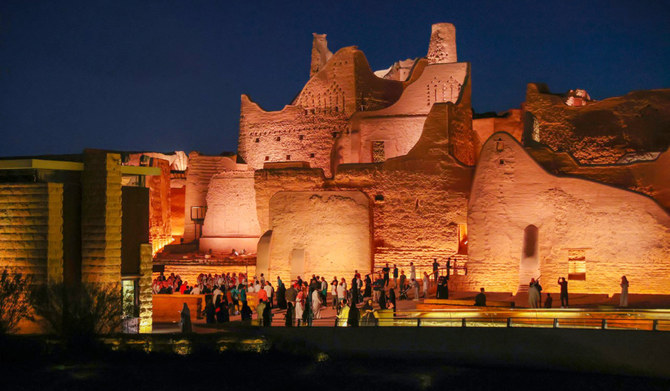

RIYADH: The prominent citadel of Salwa Palace, made from mudbricks three centuries ago in the historic Turaif district, the first capital of the Saudi dynasty, was illuminated on Dec. 4 with a spectacular light display in celebration of its opening to the public.
Just a few steps away, also in the historic Diriyah area, the Bujairi Terrace, a slew of high-end dining experiences ready to welcome over 3,000 people within an area of 15,000 square meters and featuring both Saudi and top international restaurants, opened to its first visitors.
It was a historic day for Saudi Arabia as the opening of both sites marked the first phase of completion for the $50 billion project of the Diriyah Gate Development Authority.
“This area is very special because it is the birthplace of the Kingdom,” Jerry Inzerillo, group CEO at the DGDA told Arab News. “It’s the ancestral home of Al-Saud, and it is the source of national identity and pride for all Saudis and all Arabs.”
To mark the special day, traditional performers in national dress put on a show and distributed gifts to visitors.
Stunning illuminated walkways lead the way through new buildings reflective of traditional mudbrick Arabian homes and lampposts decorated in the Najdi style typical to central Arabia. Palm trees line the Wadi Hanifa that separates the Bujairi Terrace from Turaif.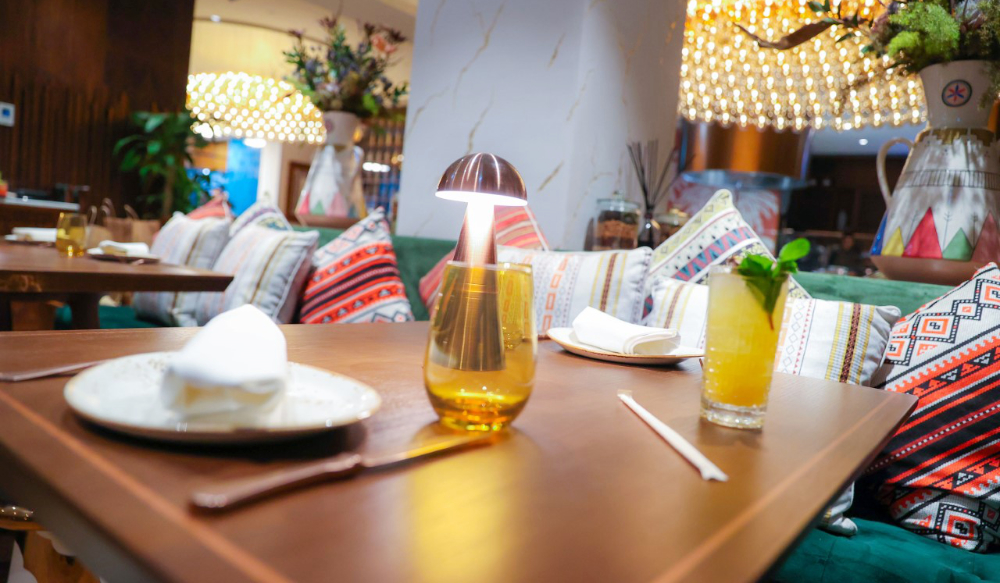
Visitors can walk over a bridge after dining at the Bujairi Terrace to visit the recently restored ruins of the original seat of the Al-Saud dynasty, taking the same steps as Saudi rulers did centuries ago.
What distinguishes the Bujairi Terrace from other high-end dining areas in the Gulf is the balanced offering of Saudi cuisine alongside top-notch international Michelin-star brands.
Maiz and Takya, two Saudi restaurants, offer a mix of traditional and contemporary cuisine within sleek settings decorated with a modern take on native Najdi patterns and architecture.
“We are offering specialties from the 13 provinces of Saudi Arabia,” Bader Al-Shaikh, a chef at Maiz, told Arab News.
“The idea was to create a place where people can dine in comfort and peace,” Hessah Al-Mutawa, owner of Takya, told Arab News. “We offer a contemporary fusion of traditional Saudi dishes.”
Inzerillo said that, in addition to the first 20 restaurants already present at the site — including well-known names like Angelina Paris, Café de L’Esplanade, Flamingo Room by tashas, which over the last few years has taken neighboring Dubai by storm — there are other 10 in the works for the second phase of development.
Six million trees and plants have also been incorporated into the area so that visitors can walk for hours, enjoying the natural and historic surroundings before and after dining at world-class restaurants.
Bruno, the famed French restaurant from the south of France, also opened in Bujairi, marking its second branch abroad after St. Petersburg, Russia. Saudi-owned gastronomical brands include GRIND, Somewhere, SUGAR and Sum + Things.
Upon the completion of the DGDA project, scheduled to be finished in 2030, Diriyah will be home to cultural, educational and entertainment shows, along with retail and hospitality facilities. The latter will include 38 hotels, in addition to a series of museums, cultural and academic institutes and retail areas.
The destination is expected to add around SR27 billion ($7.2 billion) to the country’s gross domestic product and create 55,000 jobs, with a focus on upskilling women.
The historic area of Diriyah, known for its Bedouin hospitality and culture, is experiencing a renaissance through a celebration of its past and present.
Inzerillo stated: “Now, from today, it is going to be one of the great gathering places in the world. Everybody will come.”


