

Indonesia’s new criminal code raises concerns for human rights, free speech

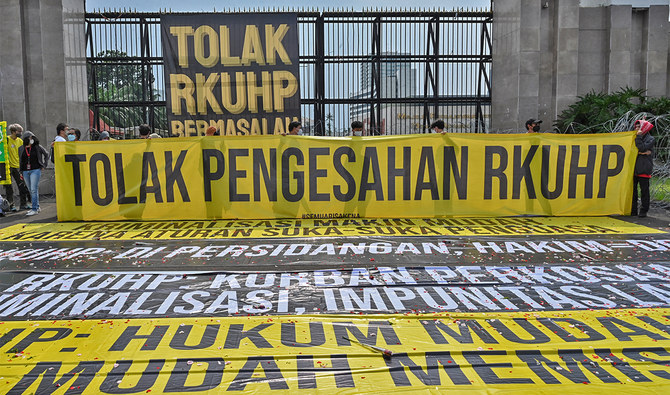
This picture taken on December 5, 2022 shows activists holding a protest against the new criminal code outside the parliament building in Jakarta. (AFP)
Short Url
Updated 06 December 2022
Follow

Indonesia’s new criminal code raises concerns for human rights, free speech

  • New criminal code was approved unanimously by Indonesian lawmakers
  • It replaces a framework that stretches back to the Dutch colonial era

JAKARTA: Indonesian lawmakers passed on Tuesday a long-awaited and controversial revision of the country’s criminal code, a sweeping overhaul that critics say is a huge setback to human rights and freedom of expression in the Southeast Asian nation. 

The new rules were approved unanimously by Indonesia’s House of Representatives, three years after a similar draft law was shelved by President Joko Widodo following large-scale protests involving tens of thousands of young people, who had argued that the law threatened their civil liberties. 

The new penal code, which also applies to foreigners in the country, restores a ban on insulting the president, state institutions or Indonesia’s national ideology known as Pancasila. 

“We have tried our best to accommodate the important issues and different opinions which were debated,” Yasonna Laoly, the minister of law and human rights, told parliament. “However, it is time for us to make a historical decision on the penal code amendment and to leave the colonial criminal code we inherited behind.” 

A revision to the criminal code, which stretches back to the Dutch colonial area, had languished for decades as lawmakers in the world’s biggest Muslim-majority nation struggled to adapt its native culture and norms to the penal code. 

The new criminal code must be signed by the president after ratification and will not apply immediately to allow for the drafting of implementing regulations, with a transition period set for a maximum of three years. It can also be challenged in the Constitutional Court. 

Most criticism of the new laws has largely focused on penalties around consensual sex outside of marriage, as it makes extramarital sex punishable by a year in jail and cohabitation by six months, though charges must be based on police reports lodged by their spouse, parents or children. Currently, Indonesia bans adultery but not premarital sex. 

Others have also highlighted articles critics say will curb free speech, including mandatory police permit for public protests, without which protesters can be punished for up to six months in jail. 

“This criminal code is still thick with colonial aroma, and there are many articles threatening civil liberties and limiting democratic spaces,” Tunggal Pawestri, gender rights activist and executive director of Hivos Foundation, told Arab News. 

Pawestri acknowledged that there has been some progress since the nationwide protests in 2019 when opponents of the bill said the law-making process had lacked transparency and contained articles that discriminated against minorities. 

“Even though they said were open and tried to include input from the larger civil society, we think this was not their best attempt,” Pawestri added. “We have been shouting and giving our input, but it’s almost as if they didn’t listen to us.” 

Editorials in national newspapers decried the new laws, including daily newspaper Koran Tempo, saying the code has “authoritarian” tones and could be a “disaster” in the future. 

Under the new code, disseminating the teachings of Marxism, Leninism and communism in Indonesia is punishable by up to four years in prison. There are also expanded punishments for blasphemy, as promoting atheism or any beliefs beyond Indonesia’s recognized religions is punishable by up to two years in prison. 

The blasphemy chapter is “a huge setback in protecting freedom of religion and belief in Indonesia,” said Phil Robertson, deputy director of Human Rights Watch’s Asia Division. 

Robertson said the new legal provisions were “oppressive,” as they open doors to “invasions of privacy and selective enforcement that will enable police to extort bribes and officials to harass and jail political opponents. 

“In one fell swoop, Indonesia’s human rights situation has taken a drastic turn for the worse,” Robertson told Arab News. 

“Make no mistake, passage of this criminal code is the beginning of an unmitigated disaster for human rights in Indonesia. Lawmakers and the government should immediately reconsider this move, repeal this law and send it back to the drawing board.”


Barcelona train crash kills 1 in Spain's second deadly rail accident in days

Updated 7 sec ago
Follow

Barcelona train crash kills 1 in Spain's second deadly rail accident in days

  • The northeastern region's Interior Minister, Nuria Parlon, told local media the crash killed one person and injured 37
BARCELONA: A commuter train near Barcelona ploughed into the rubble of a collapsed wall on Tuesday, killing one and injuring dozens in Spain's second deadly rail accident in days.
The latest incident is likely to raise more questions about Spanish transport safety, coming two days after the collision of two high-speed trains in the southern region of Andalusia killed 42 people -- the country's deadliest rail accident in more than a decade.
On Tuesday, "a retaining wall collapsed onto the tracks, causing an accident involving a passenger train" in the municipality of Gelida, around 40 kilometres (25 miles) west of Barcelona, the Catalonia region's civil protection agency posted on social media.
The northeastern region's Interior Minister, Nuria Parlon, told local media the crash killed one person and injured 37 -- several seriously.
"We regret to announce the death of one of the passengers on the train," said Parlon, adding authorities had not yet completed the identification process of the deceased.
"Of the total number of people treated, five are in serious condition," she added.
Emergency workers used torches to survey the wreckage of the derailed train carriage, which had turned into a mass of crumpled metal, an AFP reporter saw on Tuesday night.
Spanish rail infrastructure operator Adif said a storm caused a wall to fall, creating the rubble that the train slammed into. Catalan commuter trains would remain suspended, it added.
Earlier on Tuesday, Spain's king and queen visited the site where two high-speed trains collided on Sunday as well as survivors of the accident that injured more than 120 people, 37 of whom are still in hospital.
The country's deadliest rail accident in more than 12 years took place when a train operated by rail company Iryo, travelling from Malaga to Madrid, derailed near Adamuz in the southern Andalusia region.
It crossed onto the other track, where it crashed into an oncoming train heading to the southern city of Huelva, which also derailed.
Dressed in dark clothing, King Felipe VI and Queen Letizia shook hands with emergency services workers near the spot where the mangled wreckage of the trains lay.
They then visited a hospital in the nearby city of Cordoba, where some of the injured are being treated.
Speaking to reporters after leaving the hospital, Felipe said he wanted to "convey the affection of the entire country" to the victims.
Santiago Salvador, a Portuguese national who broke a leg in the accident, said he felt lucky to be alive.
"I was thrown through the carriage; it felt like being on a carousel," Salvador, his face covered in cuts, told Portuguese state television RTP.
"It looked like hell. There were people who were very seriously injured."
- Crack on tracks -
Sunday's derailment was Spain's deadliest rail accident since 2013, when 80 people were killed after a train veered off a curved section of track outside the northwestern city of Santiago de Compostela.
Flags flew at half-mast on public buildings, television anchors wore black, and cabinet ministers curtailed public appearances as Spain observed the first of three days of national mourning.
The government has vowed a full and transparent investigation into the cause of the accident.
Unlike the 2013 disaster, the derailment occurred on a straight section of track, and the trains were travelling within the speed limit of 250 kilometres (155 miles) for the area concerned, officials said.
Spanish media report that the probe is focusing on a crack more than 30 centimetres (12 inches) long in the track at the site of the accident.
The crack may have resulted from "a poor weld or a weld that deteriorated due to train traffic or weather", daily newspaper El Mundo reported, citing unidentified technicians with access to the inquiry.
Transport Minister Oscar Puente said investigators were looking to see if a broken section of rail was "the cause or the result" of the derailment.
He said the Iryo train was "practically new" and the section of track where the disaster happened had been recently renovated, making the accident "extremely strange".
- Sabotage ruled out -
Interior Minister Fernando Grande-Marlaska said "the possibility of sabotage was never considered" and that "there has never been any element suggesting otherwise."
The head of state rail operator Renfe, Alvaro Fernandez Heredia, said human error has "been practically ruled out".
Rail operator Adif on Tuesday also imposed a temporary 160 kph speed limit on parts of the high-speed line between Madrid and Barcelona after train drivers reported bumps.
Maintenance crews will inspect the tracks overnight, and the restriction is expected to be lifted if no issues are found, the company added.
