

Saudi adventurers complete 1,200 km walk to mark UAE National Day

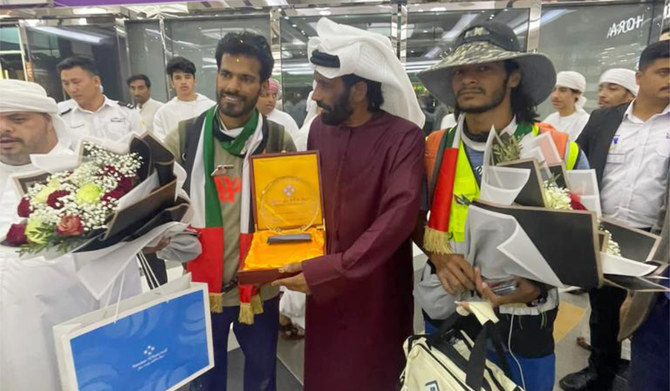
Naif Shukri broadcasted his trip on social media and was amazed by the interaction from Emiratis many of whom were waiting to greet the duo on the UAE border. (Supplied)
Short Url
Updated 05 December 2022
Follow

Saudi adventurers complete 1,200 km walk to mark UAE National Day

  • Naif told Arab News that the walk had been “another accomplishment” after he previously completed more than 4 billion steps, covering 4,000 km on foot, through nine treks taking in NEOM, Makkah, Abha, Madinah, and AlUla

JEDDAH: Two Saudi adventurers have arrived in Abu Dhabi after walking for 30 days to celebrate the 51st UAE National Day.

Thirty-two-year-old Naif Shukri and his nephew Abdul Ellah Shukri, 19, started their trek from Riyadh passing through Al-Ahsa and Al-Hofuf before arriving at the UAE border, a journey of 1,200 kilometers.

Naif told Arab News that the walk had been “another accomplishment” after he previously completed more than 4 billion steps, covering 4,000 km on foot, through nine treks taking in NEOM, Makkah, Abha, Madinah, and AlUla.
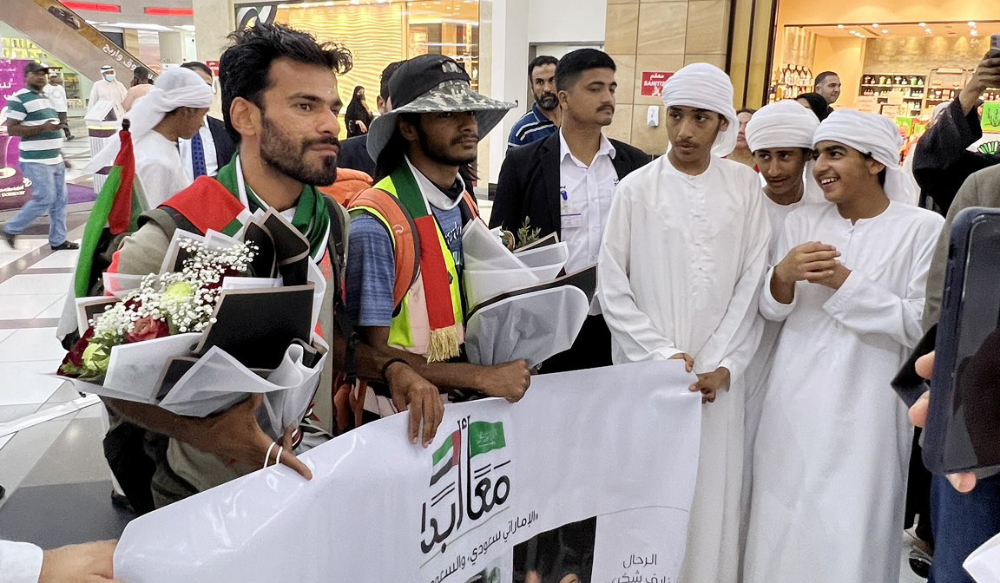
He said: “Our journey titled, the Saudi is Emirati and the Emirati is Saudi, has several goals, but the most notable was the participation with Emirati brothers in their UAE National Day. It was a way to express our love and affection to the Emirati people.”

He broadcasted his trip on social media and was amazed by the interaction from Emiratis many of whom were waiting to greet the duo on the UAE border.

On Dec. 1, followers, supporters, and friends gathered at Bani Yas as Naif sent pictures of himself and his nephew holding the Saudi and UAE flag and another showing them arriving in the UAE.

“The Emirati people have been so hospitable and encouraging. The best part of the journey was the warm welcome we received upon our arrival,” he added.


Najran’s camels are embedded in local culture and traditions

Camels are not only a vital livestock resource in Najran, but also a cornerstone of local identity and tradition. (SPA)
Updated 25 December 2025
Follow

Najran’s camels are embedded in local culture and traditions

  • Several distinct camel breeds are found in the region
  • Animals permeate Arab consciousness, says expert

RIYADH: In Najran, camels are not only a vital livestock resource but also a cornerstone of local identity and tradition.

According to Hadi Benyan Al-Amer, head of Najran’s Camel Association, the region has several distinct camel breeds.

Principal among them is the Awarik, an ancient Arabian lineage linked to territories where arak trees flourish, the Saudi Press Agency reported on Thursday.

These light-colored, sparsely-haired camels possess remarkable resilience, and are prevalent across southern Arabia.

The Majahim are characterized by dark hues spanning black to brown, and excel in both milk yield and endurance.

The Asayil are prized for their sleek, lean physiques, and dominate in speed-based competitions.

Al-Amer said traditional water sources known as Odood, or traditional water wells and artesian wells, have sustained herders navigating the Empty Quarter’s grazing lands for generations.

These permanent water points, equipped with dedicated drinking basins for camels, showcase the animals’ extraordinary environmental resilience.

Among the principal wells accessible from Najran are Al-Minkhali, Abu Shadid, Hamra Nathil, Tamani, Umm Al-Wahat, and Khujaima.

Countless additional wells dot the Empty Quarter and adjacent territories, forming the backbone of camel owners’ far-reaching pastoral networks.

Dr. Hind bint Dawood Al-Shuqair of Najran University’s Arabic Language Department explained how camels have permeated Arab consciousness through legends and stories spanning thousands of years.

Representing endurance, power, and grace, they have become inseparable from Arab cultural identity.

Archaeological evidence at Al-Ukhdood, Mount Al-Tharwa and Hima, preserves through carvings and ancient artwork the deep bond between people and camels, Al-Shuqair said.

She drew attention to Saudi Arabia’s substantial investment in camel heritage, exemplified by proclaiming 2024 as the Year of the Camel.

This designation emphasizes their importance to national prosperity and cultural heritage while backing global initiatives to promote awareness of camels as valuable economic and cultural assets.

The Kingdom further demonstrates its commitment to protecting the animals through the annual King Abdulaziz Festival, the SPA reported.